When Thor: Love and Thunder premiered across international theaters in July 2022, it arrived with the colossal weight of audience anticipation and cinematic expectation.
Chris Hemsworth had already spent over a decade shaping the Marvel Cinematic Universe’s beloved Norse deity into an international cultural icon.
Yet, rather than uniting moviegoers in celebration, the fourth solo installment ignited one of the fiercest debates ever witnessed across Marvel fandom.
The conversation centered on Hemsworth’s performance and the distinct creative vision established by director Taika Waititi.
While some viewers praised the production as an inventive deconstruction of grief, others felt it sacrificed emotional gravity in pursuit of unrelenting humor.
Decisions made in the editing suite and on the soundstage sparked intense online discourse that continues to echo years later.
Recent comic releases and multimedia adaptations have continued to feature the movie’s most controversial creative choices, demonstrating Marvel’s steadfast commitment to this interpretation.
Understanding this cinematic flashpoint requires a careful examination of Hemsworth’s evolution, Waititi’s directorial mechanics, and the shifting dynamics of modern comic book storytelling.
Cre: Gage Skidmore / Wikimedia Commons
From Regal Shakespearian Prince to Cosmic Comedy Maestro
To fully appreciate why Love and Thunder polarized fans, one must look back to how Hemsworth’s superhero journey originally began.
In Kenneth Branagh’s 2011 origin film Thor, the character was conceived through a distinctly classical, quasi-Shakespearean lens.
Hemsworth played the crown prince of Asgard with stiff theatricality, dignified cadence, and heavy royal gravitas.
The dialogue featured heightened speech patterns that intentionally separated Asgardian royalty from modern mortals on Earth.
That solemn approach carried directly into Joss Whedon’s The Avengers in 2012 and Alan Taylor’s Thor: The Dark World in 2013.
However, behind the scenes, both critics and Hemsworth himself began expressing creative fatigue regarding the character’s emotional rigidity.
The traditional fantasy warrior archetype felt increasingly boxed in compared to the quippy, charismatic presence of Robert Downey Jr.’s Tony Stark.
A seismic transformation occurred in 2017 when Marvel Studios enlisted New Zealand filmmaker Taika Waititi to helm Thor: Ragnarok.
Waititi recognized Hemsworth’s natural comedic timing, deadpan instincts, and self-deprecating wit.
Ragnarok stripped the hero of his majestic cape, shattered his hammer Mjolnir, and cropped his signature golden hair.
The resulting tonal pivot was met with critical adoration and transformed Thor into one of the MCU’s most vibrant, box-office-dominant heroes.
Anthony and Joe Russo subsequently carried that momentum into Avengers: Infinity War and Avengers: Endgame.
In those ensemble epics, the comedy was balanced against heartbreaking trauma, acute depression, and monumental personal loss.
Audiences loved seeing Thor navigate complex survivor’s guilt while retaining charming eccentricities and vulnerable human flaws.
That careful balance established the sky-high expectations audiences held as Phase Four unfolded.
Pushing the Boundaries of Absurdity: The Creative Choices That Divided Audiences
When Love and Thunder arrived, Waititi pushed the aesthetic and comedic envelope significantly further than Ragnarok ever dared.
Instead of using comedy to highlight dramatic moments, the sequel often deployed humor to actively disrupt and undercut them.
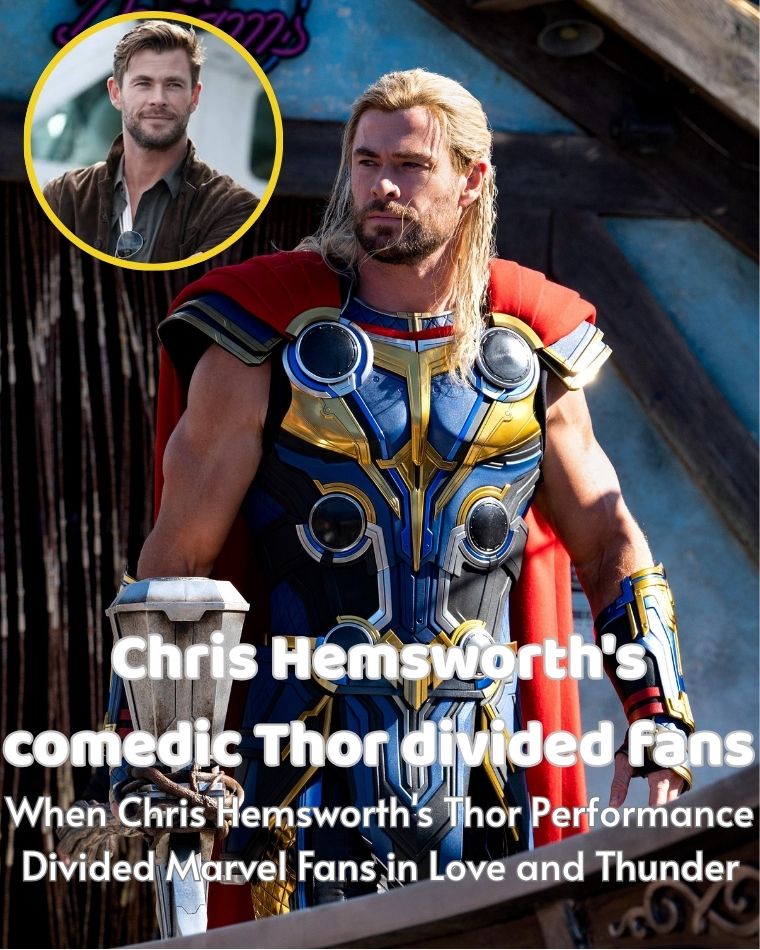
Hemsworth committed wholeheartedly to this tonal framework, delivering an exaggerated and overtly buffoonish portrayal of Thor.
Rather than portraying an experienced cosmic god who had lived for fifteen centuries, the character frequently behaved like an overgrown, clueless adolescent.
Thor’s battlefield demeanor transformed into exaggerated showmanship that treated life-or-death battles like lighthearted party games.
One notable sequence saw the hero doing dynamic splits between alien skiffs while humming 1980s hard rock anthems.
The relationship between Thor and his mystical axes was also reframed into a slapstick romantic rivalry.
The script framed Stormbreaker as a jealous, sentient partner constantly glowering whenever Thor glanced affectionately toward the reconstructed Mjolnir.
Furthermore, the introduction of Toothgnasher and Toothgrinder, the pair of mystical Asgardian goats, became an immediate lightning rod for critique.
Instead of acting solely as majestic mythical steeds from ancient folklore, the animals let out shrill, unyielding shrieks inspired by internet memes.
The shrieking goat gag repeated relentlessly across the runtime, testing the patience of moviegoers who found it grating rather than charming.
Simultaneously, the film asked audiences to invest in deeply solemn and tragic subplots.
Natalie Portman returned as Dr. Jane Foster, who was battling terminal Stage IV cancer while assuming the mantle of the Mighty Thor.
Christian Bale delivered a terrifying, shadowed, and whisper-quiet performance as Gorr the God Butcher.
Yet whenever scenes shifted back to Thor, the atmosphere snapped violently toward broad, slapstick farce.
When Thor stood before Zeus in Omnipotence City, what could have been an awe-inspiring pantheon summit turned into cartoonish robe-flicking comedy.
Many spectators felt that Hemsworth’s over-the-top antics undermined the palpable stakes established by Bale and Portman.
Actor Commitment Versus Narrative Cohesion
A critical dimension of the controversy involves Hemsworth’s complete willingness to trust his director’s vision.
Hemsworth has consistently earned industry praise for throwing his entire physical and emotional energy into every role he accepts.
In Love and Thunder, his physical conditioning reached absolute peak performance, boasting an incredible muscular build tailored for screen spectacle.
His commitment to physical comedy, improvisational riffing, and vulnerability was undeniably energetic.
He never phoned in a scene, nor did he shy away from looking foolish on camera.
Yet an actor’s absolute surrender to an auteur’s vision can become a double-edged sword when tonal discipline falters.
Waititi operates with an improvisational, loose set environment where actors are encouraged to test out wild, alternative jokes on every take.
In Ragnarok, veteran Marvel editors and producers helped rein in excessive tangents, creating a lean, balanced narrative curve.
In Love and Thunder, that editorial filter appeared considerably looser, letting unrestrained improv make the final theatrical cut.
The resulting tonal contrast left Hemsworth’s character feeling untethered from the broader reality of the MCU.
Fans argued that the film stripped Thor of the hard-earned wisdom he had accumulated through endless tragedies.
He had lost his mother Frigga, his father Odin, his brother Loki, his best friend Heimdall, and half of his Asgardian populace.
Seeing him respond to those profound scars with surface-level buffoonery felt jarring to longtime comic enthusiasts.
Conversely, defenders of the performance argued that humor served as Thor’s psychological coping mechanism.
They viewed his boastful posturing and loud bravado as a deliberate emotional mask hiding unhealed heartbreak and fear of abandonment.
From this perspective, Hemsworth’s broad comedy was an authentic manifestation of a deity desperately attempting to avoid confronting loneliness.
Nevertheless, because the screenplay rarely allowed dramatic silences to breathe without an immediate punchline, that nuanced subtext was lost on many viewers.
The Broad Spectrum of Hemsworth’s Range and Audience Expectations
The intense reaction to Love and Thunder also reflects the fascinating evolution of Chris Hemsworth’s broader acting career.
Throughout the 2010s, Hemsworth proved he was far more versatile than a standard Hollywood action hero.
His performance as James Hunt in Ron Howard’s Rush highlighted his dramatic depth, internal fire, and emotional sensitivity.
In Paul Feig’s 2016 Ghostbusters and Drew Goddard’s Bad Times at the El Royale, he showcased brilliant comedic timing and magnetic charisma.
His work in the Extraction franchise established his capability to carry grounded, gritty, and physically exhausting action cinema.
Because audiences knew Hemsworth possessed such remarkable dramatic range, seeing him confined to cartoonish antics in Love and Thunder felt frustrating.
The public knew he was entirely capable of matching Christian Bale’s dark intensity step for step.
Instead, the creative direction largely relegated him to playing the wide-eyed straight man turned clown.
The reception stands in stark contrast to Ragnarok, which struck gold because the humor was fresh, unexpected, and grounded in narrative stakes.
In Ragnarok, the destruction of Asgard carried real consequence, and Thor’s humorous moments arose naturally from being an out-of-water prisoner on Sakaar.
Love and Thunder, by contrast, frequently felt like a self-conscious parody of Ragnarok itself.
The jokes felt louder, the pacing more chaotic, and the emotional resonance diluted by rapid-fire gags.
This sharp divergence created two distinct camps among modern pop-culture consumers.
One faction embraces the MCU as an experimental pop playground where camp, absurdism, and comic-strip irreverence ought to run wild.
The opposing faction views the franchise as an ongoing modern mythos that requires emotional fidelity, stakes, and narrative respect.
Neither camp is objectively wrong, but Hemsworth’s turn became the primary battleground where these competing philosophies collided.
Reaffirming the Absurd: Marvel’s Double Down on Divisive Lore
Despite the contentious theatrical discourse, Marvel Studios has not backed away from the eccentric choices established in the 2022 film.
In recent months, Marvel officially resurrected some of Love and Thunder’s most debated elements in brand-new expanded storylines.
In Marvel’s Godzilla Conquers the Multiverse comic series, creative teams made the bold decision to bring back Thor’s screaming goats.
Issue #3 depicts Spider-Man navigating an epic clash involving the King of the Monsters across alternate realities.
During this multiversal crisis, Miles Morales finds himself supplied with an enchanted Asgardian steed by Odin himself.
Spider-Man specifically identifies his unexpected flying mount as a “death-metal goat”.
True to the cinematic depiction in Love and Thunder, the beast launches into the air with an ear-splitting shriek as it ferries the hero across the cosmos.
Collider noted that reintroducing this divisive comedic gag illustrates Marvel’s unapologetic embrace of over-the-top absurdism.
Rather than quietly retiring elements that irritated vocal pockets of fandom, the company continues to lean into them as recognizable signature motifs.
This editorial continuity proves that within Marvel’s corporate creative strategy, Love and Thunder was not viewed as an embarrassing misstep to erase.
Instead, the creative leadership treats it as an authentic, valid aesthetic branch of the sprawling multimedia universe.
For Chris Hemsworth, the long-term impact of Love and Thunder remains a pivotal chapter in his ongoing cinematic legacy.
The actor has candidly admitted in subsequent retrospective interviews that the production may have leaned a little too silly for its own good.
He acknowledged that even his own children’s schoolmates critiqued the excessive humor and preferred a more grounded warrior.
Nevertheless, Hemsworth’s fearless willingness to push boundaries remains a defining trait of his tenure as an Avenger.
He transformed Thor from an austere, one-dimensional archetype into one of the most flexible, emotionally varied heroes in modern Hollywood history.
Whether one views Thor: Love and Thunder as an irritating miscalculation or a joyfully chaotic pop confection, its cultural footprint is undeniable.
The film demonstrated that even within a multi-billion-dollar cinematic machine, bold stylistic experiments can still ignite passionate, enduring debate.
As Marvel shapes the next era of cosmic storytelling, the lessons of Hemsworth’s comedic outing will continue to influence how superhero stories balance humor, heart, and heroism.
Để lại một phản hồi