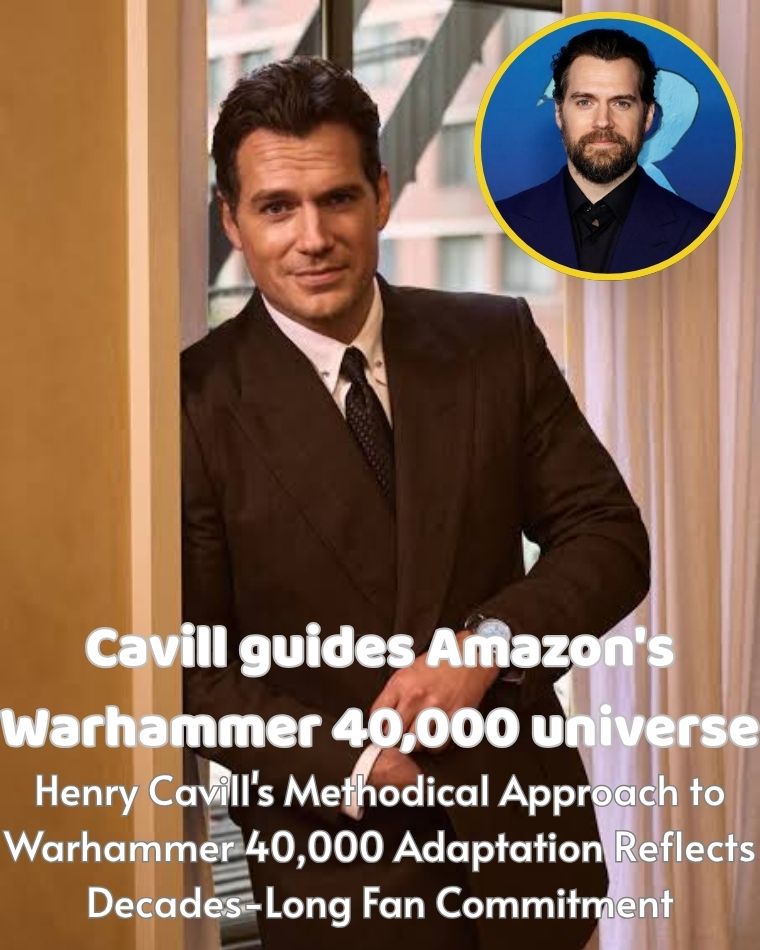
Henry Cavill is stepping into the sprawling universe of Warhammer 40,000 with an official role that unites his lifelong dedication as a fan with his executive reach in Hollywood.
Announced in late 2022, the major collaboration between Amazon Studios and Games Workshop positions the British actor not only as a leading star but also as an executive producer.
This landmark entertainment partnership grants Cavill unprecedented creative stewardship over an expansive sci-fi franchise that has captivated tabletop gamers across the globe for decades.
A Passion Rooted Long Before Hollywood Fame
Henry Cavill has never hidden his immense appreciation for the rich and detailed world of miniature wargaming.
His connection to Warhammer 40,000 dates back far earlier than his rise to global superstardom in major film franchises.
Long before he donned the iconic red cape of Superman or wielded silver swords on television sets, Cavill was actively painting armies and reading dense sci-fi lore.
Hobby painting requires remarkable patience, fine motor control, and hundreds of quiet hours dedicated to bringing plastic miniatures to life.
Throughout his rise in the entertainment industry, Cavill openly maintained this labor-intensive tabletop hobby.
His genuine familiarity with the factions, heroes, and tragic battles of the setting earned him immediate credibility among community veterans.
In modern pop culture, celebrity endorsements of niche geek cultures are occasionally met with skepticism by longtime fans.
Yet Cavill’s demonstrable technical knowledge of the lore established an authentic bond with tabletop players across the world.
He represents the rare Hollywood luminary who truly understands the delicate balance between competitive tabletop mechanics and literary depth.
The tabletop community recognized that his appreciation was not a manufactured publicity stunt, but rather an authentic personal obsession.
Cre: Wikimedia Commons
Beyond Acting: Stepping into the Role of Creative Custodian
When Amazon secured the rights to develop Warhammer 40,000 content in late 2022, the industry took notice of Cavill’s multifaceted credit.
Cavill was not merely signed to play a charismatic protagonist on camera.
Instead, his contract officially positioned him as an executive producer within the core production architecture.
This creative role allows him to directly influence foundational world-building choices from the ground up.
In conventional franchise productions, actors arrive after scripts are finalized and aesthetics are already approved.
Under that traditional model, screen performers have minimal say in conceptual world-building or long-term structural storytelling.
Cavill’s dual role directly subverts that Hollywood paradigm by placing an authentic fan directly at the decision-making table.
As an executive producer, he is positioned to steer tone, artistic choices, and thematic directions across development stages.
This structural empowerment ensures that the heart of the tabletop franchise remains front and center during early production discussions.
Rather than being subjected to corporate sanitization, the narrative can benefit from someone who understands why the universe resonates so deeply.
His creative custody serves as a vital bridge between Hollywood studio executives and Games Workshop’s decades of literary lore.
Having an executive producer who respects the source material reassures a fanbase that is notoriously protective of its universe.
The arrangement represents a significant evolution in how major entertainment studios approach complex legacy properties.
Amazon’s willingness to grant Cavill executive authority reflects an increasing awareness of community trust in adaptation success.
Navigating a Millennia-Spanning Grimdark Mythology
Warhammer 40,000 presents narrative hurdles that differ drastically from typical fantasy or science fiction properties.
The franchise takes place in a terrifying, distant future where humanity clings to survival amid constant galactic warfare.
The aesthetic of this setting is famously coined as grimdark, defined by perpetual conflict, religious zealotry, and cosmic dread.
There are no truly benevolent factions navigating the dark expanse of the galaxy.
Every civilization, alien species, and military empire is locked in an unrelenting battle for survival and supremacy.
The history of this fictional universe spans tens of thousands of years of recorded lore, wars, and catastrophic betrayals.
Thousands of officially published Black Library novels have fleshed out the factions, inquisitors, and warriors that inhabit this space.
For any newcomer, deciding where to begin a live-action adaptation is an overwhelming creative prospect.
Selecting the very first narrative thread to bring to the screen requires extraordinary narrative discernment.
Focusing on the wrong faction or altering the setting’s foundational philosophy could easily alienate longtime enthusiasts.
Conversely, making the narrative too dense could confuse mainstream viewers who have never touched a codex or rolled dice.
Cavill’s encyclopedic grasp of the lore provides the production with internal guidance on what makes this universe truly unique.
His fan perspective can help pinpoint the emotional core and ideological tensions that define great Warhammer stories.
By understanding what drives the human experience inside an oppressive galactic empire, the adaptation can balance spectacle with emotional weight.
Navigating this immense mythology requires passion and respect rather than superficial blockbuster shortcuts.
A Firm Stance on Source Material Fidelity
Throughout his high-profile career, Henry Cavill has consistently voiced his profound commitment to source material integrity.
His previous work on major fantasy adaptations, particularly his time starring in The Witcher, underscored this core philosophy.
During his tenure as Geralt of Rivia, Cavill frequently emphasized the importance of staying loyal to Andrzej Sapkowski’s original books.
His evident frustration with productions that drift away from established literary foundations became well documented across industry circles.
He has repeatedly stated in public discussions that established lore should be treated as a sacred foundation rather than a loose outline.
When writers and showrunners diverge radically from beloved source texts, projects often lose the very essence that created their audience.
This track record indicates that Cavill will actively advocate for narrative and tonal fidelity throughout his Warhammer journey.
Warhammer 40,000’s established canon is both complex and intensely scrutinized by millions of devoted readers worldwide.
Any effort to soften its harsh gothic atmosphere or rewrite its core historical conflicts could compromise its distinctive identity.
Having an executive producer who is ready to defend canonical boundaries is a profound asset for the adaptation’s artistic health.
Cavill’s passion ensures that key ideological themes, ancient rivalries, and atmospheric nuances are not diluted for quick corporate trends.
Instead, the production has an internal advocate committed to translating the original tone without compromising its dark essence.
This loyalty to text and canon directly aligns with what the global tabletop community has longed to see on screen.
By insisting on source fidelity, Cavill helps protect the unique storytelling heritage that Games Workshop developed over decades.
Meeting the Intricate Visual Demands of the Tabletop
Adapting Warhammer 40,000 for screen entertainment demands unprecedented visual ambition from production designers.
The tabletop game is globally famous for its highly distinct, intricate visual identity.
Every faction features elaborate armor designs, mechanized war walkers, and towering monuments steeped in grimdark gothic architecture.
Colossal starships resemble flying medieval cathedrals adorned with gargoyles, buttresses, and massive weapon batteries.
Genetically modified Space Marines wear bulky power armor adorned with archaic purity seals and ornate chapter heraldry.
Translating these exaggerated, baroque designs into tangible cinematic sets and convincing digital effects is a mammoth technical challenge.
If the armor looks too light or the scale feels diminished, the visceral weight of the universe instantly evaporates.
Tabletop players spend hundreds of hours studying every ridge, insignia, and weapon barrel on miniature models.
Consequently, screen visuals must exhibit an extraordinary level of physical craftsmanship and tactile realism.
Sprawling battlefields must convey the horrifying scale of planetary conflicts involving millions of combatants.
Every set piece requires meticulous attention to the rust, battle damage, and ancient wear that characterize humanity’s decaying technological past.
Cavill’s personal experience assembling and painting these figures gives him a concrete understanding of this detailed physical aesthetic.
He understands how armor proportions, weapon weights, and decorative motifs contribute to the setting’s unmistakable atmosphere.
His artistic standards will naturally encourage production teams to match the visual complexity that hobbyists cherish.
Achieving this high bar of visual fidelity will require substantial budget dedication and visionary set design from Amazon Studios.
A Rare Fan-to-Custodian Trajectory in Modern Entertainment
Henry Cavill’s journey from tabletop hobbyist to executive producer represents a rare trajectory within contemporary Hollywood.
Historically, creative power over major entertainment properties has resided almost exclusively with studio executives and non-fan producers.
Actors with deep personal love for specialized geek subcultures were typically hired purely for their screen presence and star power.
Under that conventional framework, an actor had virtually no authority to correct inaccuracies or preserve beloved lore details.
Cavill’s position on the Warhammer 40,000 project fundamentally disrupts that traditional Hollywood power dynamic.
He is not an outsider attempting to quickly learn an unfamiliar lore Bible before filming commences on location.
Rather, he enters the executive suite possessing decades of accumulated personal insight into the property’s cultural legacy.
This authentic passion allows him to champion the franchise from inside the core production machinery.
His involvement reassures longtime enthusiasts that the soul of their favorite universe is guarded by one of their own.
At the same time, his international box-office visibility provides the commercial credibility required for a massive streaming investment.
This synthesis of superstar drawing power and genuine fan loyalty is exceptionally rare in the film and television landscape.
While no public production timeline or additional casting specifics emerged through 2023, Cavill remains the adaptation’s primary driving force.
His creative guardianship establishes a hopeful blueprint for how passionate enthusiasts can guide adaptations of intricate literary universes.
As development continues, the world watches to see how his lifelong fandom shapes the grim darkness of the far future.
Để lại một phản hồi