Kansas City Chiefs tight end Travis Kelce delivered a refreshingly honest confession regarding a blatant uncalled hold during Patrick Mahomes’ opening touchdown run against the Denver Broncos.
Addressing the viral moment on the New Heights podcast, Kelce candidly explained how his aggressive block almost erased back-to-back scoring plays.
The veteran playmaker acknowledged getting away with the penalty, spotlighting the remarkable locker room chemistry and film-room accountability that define Kansas City’s championship culture.
Travis Kelce never shies away from telling the raw truth when breaking down game film.
During Kansas City’s season-opening showdown against the Denver Broncos at Arrowhead Stadium, superstar quarterback Patrick Mahomes scrambled toward the end zone for a hard-fought touchdown.
While Chiefs Kingdom erupted in celebration, sharp-eyed fans and television commentators immediately noticed something dubious along the perimeter.
Kelce had engaged a Denver defender with a block that looked far more like an aggressive wrestling hold than a textbook seal.
Despite the obvious contact, no yellow penalty marker fluttered onto the grass, and the touchdown stood on the scoreboard.
Rather than skirting around the issue or deflecting questions from critics, Kelce tackled the controversy head-on during an episode of his popular New Heights podcast.
The All-Pro tight end frankly admitted that he had gotten away with an egregious infraction while clearing a path for his quarterback.
His public honesty transformed what could have been a bitter officiating debate into one of football’s most entertaining and revealing moments.
Beyond the humor of the admission, Kelce’s words peel back the layers of accountability, elite football IQ, and unwavering camaraderie that anchor the Kansas City dynasty.
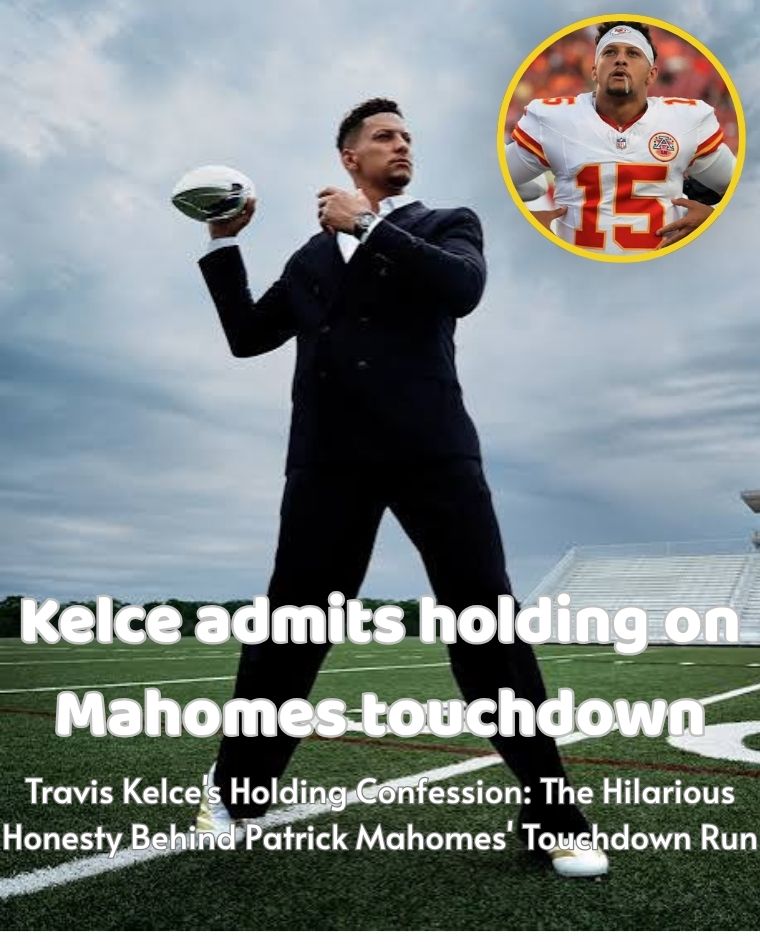
Cre: Wikimedia Commons
The Confession: “Please Don’t Be Any Laundry on the Field”
Speaking directly to his brother Jason Kelce on New Heights, Travis did not mince words when evaluating the tape of Mahomes’ touchdown scramble.
“It was definitely a questionable play,” Kelce chuckled while replaying the critical red-zone snap.
He described the immediate surge of panic that washed over him the moment he hit the turf next to the goal line.
“That’s one of those where you get up slowly like, ‘Please don’t be any laundry on the field,'” Kelce confessed with trademark candor.
NFL players often refer to yellow penalty flags as “laundry,” and Kelce knew he had given officials ample reason to throw one.
He went on to break down exactly what happened mechanically between his hands and the defender’s upper pads.
“I had the man up by his neck,” Kelce explained without trying to sugarcoat the illegal technique.
“Can’t do it. Can’t do it. Almost cost us,” he reiterated while dissecting the high-leverage miscue.
Kelce recognized that taking an opponent by the collar area inside the five-yard line constitutes an open-and-shut holding call under league rules.
“That was risky business,” Kelce concluded with a grin. “You know what? Sometimes you’re just living right.”
His self-deprecating remarks swept through social media, striking a chord with supporters who appreciate authenticity over canned public relations answers.
Instead of waiting for coaches to scrutinize the mistake behind closed doors, Kelce beat everyone to the punch by owning it publicly.
Anatomy of the Play: Chaos in the Red Zone
To fully understand why Kelce was so nervous as he rose to his feet, one must examine the high-stakes context of that specific drive.
Only moments prior to the scoring play, Patrick Mahomes had already scrambled into the end zone for what appeared to be an electric rushing touchdown.
However, that initial score was abruptly wiped off the board due to an offensive holding penalty called against rookie left tackle Kahlil Benson.
The penalty backed the Chiefs up, threatening to derail what had been an impressive offensive march deep inside Denver territory.
Kansas City reset at the line of scrimmage determined not to settle for a field goal after coming within inches of six points.
Mahomes took the snap, surveyed his initial progressions, and spotted an opening in the defense’s front seven.
Without hesitation, the superstar quarterback tucked the football and accelerated toward the pylon.
Kelce was assigned to maintain blocking leverage on the edge to shield his franchise quarterback from incoming collisions.
As Mahomes lunged forward, Kelce found himself engaged in a desperate hand battle against a hard-charging defender.
Realizing that the defender was angling to drop Mahomes short of the goal line, Kelce extended his arms and clamped onto the player’s chest and neck area.
The hold clearly restricted the defender’s lateral range, clearing just enough space for Mahomes to cross the plain of the goal line.
“That would’ve been Patrick Mahomes’ second rushing touchdown called back in two plays, it was the same thing,” Kelce emphasized on the podcast.
“That would’ve taken us out of the red zone,” he added, acknowledging how disastrous a ten-yard penalty would have been in that exact sequence.
Had the whistle blown, Kansas City’s momentum would have evaporated, leaving them facing a difficult down-and-distance outside the scoring threshold.
Why Kelce Instantly Knew He Got Away With One
Veterans who have spent over a decade competing in the NFL develop an instinctual awareness of what crosses the line of legality.
Kelce has run thousands of routes and executed countless perimeter blocks throughout his storied career.
When an offensive lineman or tight end loses proper hand placement inside the numbers, muscle memory sounds an immediate internal alarm.
Kelce knew the moment his fingers grabbed the cloth around the defender’s neckline that he was living on borrowed time.
In modern NFL officiating mechanics, line judges and back judges focus heavily on restriction at the point of attack near the goal line.
When a ball carrier changes direction or darts toward the perimeter, blocks that pull a defender’s jersey away from their frame normally draw immediate flags.
During the broadcast, ESPN analyst Troy Aikman and rules analyst Russell Yurk broke down the replay angles for millions of viewers.
Both analysts concurred that Kelce had blatantly restricted the defender’s path toward Mahomes.
Yurk pointed out that the officials likely had their sightlines obstructed by the traffic converging on the goal line.
Because offensive holding penalties are not eligible for video review under NFL bylaws, the missed call could not be overturned once the touchdown signal was given.
Kelce did not need television analysts or a rules expert to inform him of the reality.
He experienced the physical contact firsthand and knew that the refereeing crew simply missed the infraction amidst the pileup.
His reaction—getting up slowly and glancing around the turf—is the universal body language of a football player praying that no penalty marker has been thrown.
The Unspoken Dynamic Between Mahomes and Kelce
The hilarious post-game reaction between Mahomes and Kelce reflects a bond forged through years of triumph, adversity, and championship rings.
When Mahomes found out about Kelce’s frantic worry over a potential penalty flag, the quarterback could only shake his head and laugh.
The two superstars have played in hundreds of high-stakes quarters together, developing telepathic communication on and off the field.
Mahomes knows that Kelce’s physical block, however reckless or technically flawed, stemmed from an instinctive desire to protect his quarterback.
Mahomes was playing with intense competitive fire, refusing to slide and choosing instead to power through contact at the goal line.
Seeing his quarterback put his body on the line compelled Kelce to do whatever was necessary to ensure Mahomes crossed the threshold safely.
When an offensive weapon knows his quarterback will sacrifice everything for a first down, he will risk a holding flag to prevent a punishing hit.
At the same time, Mahomes could easily tease Kelce about almost wiping away two consecutive rushing scores in less than two minutes.
Very few teammate pairings in professional sports possess the equity required to publicly laugh at a near-catastrophic mistake.
Because their mutual trust is absolute, honesty never feels like an attack or a personal slight.
Mahomes and Kelce do not need to sugarcoat their performance evaluations because their ultimate goal is completely aligned: winning football games.
When Kelce openly admitted his blunder, Mahomes did not harbor frustration; he appreciated the sheer honesty and the humor of the outcome.
What the Admission Reveals About Kelce’s Football IQ
While fans often focus on Kelce’s charismatic personality and celebrity status, his longevity at the highest level of football is driven by brilliant tactical intelligence.
Elite tight ends must understand spacing, defensive assignments, and whistle-to-whistle situational awareness better than almost anyone on the gridiron.
Kelce’s immediate recognition of his error illustrates just how tuned in he is to every variable of a football game.
Many players who commit an uncalled penalty pretend innocence, hoping to convince themselves and their coaches that their technique was spotless.
Kelce, by contrast, evaluated the play with clinical precision even as he celebrated the touchdown.
He recognized the exact down, the specific yard line, the previous penalty on Benson, and the devastating impact another ten-yard setback would have caused.
Understanding the fine line between legal aggressiveness and drive-killing penalties is what separates good athletes from Hall of Fame veterans.
Kelce knew that if an official had spotted his hand on the defender’s collar, the Chiefs would have been pushed back to the fifteen-yard line.
That awareness proves that Kelce processes the game through the lens of a coordinator rather than a passive participant.
He understands that lucky breaks balance out over a seventeen-game NFL season, but relying on luck is a dangerous proposition.
By verbalizing the technical mistake, Kelce mentally cataloged the error so he would not repeat it in future crucial scenarios.
His ability to simultaneously play with violent intensity and analyze his own technical flaws represents the gold standard of NFL football IQ.
The Film-Room Culture: Calling Yourself Out First
The Kansas City Chiefs under head coach Andy Reid have built an organizational culture centered on unvarnished accountability.
Monday morning film review can be a brutal exercise in professional football, where coaches freeze-frame every assignment error in front of the entire roster.
In toxic locker rooms, players make excuses, blame teammates, or try to hide their blunders from the coaching staff.
In championship organizations, leaders set the standard by pointing out their own mistakes before the coaches even press play on the projector.
Kelce’s candid admission on New Heights is merely an extension of how the Chiefs conduct business in their film room.
When an All-Pro veteran with multiple Super Bowl rings openly declares, “Can’t do it. Almost cost us,” it sets a powerful precedent for younger players.
A rookie watching Kelce call himself out realizes that nobody on the roster is above self-criticism.
It removes the fear of making a mistake and replaces it with a focus on immediate ownership and rapid correction.
Reid and offensive coordinator Matt Nagy foster an environment where honest self-evaluation is celebrated rather than punished.
When leaders lead through vulnerability, the entire locker room adopts a resilient, problem-solving mindset.
Kelce did not wait for the coaching staff to grade his blocking grade down; he graded himself down in front of a global listening audience.
That level of psychological safety within the team allows the Chiefs to navigate high-pressure playoff environments without fracturing under adversity.
The Power of Humor in Maintaining Championship Equanimity
Defending a championship title is an exhausting, relentless grind that places enormous mental strain on an NFL roster.
Teams that carry heavy expectations often become brittle, collapsing under the pressure of external scrutiny and perfectionism.
The Kansas City Chiefs have managed to sustain their dominance over several years largely because they know how to stay loose.
Humor acts as a vital pressure-relief valve inside their facility.
When Kelce jokes that “sometimes you’re just living right,” he injects levity into what could have been a tense talking point.
He acknowledged the reality of the situation without letting it morph into an unnecessary crisis.
Laughter allows athletes to process near-misses constructively without carrying the burden of negative anxiety into the next practice session.
Teammates hearing Kelce’s breakdown can laugh about the chaos of the moment while absorbing the tactical lesson embedded inside it.
Championship teams that take themselves too seriously often choke when unexpected adversity strikes in the fourth quarter.
Teams that maintain their sense of humor and joy remain calm, composed, and adaptable when things do not go according to the playbook.
Kelce’s magnetic personality has long served as the heartbeat of Kansas City’s emotional equilibrium.
He knows when it is time to dial in with fiery intensity and when it is time to laugh off a lucky break with his brothers in the locker room.
Why Locker Room Chemistry Outlasts Tactical Schemes
Xs and Os are vital to winning football games, but culture and chemistry are what sustain dynasties across decades.
Every NFL team employs brilliant tacticians, explosive athletes, and exhaustive analytics departments.
What distinguishes perennial contenders from mediocre franchises is the intangible bond binding the roster together.
When players genuinely care for one another and respect each other’s craft, they hold themselves to an impossibly high standard.
Kelce risked getting a penalty not out of laziness, but because he was desperately trying to pave a clear runway for Mahomes to score.
Mahomes knew that Kelce’s hold came from an unselfish place, even if the execution was dangerously flawed.
That mutual understanding prevents finger-pointing and creates a unified front against outside noise.
When the media and opposing fanbases erupted over the missed penalty call, the Chiefs did not get defensive or engage in online squabbles.
They let Kelce tell the truth, had a hearty laugh about it, and immediately shifted their focus toward preparing for the next opponent on the schedule.
That emotional maturity and collective solidarity are precisely why Kansas City continues to dominate the modern NFL landscape.
Moving Forward: The Lessons of a Near-Miss
As the NFL regular season unfolds, every yard and every penalty will carry immense weight in the playoff seeding race.
Kelce’s candid confession serves as a sharp reminder that fortune favors the bold, but discipline wins championships.
The Chiefs walked away from their season opener with a victory and a highlight-reel touchdown run from their franchise quarterback.
Yet behind the scenes, you can be certain that offensive line coaches and tight end instructors used that clip as an instructive case study.
Kelce knows that opposing defensive coordinators and future refereeing crews will watch that tape with magnifying glasses.
Officials who missed the hold against Denver will undoubtedly keep an extra eye on Kelce’s hands during perimeter running concepts in upcoming weeks.
By getting out in front of the narrative, Kelce neutralized the controversy and reminded his teammates of the razor-thin margins between a touchdown and a punt.
His willingness to look into the camera and say “Can’t do it. Almost cost us” proves that greatness is not about never making mistakes.
True greatness is defined by recognizing those mistakes instantly, learning from them humbly, and continuing to push forward with complete honesty and relentless passion.
The Chiefs survived the risky business against Denver, but Kelce’s self-awareness guarantees they will be sharper the next time the game hangs in the balance.
Để lại một phản hồi