When music historians survey the sonic landscape of the 1980s, Dionne Warwick’s collaborative masterpiece “That’s What Friends Are For” consistently stands out as a monumental milestone of pop history. A recent retrospective published by Mental Floss examining the top song from every year in the 1980s contextualizes how this benefit single captured the spirit of an era defined equally by high-gloss studio craftsmanship and historic philanthropic mobilization. By uniting an all-star quartet composed of Warwick, Gladys Knight, Elton John, and Stevie Wonder, the 1986 chart-topper set the gold standard for purpose-driven pop recordings.
The Mental Floss Decade Retrospective and Year-End Chart Methodology
In its comprehensive decade retrospective, Mental Floss examined the cultural forces and chart metrics that defined popular music throughout the 1980s.
The publication structured its historical survey around Billboard magazine’s official year-end Hot 100 rankings to identify the single track that dominated each calendar year.
This methodology spotlights recordings that achieved sustained nationwide radio rotation and massive commercial retail consumption over an extended multi-month cycle.
The 1980s represented a transformative era marked by the rise of MTV in 1981, rapid advancements in synthesizers, and massive stadium benefit concerts like Live Aid.
Billboard’s annual rankings tracked shifts from the new wave rock of Blondie’s “Call Me” in 1980 to Kim Carnes’ synth-tinged “Bette Davis Eyes” in 1981.
The survey chronicled the dark surveillance grooves of The Police’s “Every Breath You Take” and the bassless minimalist funk of Prince’s “When Doves Cry.”
It followed the saxophone-driven allure of George Michael’s “Careless Whisper” through the playful pop of The Bangles’ “Walk Like an Egyptian.”
Mental Floss documented Michael’s dominant return with “Faith” in 1988 before concluding with Chicago’s power ballad “Look Away” in 1989.
Within this diverse musical trajectory, the survey recognized “That’s What Friends Are For” as the undisputed top song of 1986.
The inclusion of the track highlights how an adult contemporary charity ballad managed to cut through fierce competition to become the year’s definitive commercial juggernaut.
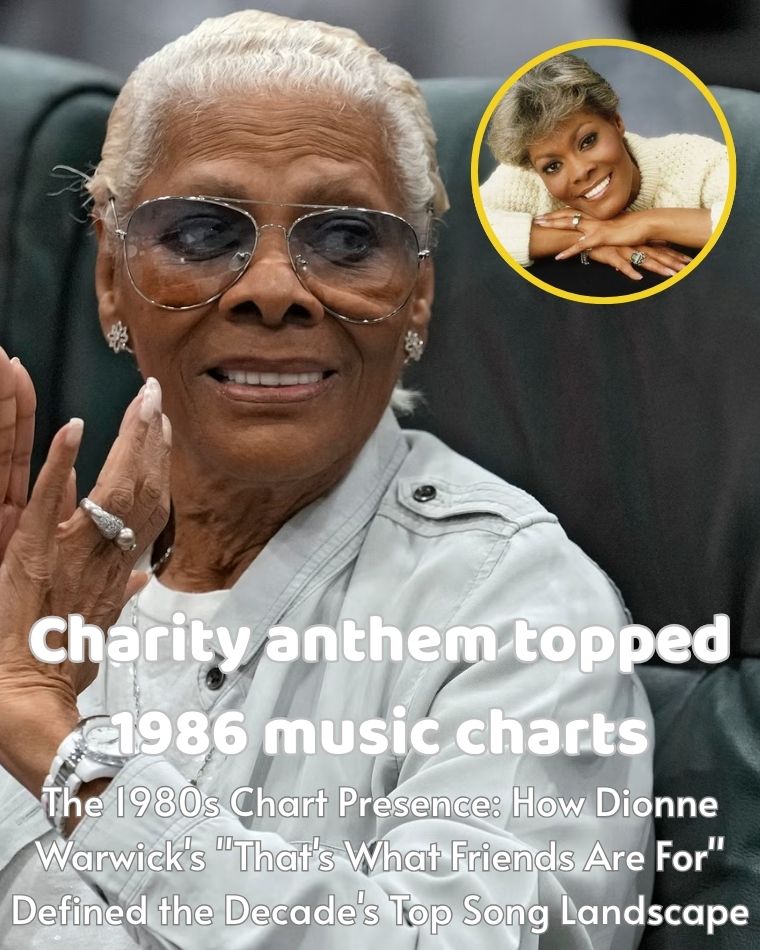
Cre: Montclair Film / Wikimedia Commons
The Genesis of an AIDS Research Benefit Recording
Recorded under the collaborative billing Dionne Warwick and Friends, the track arrived during a critical moment in contemporary public health history.
The song had originally been written by the legendary songwriting partnership of Burt Bacharach and his then-wife Carole Bayer Sager.
The composition initially appeared in an earlier form on the soundtrack of the 1982 film Night Shift, performed by Rod Stewart.
The decision to resurrect and transform the track into an unprecedented benefit initiative came directly through actress Elizabeth Taylor.
Taylor approached the songwriting duo with the vision of dedicating the commercial proceeds of a new recording directly to medical research for AIDS.
During the mid-1980s, the global public health emergency faced widespread institutional hesitation, severe social stigma, and catastrophic funding deficits.
Warwick embraced the concept immediately, resolving to turn the heartfelt ballad into a nationwide vehicle for education, awareness, and fundraising.
Released commercially in late 1985 on Arista Records, the single rapidly climbed American radio playlists and retail sales tallies heading into the new year.
By early 1986, the single ascended to number one on the Billboard Hot 100, maintaining its lock on the pinnacle position for four consecutive weeks.
It achieved simultaneous supremacy across the Billboard Adult Contemporary and Hot Black Singles charts, demonstrating universal demographic appeal.
The collaborative release raised more than $3 million directly for the American Foundation for AIDS Research.
Beyond the substantial financial milestone, the recording broke through long-standing cultural barriers by forcing the reality of the crisis into mainstream living rooms.
Warwick’s leadership on the single led directly to her appointment in 1987 by President Ronald Reagan as an honorary ambassador of public health.
As Warwick later recalled, the official platform enabled her to confront the administration’s silence directly during a White House press gathering.
Warwick publicly asked Reagan to state the name of the condition aloud, prompting the president to say the word AIDS publicly for the first time.
Assembling the Roster: A Spontaneous Supergroup Collaboration
The formation of the quartet behind “That’s What Friends Are For” reflected both serendipity and the decade’s growing trend of all-star cause recordings.
Following the unprecedented international success of the 1985 USA for Africa recording “We Are the World,” supergroup charity projects became a powerful pop format.
Rather than assembling dozens of singers for brief choral passages, Warwick opted for an intimate ensemble of four distinctive vocal stylists.
Warwick enlisted rhythm-and-blues icon Gladys Knight and multi-instrumentalist musical genius Stevie Wonder to anchor the project.
The final piece of the quartet came together through an entirely chance encounter on the eve of the scheduled Los Angeles studio session.
While browsing the aisles of a Beverly Hills grocery store the night before recording, Warwick unexpectedly crossed paths with Elton John.
Warwick seized the moment, approaching the British superstar directly and telling him that she was recording the following morning and needed his voice.
John immediately accepted the invitation, arriving at the recording studio the next day to lend his unmistakable tenor to the historic session.
The resulting recording brought together four distinct musical lineages that represented the very best of American soul, British pop, and Motown artistry.
Each vocalist brought decades of individual chart dominance, technical mastery, and passionate interpretation to their respective verses.
The interplay between Warwick’s graceful delivery, Knight’s soaring church-rooted passion, and John’s melodic clarity produced seamless musical chemistry.
Stevie Wonder rounded out the vocal quartet while providing the song’s most emotionally charged instrumental signature with his chromatic harmonica.
Studio Craft: Bacharach, Bayer Sager, and 1980s Production
The enduring resonance of the single stems from its masterclass in songwriting craft, arranged and produced by Burt Bacharach and Carole Bayer Sager.
Throughout the 1960s, Bacharach and lyricist Hal David had collaborated with Warwick on dozens of classic hits that redefined sophisticated orchestral pop.
Reuniting with Bacharach in the mid-1980s allowed Warwick to reconnect with the composer whose signature chord progressions best suited her expressive vocal phrasing.
Bacharach and Bayer Sager approached the production with meticulous attention to melodic balance, harmonic warmth, and emotional resonance.
Rather than succumbing to the rigid electronic drum programming and harsh synthesizer textures popular across 1986 airwaves, the production emphasized acoustic warmth.
Delicate acoustic piano chords and shimmering electric keyboards establish the foundational bed of the track without overwhelming the vocalists.
The arrangement carefully introduces each legendary voice, allowing listeners to experience individual solo lines before weaving them into soaring four-part harmonies.
Wonder’s harmonica work provided an instantly recognizable counter-melody that wove through the verses, choruses, and extended vamp outro.
The lyrical message crafted by Bayer Sager avoided moralizing slogans, focusing instead on unwavering friendship, mutual loyalty, and compassionate support.
The refrain, asserting that friendship means standing together through good times and bad times, offered emotional solace to communities facing immense loss.
This timeless compositional elegance allowed the single to sound modern on contemporary radio while retaining the classic pedigree of traditional American pop songwriting.
At the 29th Annual Grammy Awards, the recording was recognized with the prestigious Song of the Year prize for Bacharach and Bayer Sager.
The four artists also earned the Grammy Award for Best Pop Performance by a Duo or Group with Vocal, cementing its industry acclaim.
Chart Competition and the Cultural Climate of 1986
The commercial victory of “That’s What Friends Are For” as Billboard’s number one song of 1986 occurred amid an extraordinarily competitive pop landscape.
The mid-1980s was an era when radio programming was dominated by high-energy dance tracks, arena rock anthems, and flashy MTV music videos.
Artists like Madonna, Whitney Houston, Peter Gabriel, and Bon Jovi released career-defining albums that generated intense battles for the top of the Hot 100.
Pop radio playlists shifted rapidly between the synthetic rhythms of dance-pop and the aggressive guitar hooks of mainstream hair metal.
Despite these prevailing stylistic trends, “That’s What Friends Are For” sustained remarkable longevity across multiple radio formats simultaneously.
Top 40 pop stations, urban contemporary outlets, and adult contemporary broadcasts gave the track blanket, round-the-clock airplay.
The single spent months near the peak of the national sales charts, driven by listeners who bought copies not just for entertainment, but as an act of solidarity.
Listeners recognized that buying the record contributed directly to an urgent humanitarian cause that the broader culture had long ignored.
By conquering Billboard’s year-end chart, Warwick and her collaborators demonstrated that genuine musical artistry and sincere empathy could triumph over fleeting pop novelties.
The song stood alongside other prominent year-end champions highlighted by Mental Floss, proving that adult contemporary ballads could capture the cultural zeitgeist.
In an era often remembered for neon commercialism and electronic excess, the quiet dignity of the track provided the decade with its most compassionate soundtrack.
Lasting Impact: The Standard for Benefit Recordings
Decades after its historic chart run, “That’s What Friends Are For” remains a singular benchmark in the evolution of modern philanthropic music.
The track demonstrated that a targeted, artist-driven charitable single could raise significant millions for a specific, stigmatized humanitarian mission.
Prior benefit efforts had primarily focused on international famine relief, whereas Warwick’s project addressed an urgent crisis unfolding on American soil.
The single set a precedent for how music industry icons could leverage commercial celebrity capital to destigmatize misunderstood health emergencies.
By placing Elizabeth Taylor’s fundraising vision at the heart of the campaign, the initiative pioneered modern celebrity advocacy in the public health sphere.
The song’s widespread success helped establish mainstream support that paved the way for broader medical research grants and vital support programs worldwide.
Beyond its quantifiable financial contributions, the composition permanently entered the canon of classic pop songs celebrating friendship and human solidarity.
It remains Warwick’s signature collaborative accomplishment, showcasing her enduring status as one of American music’s greatest interpretive vocalists.
The single proved that when extraordinary vocal talents unite behind exceptional songwriting, the result can redefine the charts and inspire societal progress.
As modern retrospective analyses continue to revisit the cultural markers of the 1980s, the recording stands out with unrivaled moral and musical power.
It endures not merely as a relic of 1986 radio playlists, but as an enduring testament to the lifesaving potential of musical community.
Để lại một phản hồi