Even as Adam Sandler continues to garner critical acclaim for his dramatic turns, his 2011 comedy Jack and Jill remains widely cited as one of the lowest points in modern cinematic history. Yet among internet communities and comedy enthusiasts, fans consistently defend a single unhinged sequence featuring legendary actor Al Pacino as the sole justification for the film’s existence.
Al Pacino’s inexplicably committed performance in Adam Sandler’s 2011 comedy Jack and Jill remains a legendary pop-culture anomaly.
Despite being universally panned upon release, fans online frequently point to Pacino’s bizarre fictional Dunkin’ Donuts commercial as the movie’s lone bright spot.
This strange intersection of prestige acting and slapstick parody illustrates what audiences truly value when examining Adam Sandler’s most ridiculed projects.
The Lingering Stigma of Jack and Jill
Adam Sandler has built one of the most profitable and polarizing careers in Hollywood history.
Over the decades, his filmography has swung between beloved broad comedies and sophisticated prestige dramas.
Recent dramatic achievements in movies such as Uncut Gems and The Meyerowitz Stories proved Sandler possesses remarkable range as an actor.
Those acclaimed performances earned the legendary comedian newfound respect from critics who once dismissed his output entirely.
Nevertheless, retrospective appraisals of Sandler’s legacy inevitably run into the infamous wall that is Jack and Jill.
Released in 2011 by Sony Pictures Releasing, the comedy represents an unavoidable pop-cultural low watermark.
The film stars Sandler in a dual role as twins Jack and Jill Sadelstein.
Jack works as a successful advertising executive in Los Angeles, enjoying an affluent and tranquil suburban existence.
His life is turned upside down when his grating, needy, and abrasive twin sister Jill visits from the Bronx for Thanksgiving.
The core conflict revolves around Jack’s escalating desperation to tolerate his sister while orchestrating a major advertising deal.
When Jill overstays her welcome, chaos erupts across various family gatherings and an ill-fated cruise ship vacation.
To say that professional critics and moviegoers disliked the film would be a massive understatement.
Jack and Jill quickly cemented a horrific reputation that proved nearly impossible to move past, even for a star as prolific as Sandler.
On review aggregator Rotten Tomatoes, the movie holds an abysmal 3% approval rating.
Many major reviewers across the industry declared it one of the absolute worst motion pictures ever released in theaters.
The critical revolt culminated at the 32nd Golden Raspberry Awards, an annual parody ceremony that dishonors Hollywood’s biggest misfires.
Jack and Jill made history by scoring a record-setting 12 Razzie nominations.
It subsequently accomplished an unprecedented clean sweep, winning in all 10 categories, as reported by The Hollywood Reporter.
The project took home dishonors for Worst Picture, Worst Director, and Worst Screenplay.
In an unusual twist, Sandler won both Worst Actor for playing Jack and Worst Actress for portraying Jill.
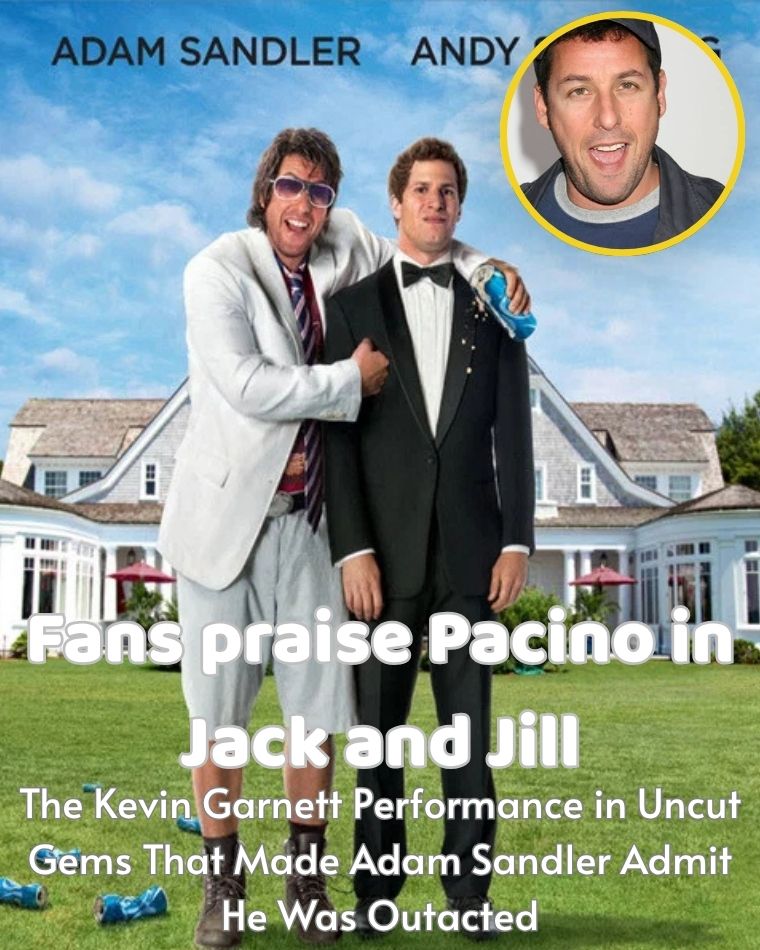
Cre: Sony Pictures Releasing
The Online Defense and the Legend of Dunkaccino
Despite the film’s standing as a cinematic disaster, modern audiences on social media have voiced a peculiar defense.
Discussions on platforms like Reddit reveal that fans hold a genuine affection for one specific storyline inside the project.
According to online commentators, Al Pacino’s performance is universally considered the sole redeeming part of the entire feature.
In the film’s narrative, Jack Sadelstein faces tremendous pressure at his agency to land an iconic spokesperson for Dunkin’ Donuts.
Jack’s corporate objective is to convince the Oscar-winning heavyweight Al Pacino to promote a new coffee beverage called the Dunkaccino.
Pacino agrees to entertain the pitch under one bizarre condition: Jack must help him woo Jill.
In the world of the comedy, the celebrated dramatic titan becomes completely infatuated with Jack’s obnoxious twin sister.
This absurd dynamic culminates in a full commercial sequence at the conclusion of the film.
The scene features Pacino performing an energetic rap and dance number centered entirely on the fictional drink.
Pacino enthusiastically rhymes about the Dunkaccino while dancing alongside background performers, including a man dressed head-to-toe as a coffee cup.
The resulting sequence plays like an unbelievable fever dream, especially when viewed completely out of context.
For many contemporary viewers, the surreal entertainment value of that musical number makes the agony of the surrounding movie worthwhile.
Online users frequently resurface the clip on social media threads discussing forgotten comedies and notorious box-office disappointments.
On Reddit, a user named u/Gerrywalk encapsulated the prevailing sentiment when responding to a thread dissecting the comedy’s failures, writing: “Yes, but it gave us Dunkaccino so”.
Another contributor, u/Person884, echoed that sentiment by analyzing Pacino’s storied career trajectory through an ironic lens.
“To me, the legacy of Al Pacino is screaming, anger, and this movie,” the user noted.
A third participant, u/CBOThrow, chimed in with similar resignation during the same exchange, stating: “At least we got dunkaccino out of it”.
Even the official Rotten Tomatoes critical consensus acknowledged Pacino’s contribution as the movie’s only bright spot.
The consensus explicitly noted: “Although it features an inexplicably committed performance from Al Pacino, ‘Jack and Jill’ is impossible to recommend on any level whatsoever”.
That an industry-standard review consensus would specifically highlight Pacino underscores just how prominently his turn stood out amid universal disdain.
Why Pacino’s Commitment Transcends the Slapstick
To understand why this specific sequence resonates while the rest of Jack and Jill falls flat, one must examine Pacino’s approach to acting.
A lesser performer might have phoned in an appearance in an Adam Sandler lowbrow production, treating it strictly as an easy payday.
Hollywood history is full of revered stage and screen veterans delivering half-hearted cameos in frivolous comedies.
Pacino did the exact opposite.
He threw himself into the absurdity of the premise with total, unrestrained artistic intensity.
In the film, Pacino plays an exaggerated, manic version of himself who takes commercial branding just as seriously as classic Shakespeare.
He treats his pursuit of Jill not as an offhanded joke, but as a grand, passionate, theatrical obsession.
When the story transitions into the Dunkaccino musical sequence, Pacino does not wink at the camera or display embarrassment.
Instead, he delivers the awkward rap lyrics and physical choreography with genuine bravura and commitment.
The contrast creates a delicious comedic tension between prestige high-art theater and vulgar commercial consumerism.
Watching Michael Corleone from The Godfather rap adjacent to an anthropomorphic coffee cup produces an unforgettable shock value.
The sequence functions on multiple levels of self-parody that elevate it far above ordinary bathroom humor.
Pacino effectively deconstructs his own iconic image, turning decades of solemn cinematic reverence inside out for a quick gag.
The scene ends on an even sharper self-aware punchline that further delights fans.
After Jack Sadelstein watches the completed Dunkaccino commercial and expresses astonishment, Pacino immediately demands that Jack destroy every existing copy.
Pacino looks at Jack dead in the eye and insists that nobody can ever see the footage, demonstrating that the character knows exactly how humiliating the spot is.
That final meta-joke acts as an artistic safety valve, acknowledging the exact reaction every viewer is having in real time.
By admitting the horror of the commercial within the fiction of the film, Pacino and Sandler invite the audience into the absurdity.
It gives viewers permission to laugh at the shamelessness of corporate marketing and Hollywood celebrity culture simultaneously.
The Role of Celebrity Cameos Across Sandler’s Career
The presence of an out-of-place celebrity cameo is not an isolated experiment in Adam Sandler’s creative catalog.
Over the course of three decades, Happy Madison Productions has turned high-profile guest appearances into a signature comedic tradition.
In Happy Gilmore, game show host Bob Barker engaged in an iconic, profanity-laced fistfight on a golf green that remains legendary.
In Anger Management, Sandler paired himself with Jack Nicholson, pitting his low-key irritation against Nicholson’s unhinged ferocity.
In The Wedding Singer, rock icon Billy Idol stepped into a first-class airplane cabin to assist Sandler’s protagonist in winning back his true love.
Even Johnny Depp makes an uncredited, self-deprecating cameo appearance in Jack and Jill wearing a Justin Bieber t-shirt.
Audiences have long expected Sandler movies to feature familiar cultural figures letting their hair down in unexpected environments.
However, the Pacino sequence in Jack and Jill differs substantially in scale and structural importance.
Most celebrity cameos in Sandler projects function as brief, punchy walk-ons designed to elicit momentary audience recognition.
Pacino, by contrast, is central to the entire narrative architecture of the third act.
His presence is woven directly into Jack’s corporate career stakes and Jill’s emotional validation.
Because Pacino is treated as a major supporting player rather than a throwaway gimmick, his antics occupy significant narrative space.
The sheer duration of his subplot forces the audience to witness a revered living legend fully embrace unhinged silliness.
When the rest of the film’s jokes lean on repetitive bathroom gags and mean-spirited sibling mockery, Pacino’s storyline injects vibrant energy.
It provides an oasis of genuine comedic surprise inside a script that otherwise follows predictable patterns.
For fans of Happy Madison comedies, this dynamic highlights a recurring paradox in Sandler’s body of work.
Even when Sandler’s personal scripts reach their most derivative points, he retains an extraordinary ability to recruit top-tier talent.
A-list actors willingly join his projects because Sandler productions have a reputation for providing fun, low-stress working environments.
That relaxed atmosphere frequently yields spontaneous, joyful performances that defy conventional Hollywood expectations.
Pacino’s willingness to partake in the madness demonstrates how much goodwill Sandler commands among fellow industry veterans.
Does Dunkaccino Save the Film’s Overall Legacy?
While modern internet culture loves celebrating isolated movie moments, film scholars and general audiences draw a firm line at revisionism.
Acknowledging that the Dunkaccino scene is funny does not equate to rehabilitating Jack and Jill as an overlooked masterpiece.
No serious retrospective has argued that the 2011 comedy was unfairly judged or ahead of its time.
The broader movie remains burdened by deeply grating comedic choices that alienate mainstream audiences.
The central premise of Sandler playing both siblings frequently feels exhausting rather than endearing.
Pervasive product placement and unsubtle brand integration throughout the narrative attracted severe condemnation from contemporary film critics.
The dialogue leans heavily on juvenile bodily humor that fails to connect with viewers beyond Sandler’s most forgiving devotees.
Furthermore, the record clean sweep at the Razzie Awards cemented a pop-cultural punchline that the film can never truly outrun.
In the annals of Hollywood, sweeping every single Razzie category represents an institutional rebuke of historic proportions.
No amount of affectionate social media reposting can erase that commercial and critical stigma.
Yet the durability of the Dunkaccino discourse illustrates how contemporary audiences consume and preserve cinema.
In the digital streaming and social media era, movies no longer live or die exclusively as monolithic, two-hour theatrical experiences.
Instead, films are increasingly sliced into modular cultural artifacts, memes, and standalone video excerpts.
A feature film can be an irredeemable artistic failure as a whole while still containing four minutes of pure comedy gold.
Viewers do not need to sit through an hour and a half of sibling bickering to appreciate Pacino dancing in front of coffee cups.
On video platforms like YouTube, the Dunkaccino scene boasts millions of views from audiences who have never watched the full motion picture.
It exists as an independent cultural meme, divorced entirely from the narrative baggage of the Sadelstein family.
This separation allows audiences to celebrate the spark of comedic genius without endorsing the surrounding cinematic mess.
It proves that modern film legacy is multifaceted and driven by community preservation rather than purely professional reviews.
Even within the most despised Hollywood releases, human creativity can produce something that lingers in public memory for decades.
The Enduring Appeal of Unapologetic Absurdity
Ultimately, the fan defense of Al Pacino’s cameo reveals a fundamental truth about what makes comedy memorable.
Audiences forgive many flaws when an artist exhibits complete, unadulterated passion for an absurd premise.
What viewers reject in bad movies is apathy, cynicism, and commercial laziness.
Much of Jack and Jill feels like an assembly-line product constructed from familiar studio formulas and corporate sponsorships.
The sibling squabbles and predictable family resolutions feel perfunctory and transactional.
In contrast, Pacino’s commitment in the Dunkaccino sequence radiates an undeniable sense of theatrical joy.
He is an acting titan who has reached the pinnacle of his profession, possessing nothing left to prove to the establishment.
Seeing an icon of that magnitude throw caution to the wind and perform a silly commercial dance is intrinsically exhilarating.
It breaks the fourth wall of Hollywood solemnity, reminding audiences of the sheer silliness inherent in the entertainment industry.
That spirit of unrestrained silliness is the foundation upon which Adam Sandler built his legendary career in the 1990s.
Before he was an acclaimed dramatic force or a polarizing studio mogul, Sandler was a performer who excelled at joyous absurdity.
When Pacino steps into Sandler’s sandbox, he channels that exact vintage energy, rescuing a tired project from total artistic oblivion.
The rest of Jack and Jill will likely remain safely confined to lists of cinema’s greatest critical misfires.
It will continue to serve as a cautionary tale of studio excess and uninspired franchise mechanics.
Yet decades from now, movie lovers will still be sharing video clips of an Oscar-winning maestro introducing his caffeinated beverage.
For that glorious musical aberration, fans remain eternally grateful.
In the complex tapestry of modern comedy, sometimes four minutes of inspired madness is all an audience needs to remember.
Để lại một phản hồi