Daniel Radcliffe has openly reflected on the veteran co-star who genuinely terrified him during the production of the Harry Potter series.
The young lead admitted that working alongside Ralph Fiennes provoked real fear that persisted across several years of filming.
That visceral intimidation was never the result of personal malice, but rather the imposing craft of one of Britain’s finest dramatic actors.
The Chilling Arrival of Lord Voldemort in the Graveyard
Stepping onto the set of a major fantasy franchise as an adolescent presents enormous professional challenges.
For Daniel Radcliffe, the stakes escalated dramatically during the production of Harry Potter and the Goblet of Fire.
Up until that fourth installment, the overarching villain had existed largely as a disembodied voice, a parasitic spirit, or a distant memory.
That dynamic shifted permanently when Ralph Fiennes officially stepped into the role of Lord Voldemort.
Radcliffe was around fifteen years old when he had to shoot his very first head-to-head sequences with Fiennes.
The confrontation unfolded within the chilling graveyard setting of Little Hangleton.
There was no warm-up period to soften the initial shock of sharing a scene with such a commanding performer.
Fiennes arrived on set fully immersed in the terrifying stillness and menacing rhythm of the Dark Lord.
Radcliffe later reflected candidly on that pivotal encounter in professional interviews.
He recalled that Fiennes genuinely scared him for a few years after they began working together.
The sheer intensity of Fiennes caught the young actor completely off guard.
Even before the digital removal of the nose and the addition of visual effects, Fiennes possessed an aura that silenced everyone on set.
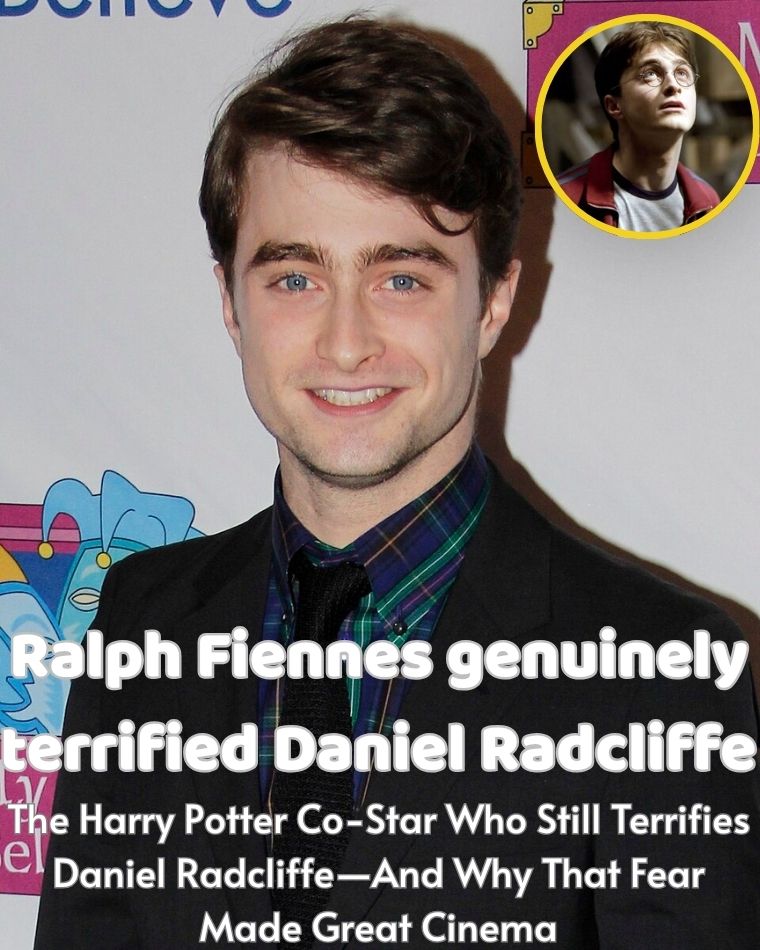
Cre: Wikimedia Commons — CC BY-SA 2.0 / Joella Marano
Radcliffe admitted that Fiennes was even scarier to him than Alan Rickman had been during the earliest films.
Rickman had certainly provided an intimidating presence as Professor Severus Snape.
Yet Rickman’s icy stare gradually gave way to a deeply supportive, mentor-like warmth off camera.
With Fiennes, however, the intense aura remained palpable throughout their dramatic confrontations.
The teenage Radcliffe found himself staring down a legendary Shakespearean heavyweight whose theatrical gravity was undeniable.
The Formidable Craft Behind Ralph Fiennes’ Command
Understanding why Radcliffe felt so terrified requires examining how Ralph Fiennes approached the dark character.
Fiennes did not rely on standard theatrical melodrama or cartoonish villainy.
Instead, he constructed a character defined by mercurial unpredictability, quiet whispers, and sudden violent outbursts.
His physical movement was snake-like, delicate, and entirely devoid of human empathy.
Fiennes brought decades of classical stage experience from the Royal Shakespeare Company and the National Theatre.
He had previously portrayed cold brutality with Oscar-nominated precision in Schindler’s List.
When Fiennes took his place under the film lights, every movement carried deliberate dramatic weight.
He controlled the silence between words just as effectively as the dialogue itself.
For a young actor who had grown up on commercial film sets, that level of mastery can be utterly daunting.
There was a natural hierarchy of craft that existed between an adolescent lead and a seasoned classical virtuoso.
Radcliffe was acutely aware that he was sharing the frame with an acting powerhouse.
Fiennes never had to raise his voice off camera to establish respect.
His total commitment to the psychology of the scene commanded absolute reverence from cast and crew alike.
Every rehearsal felt consequential because of the standard of perfection Fiennes maintained.
That seriousness created an atmosphere where failure seemed unthinkable.
Radcliffe recognized that he was witnessing elite dramatic artistry at close range.
That realization generated a healthy, awe-inspired fear that shaped every encounter between them.
Turning Real Fear into Screen Magic
While genuine fright might paralyze an untrained teenager, it worked wonders for the narrative of Harry Potter.
In the storyline, Harry was supposed to be completely terrified of Lord Voldemort.
The character had survived near-death experiences, watched Cedric Diggory die, and found himself bound to a headstone.
Radcliffe did not need to manufacture artificial apprehension for the camera.
His heart was genuinely racing whenever Fiennes stepped toward him in character.
The terror in the young protagonist’s eyes was completely authentic.
Every twitch, defensive posture, and swallowed breath reflected real emotional responses.
Fiennes feed off that dynamic to sharpen Voldemort’s predatory arrogance on camera.
The dramatic contrast between innocent vulnerability and cruel authority crackled across the screen.
Had Radcliffe felt entirely relaxed around Fiennes, the scene might have required repeated takes to manufacture urgency.
Instead, the authentic power differential elevated the emotional temperature of their first duel.
The physical exhaustion and psychological strain felt vivid to moviegoers around the globe.
Director Mike Newell and the production team captured an encounter charged with organic electricity.
Radcliffe leaned into that intimidation rather than retreating from it.
He used his nervous adrenaline to sharpen his focus and maintain eye contact with his terrifying partner.
The dynamic proved that creative tension can become a powerful asset when channeled into dramatic performance.
The scene remains widely regarded as one of the darkest and most effective turns in the entire franchise.
That success was born directly from the creative friction between young vulnerability and veteran intensity.
Masterclasses in the Shadows of Great Mentors
Growing up in front of the world on the Harry Potter soundstages was equivalent to attending Britain’s most elite drama academy.
Radcliffe worked alongside luminaries like Maggie Smith, Michael Gambon, Alan Rickman, and Gary Oldman.
Each acting legend offered a distinctly different perspective on dramatic technique and professional conduct.
Alan Rickman taught the young lead about vocal discipline, patience, and how to hold dramatic stillness.
Gary Oldman became a trusted confidant who demonstrated how intense preparation could coexist with playful warmth.
Yet Ralph Fiennes offered a unique lesson in total artistic immersion and psychological command.
Observing Fiennes construct a monster taught Radcliffe that acting is an act of uncompromised courage.
He watched how Fiennes calibrated his breathing, vocal cadence, and physical presence to manipulate the room.
The young actor learned that true screen presence is not about taking up space through noise.
Instead, it stems from the clarity of intention behind every single gesture.
Radcliffe discovered how to stand his ground against an intimidating screen partner without shrinking away.
To hold the camera’s attention while sharing a frame with Ralph Fiennes required extraordinary focus.
That challenge forced Radcliffe to mature far more rapidly as an artist than ordinary training would have allowed.
He learned to analyze scripts with greater depth and prepare with meticulous dedication.
He realized that acting opposite veteran talent demanded complete emotional presence in every single take.
Working through that intimidating fear forged a tough artistic resilience that defined his later career.
He began viewing intimidating situations as creative invitations rather than personal obstacles.
The lessons absorbed on those sets laid the bedrock for his long-term professional identity.
Redefining Professional Collaboration Beyond Hogwarts
The transformative experience of surviving those intimidating scenes fundamentally reshaped Radcliffe’s approach to post-Potter work.
When the massive cinematic saga concluded, Radcliffe chose an unconventional career path.
Rather than sticking exclusively to safe Hollywood blockbusters, he deliberately sought out daring, challenging roles.
He starred in Peter Shaffer’s controversial stage drama Equus on London’s West End and on Broadway.
He tackled complex physical performances in The Cripple of Inishmaan and Stephen Sondheim’s Merrily We Roll Along.
He embraced bold independent films such as Swiss Army Man, Horns, and Weird: The Al Yankovic Story.
In each of these ambitious creative chapters, Radcliffe carried the valuable lessons learned alongside Ralph Fiennes.
He no longer feared sharing the stage or screen with intimidatingly talented artists.
Instead, he actively sought out collaborators who pushed him far outside his personal comfort zone.
Radcliffe developed a deep appreciation for the healthy tension that exists between ambitious performers.
He understood that when two actors push each other to their limits, the resulting art becomes vastly superior.
His working philosophy became grounded in humility, rigorous preparation, and absolute fearlessness.
Having faced down Lord Voldemort in the flesh as an insecure teenager, ordinary professional pressures ceased to shake him.
He approached directors, playwrights, and seasoned co-stars with profound respect rather than paralyzing anxiety.
Radcliffe also ensured that he never imposed an intimidating environment on younger performers in his own productions.
He balanced intense artistic dedication with exceptional generosity toward everyone on set.
The fear he once experienced blossomed into an enduring model of professional mastery and graciousness.
The Transformative Role of Creative Fear
Radcliffe’s candid admission highlights a vital reality of the performing arts that is rarely discussed publicly.
In high-stakes creative environments, healthy fear is not necessarily a negative obstacle to avoid.
When experienced in a safe and supportive professional framework, fear serves as a powerful catalyst for growth.
It sharpens the senses, eliminates complacency, and forces an artist to perform with heightened vigilance.
If young performers only work with partners who feel safe and predictable, their artistic range rarely expands.
Being pushed by a legendary talent like Ralph Fiennes forced Radcliffe to stretch his creative capabilities.
It demanded that he elevate his own craft to match the breathtaking caliber of the scene around him.
The resulting tension produced some of the most memorable cinema in modern fantasy history.
Decades later, fans continue to rewatch the dramatic graveyard encounter with awe and suspense.
Behind those iconic frames lies the authentic journey of an adolescent actor confronting a master of the craft.
Radcliffe’s willingness to share that vulnerability demonstrates remarkable humility and artistic self-awareness.
He honors the legendary colleagues who guided him by speaking truthfully about how intimidating they initially appeared.
In acknowledging his fear of Ralph Fiennes, Radcliffe celebrated the extraordinary power of cinema.
He revealed how authentic human emotion can transcend the script and create enduring cinematic history.
Ultimately, that intimidating presence became one of the greatest educational gifts of his entire career.
Để lại một phản hồi