When Uruguayan singer-songwriter Jorge Drexler publicly declared Bad Bunny to be a brilliant lyricist, he disrupted a long-standing cultural boundary within the Spanish-speaking musical landscape.
This intervention directly challenged decades of entrenched skepticism regarding the literary merits of contemporary urban genres.
The unexpected validation from an artist revered for his poetic rigor has forced critics and scholars to reconsider how artistic legitimacy is assigned across Latin music traditions.
By defending the Puerto Rican superstar, Drexler reframed the ongoing debate around reggaetón from an argument about commercial dominance into a serious discussion about modern Spanish-language poetry and storytelling.
The endorsement highlights how street-level vernacular, complex rhythmic cadences, and astute social commentary can coexist within the global pop music phenomenon.
For generations, acoustic and folk traditions have been treated as the sole keepers of lyrical sophistication, while youth movements rooted in Caribbean rhythms were routinely dismissed as disposable.
Drexler’s public stance effectively bridges that historic generational and stylistic divide, legitimizing urban songwriting as an authentic continuation of the Latin American poetic canon.
As Bad Bunny continues to break records worldwide, the conversation initiated by Drexler provides a crucial framework for evaluating urban poetry without traditional cultural snobbery.
An Unlikely Ally in the Defense of Urban Poetry
Jorge Drexler has spent decades building a stellar reputation as one of the most meticulous and intellectually rigorous lyricists in the Spanish-speaking world.
Trained as a physician before devoting himself entirely to songwriting, Drexler approaches composition with an analytical precision that incorporates historical metaphors, existential philosophy, and scientific terminology.
His artistic achievements include winning an Academy Award for Best Original Song alongside a staggering collection of Latin Grammy awards across multiple decades.
Given his pedigree within refined folk, milonga, and Latin alternative music, traditionalist critics assumed Drexler would share their disdain for modern reggaetón and Latin trap.
Instead, Drexler openly praised Bad Bunny’s exceptional ability to manipulate meter, vernacular cadence, and raw emotional resonance across his expansive discography.
He specifically noted that writing direct, highly communicative verse that connects with hundreds of millions of listeners across distinct linguistic borders is an extraordinary literary achievement.
Drexler cautioned against the persistent intellectual elitism that reflexively equates acoustic instruments with profundity and electronic rhythms with creative laziness.
His defense was not a superficial nod to chart trends, but a deliberate recognition of a peer operating at the absolute peak of modern verbal storytelling.
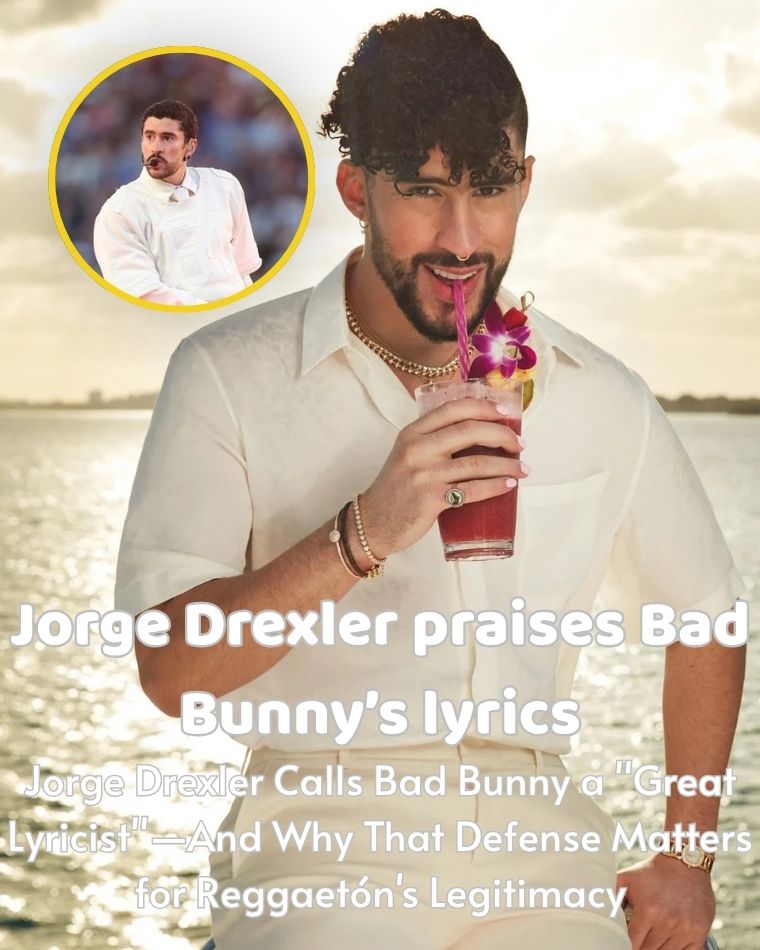
Cre: Wikimedia Commons
By speaking out, Drexler demonstrated that true artistic greatness recognizes innovation regardless of the tempo, rhythm, or delivery vehicle.
He underscored that the Spanish language is an evolving organism whose vitality often springs from the street corners rather than the lecture halls.
This perspective exposed the underlying condescension that frequently colors mainstream cultural critiques of urban Caribbean music.
Drexler emphasized that Bad Bunny’s lyrics carry an authentic weight that captures the psychological and sociological realities of modern Puerto Rico.
Rather than dismissing the repetitive nature of urban hooks, he celebrated the hypnotic precision required to construct a memorable melodic refrain.
His remarks resonated throughout the international press, prompting academic panels and music journals to analyze the rhythmic mechanics of urban verse.
Drexler’s generosity toward a younger generation set a new standard for collegiality and intellectual honesty among veteran Latin artists.
His intervention affirmed that lyrical greatness should be measured by emotional impact and cultural resonance rather than compliance with conservative formulas.
Decades of Stigma and the Systematic Dismissal of Reggaetón
The persistent criticism directed at Bad Bunny cannot be understood without examining the historical prejudice that has followed reggaetón since its inception in Puerto Rico during the 1990s.
Emerging from working-class housing projects, the genre originally known as “underground” blended Jamaican dancehall, hip-hop breakbeats, and local urban vernacular.
From its earliest manifestations, the music encountered aggressive political, legal, and institutional pushback from cultural elites on the island.
Authorities systematically raided record stores, confiscated cassettes, and attempted to ban the music under the pretext of obscenity and public decency laws.
Critics framed the rapid rhythmic delivery and explicit subject matter as a direct threat to high culture and moral order.
This early moral panic created an enduring critical trope that viewed reggaetón as fundamentally devoid of artistic intellect or poetic value.
As the genre expanded globally in the mid-2000s, commercial radio embraced its infectious dance rhythms while traditionalist tastemakers continued to malign its lyrical content.
Commentators routinely caricatured the entire musical movement as a monotonous collection of simplistic themes focused exclusively on partying and hedonism.
This historical stigma operated on an implicit cultural hierarchy that valued Eurocentric poetic forms over Afro-Caribbean storytelling.
Folklore and acoustic singer-songwriter traditions were preserved as pure cultural expressions, while urban music was treated as vulgar commercial detritus.
The critical establishment consistently ignored how reggaetón served as a vital oral history of marginalized youth navigating economic hardship and structural inequality.
The intricate cadences, spontaneous street slangs, and dynamic wordplay central to urban battles were systematically overlooked by conservative reviewers.
Even as urban Latin music grew to dominate global streaming metrics, mainstream awards ceremonies initially relegated the genre to secondary categories.
The narrative that reggaetón lacks lyrical depth became an unexamined consensus among cultural traditionalists across Latin America and Spain.
Bad Bunny entered the global consciousness within this hostile critical climate, carrying both the stigma and the cultural vitality of his forebears.
His subsequent commercial triumph forced the global music industry to confront its ingrained prejudices against the artistic capabilities of urban creators.
Deconstructing the Craft: Internal Rhyme, Cadence, and Narrative Ingenuity
A close and unbiased examination of Bad Bunny’s discography reveals a writer possessing remarkable structural command over language, rhythm, and emotional vulnerability.
Far from relying on trite formulas, his songwriting frequently deploys intricate internal rhyme schemes that shift seamlessly across polyrhythmic patterns.
On landmark projects like YHLQMDLG and Un Verano Sin Ti, he balances casual conversational idioms with disciplined poetic forms that sustain extended conceptual metaphors.
Consider his celebrated ballad “Amorfoda,” which strips away percussion entirely to leave only an acoustic piano supporting an intensely raw vocal delivery.
The composition explores romantic disillusionment through sparse, direct confessions that showcase an intuitive mastery of psychological restraint and dramatic pacing.
Throughout the song, he subverts traditional male bravado in Latin urban music by openly centering vulnerability, grief, and emotional exhaustion.
His writing rejects the emotional armor typical of classic urban bragging, opting instead for painful, self-lacerating introspection.
This willingness to deconstruct machismo through honest lyrical vulnerability represents an important evolution in the thematic scope of the genre.
In tracks such as “Si Estuviésemos Juntos,” Bad Bunny demonstrates an exceptional eye for sensory narrative detail that evokes immediate nostalgia and lingering regret.
He anchors broad emotional concepts in tactile, everyday memories: a particular brand of perfume, an unread message, or an empty passenger seat.
His wordplay relies heavily on double entendres rooted in Boricua slang, constructing layers of meaning accessible to neighborhood insiders while engaging worldwide audiences.
The rhythmic agility of his delivery allows him to bend syllables against the dembow syncopation, creating unexpected vocal pockets that mirror classic jazz phrasing.
He consistently breaks the rigid stanza structures of pop songwriting by extending lines or abruptly truncating thoughts to simulate natural speech patterns.
This technique bridges the gap between polished studio composition and intimate, unrehearsed stream-of-consciousness dialogue.
His lyrics often juxtapose euphoric revelry with profound existential loneliness, capturing the bittersweet duality of contemporary human experience.
By navigating these contrasting emotional registers with technical fluency, he achieves an authentic literary gravity that transcends simple dancefloor utility.
The Political Voice: Documenting Systemic Injustice and Colonial Anxiety
Bad Bunny’s lyrical craft extends far beyond romantic melancholy and club escapism into sharp, unflinching political and social documentation.
Nowhere is this sociopolitical awareness more evident than in his ground-breaking composition “El Apagón,” an anthem dedicated to the ongoing plight of Puerto Rico.
The song directly addresses the chronic electrical grid failures, gentrification, and corporate exploitation that have plagued the archipelago following natural disasters.
Rather than offering generic political platitudes, Bad Bunny delivers concrete, highly specific critiques targeting the privatization of public utilities and the displacement of local residents.
The track moves between infectious pride in local identity and righteous fury against foreign investors exploiting tax incentives at the expense of native communities.
He asserts local belonging with defiant clarity, proclaiming that foreign capital cannot purchase the soul, resilience, or territorial heritage of the island.
The lyrical narrative documents how systemic neglect affects everyday citizens who are forced to endure blackouts while luxury developments remain brightly illuminated.
This incisive reportage transforms a high-energy dance track into an enduring protest song that resonates deeply across the modern Caribbean diaspora.
Similarly, on the socially conscious track “Andrea,” Bad Bunny addresses the devastating epidemic of gender violence and femicide across Puerto Rico and Latin America.
The song constructs an empathetic narrative portrait of a young woman striving for safety, personal freedom, and dignity within a hyper-masculine society.
The lyrics avoid condescending savior tropes, choosing instead to honor Andrea’s autonomy, inner world, and fundamental right to exist without fear.
By leveraging his massive international platform to spotlight gender-based violence, he challenged traditional conventions within urban music culture.
His writing captures the ambient dread experienced by women in public spaces with nuanced observational acuity and deep moral seriousness.
This thematic courage proves that urban lyricism can serve as an urgent vehicle for civil advocacy and civic accountability.
He captures historical moments in real time, serving as an informal chronicler of his generation’s political disenchantment and collective protests.
Through these works, Bad Bunny firmly establishes his lyrics as an indispensable historical archive of contemporary Caribbean survival and defiance.
Bridging the Chasm Between the Trova and the Street
The profound resonance of Jorge Drexler’s endorsement lies in his status as an intellectual heir to the prestigious Latin American Nueva Trova and folk movements.
Throughout the twentieth century, movements spearheaded by figures like Silvio Rodríguez, Mercedes Sosa, and Violeta Parra set the gold standard for artistic respectability.
These traditions prioritized acoustic musicianship, metaphorical complexity, and explicit leftist political engagement as the markers of cultural authenticity.
Urban genres were frequently viewed as the absolute antithesis of this legacy—manufactured, capitalist, and indifferent to social struggles.
By stepping across this ideological divide, Drexler disrupted an artificial dichotomy that had stifled dialogue between traditionalists and urban innovators for thirty years.
He recognized that the fundamental impulse of the troubadour—to mirror society’s hopes, wounds, and contradictions—survives vibrantly within urban street music.
Drexler understood that the acoustic guitar and the drum machine are simply different instruments serving the same primordial human storytelling instinct.
The dialogue between Drexler and Bad Bunny illustrates that great popular songwriting has always synthesized high art and popular vernacular.
This convergence represents a vital generational reconciliation across Latin American cultural production.
Younger listeners no longer accept the arbitrary genre boundaries that previously dictated what qualified as serious literature or poetry.
They recognize that an artist can appreciate both the delicate verse of a milonga and the visceral energy of a hard dembow beat without contradiction.
Drexler’s public validation provided older, conservative music lovers with permission to engage with urban music on its own artistic terms.
It encouraged institutional critics to drop their reflexive condescension and listen carefully to the sophisticated wordplay being broadcast to millions.
This mutual respect fosters a richer, more unified musical ecosystem where distinct traditions can cross-pollinate and inspire each other.
The Latin music continuum is strengthened when its most revered elder craftsmen celebrate the vitality and raw talent of modern innovators.
Ultimately, Drexler’s commentary broke down an obsolete barrier, affirming that literary brilliance can emerge from any corner of the musical landscape.
The Living Continuum of Spanish-Language Popular Song
The evolving legacy of Bad Bunny’s songwriting must be contextualized within the centuries-old lineage of Spanish-language popular poetry.
From the traditional octosyllabic ballads of the Iberian Peninsula to the Afro-Cuban boleros and modern salsa dura, popular music has always been a repository for poetic innovation.
Great lyricists like Tite Curet Alonso and Rubén Blades previously faced similar skepticism before gaining universal recognition as master literary narrators.
Blades transformed salsa by embedding complex sociological short stories into dance arrangements, proving that rhythm and narrative brilliance are mutually reinforcing.
Bad Bunny stands directly in this lineage, adapting Caribbean narrative traditions for a hyper-connected, digital-first twenty-first-century global audience.
His writing keeps the Spanish language ductile, expressive, and urgently alive by incorporating colloquialisms that capture the contemporary spirit.
He demonstrates that poetic language does not belong exclusively to pristine academia, but thrives dynamically in the collective speech of ordinary people.
His work validates the dialect of Puerto Rico on the global stage, proving that localized linguistic identity can achieve universal resonance.
As international scholars and critics continue to study Bad Bunny’s cultural impact, the legitimacy of his lyrical craft will only become more apparent.
Jorge Drexler’s insightful defense will be remembered as an inflection point when the critical consensus began to shift toward intellectual fairness.
Great lyricism has never been defined by conservative instrumentation, academic pedigree, or conformity to outdated literary conventions.
It is defined by an artist’s ability to capture the human condition, articulate collective memory, and move the soul through the rhythmic magic of language.
In achieving these timeless artistic goals through the vibrant medium of urban music, Bad Bunny has earned his rightful place among the great Spanish-language lyricists.
His songs will continue to provide future generations with an indispensable window into the triumphs, heartbreaks, and political struggles of our era.
The ongoing conversation around his work reminds us that when language moves with rhythm, truth, and conviction, its poetic power remains undeniable.
Để lại một phản hồi