Tom Holland’s celebrated portrayal of Peter Parker owes much of its signature agility to rigorous stage training. Years spent performing demanding theatrical choreography provided the physical fluency, precision, and body awareness that set his cinematic action apart.
Holland’s casting as the Marvel Cinematic Universe’s web-slinger redefined what audiences expected from superhero physicality on the big screen.
While many screen actors rely almost exclusively on digital visual effects or stunt doubles, Holland brought an uncommon athletic foundation directly to camera.
His background was not forged in traditional action-movie martial arts boot camps or athletic combines.
Instead, Holland spent his formative developmental years performing in the demanding stage production of Billy Elliot the Musical on London’s West End.
That disciplined background provided an extraordinary technical vocabulary of physical movement.
Performing in live theatre required a relentless schedule of up to eight shows per week.
During that period, Holland was subjected to intensive daily regimens of ballet, tap dancing, and intricate acrobatics.
This exhaustive stage routine drilled spatial awareness deep into his musculoskeletal system.
It instilled an instinctive understanding of balance and kinetic timing at a crucial developmental age.
When the audition process for Spider-Man began, that foundation immediately distinguished Holland from thousands of other candidates.
He arrived with an ability to execute complex physical stunt sequences with the precise control of an elite dancer.
Directors quickly noticed that Holland did not simply mimic individual physical motions.
He possessed an inherent understanding of weight transfer, momentum, and kinetic energy.
This deep comprehension allowed practical, on-set movements to blend seamlessly with computer-generated imagery.
The distinction between rigid action acting and Holland’s style lies directly in this early stage discipline.
Traditional athletic training often focuses on isolated strength bursts and discrete physical gestures.
Conversely, classical dance training conditions performers to think in fluid phrases of continuous motion.
Every jump, spin, and landing on a theatre stage is intrinsically connected to what came before and what follows.
Holland brought that exact continuity to Hollywood soundstages and sprawling green screen sets.
When his Spider-Man swings, somersaults, and maneuvers through complex battles, the action flows without awkward visual hitches.
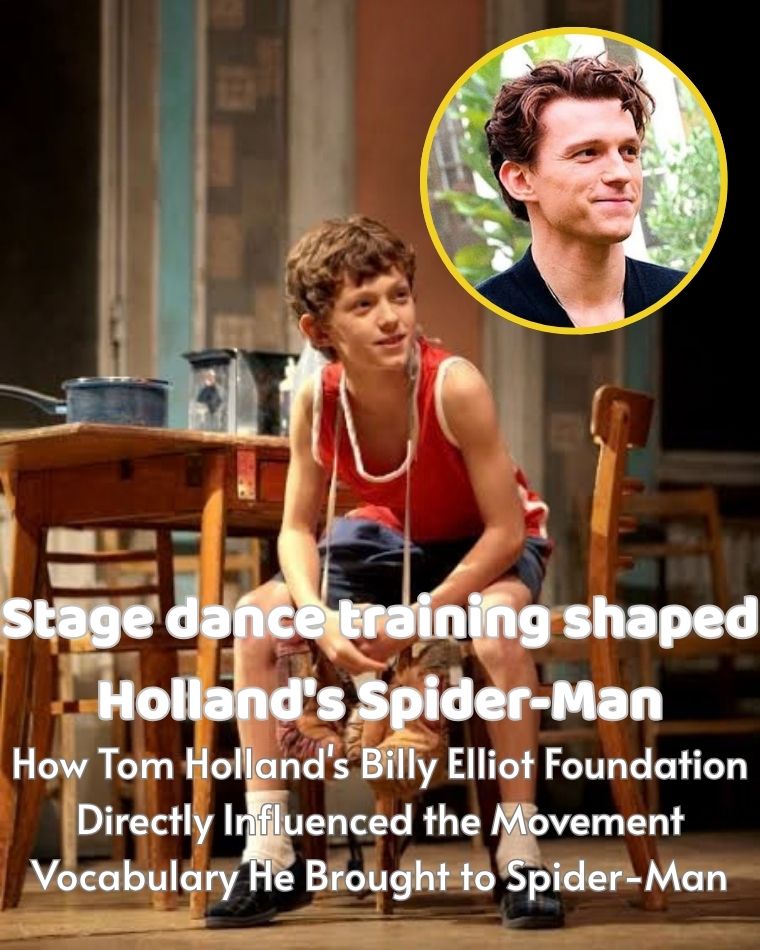
Cre: Wikimedia Commons — CC BY-SA 3.0
The years of live performance ingrained muscle memory that functions reliably under intense physical stress.
Executing intricate movements eight times a week in front of thousands of theatergoers removes hesitation from an actor’s body.
On a live stage, an artist cannot request a second take if a jump is miscalculated or an acrobatic landing falters.
That high-stakes theatrical environment fostered sharp mental and spatial awareness that translated directly to film production.
Stunt coordinators and film directors observed his rare capacity to master complex choreographies in remarkably few takes.
Saving valuable production time on massive blockbuster sets quickly proved to be an enormous logistical asset.
Because his body already understood the language of choreographed motion, adjustments from directors were applied instantly.
Holland did not need extensive mechanical instruction on how to orient his limbs mid-air.
His stage training had already taught him how to present clean physical lines to wide camera angles.
In classical ballet, line and silhouette are fundamental elements of dramatic storytelling.
Spider-Man, more than almost any other comic book hero, relies heavily on iconic aerial silhouettes and exaggerated physical poses.
From crouching low on roof ledges to arching dynamically through mid-air maneuvers, the character’s aesthetic is inherently theatrical.
Holland utilized his ballet and acrobatic precision to recreate these stylized poses in live action.
He avoided the stiffness that often plagues actors wearing tight, movement-restrictive superhero suits.
By understanding how fabric and padding interact with motion, he maintained an appearance of effortless grace.
The connection between classical dance and stunt work is far deeper than mere surface-level flexibility.
Dancers spend thousands of hours mastering the mechanics of shock absorption upon landing.
Holland’s acrobatic background protected him from injuries that frequently sideline performers during intensive action shoots.
His core stability and ankle resilience were developed during those early years on London’s West End boards.
Every dynamic stunt sequence in a major film functions essentially as a narrative dance between camera and performer.
Camera operators move on complex dolly tracks and crane arms while actors execute synchronized footwork.
Missing a physical mark by mere inches can ruin an entire multi-camera setup.
Holland’s theatrical background had conditioned him to hit exact stage marks without looking down.
He could monitor his spatial perimeter while fully delivering Peter Parker’s charismatic, fast-paced dialogue.
This dual focus—maintaining acting authenticity while executing technical choreography—is precisely what live musical theatre demands.
In Billy Elliot, an actor must sing, deliver poignant dramatic lines, and perform vigorous tap or ballet routines simultaneously.
Translating that multidisciplinary skill set to film sets made Holland unusually versatile under demanding production schedules.
Audiences can clearly detect the difference between a character animated purely by computer graphics and one guided by an experienced physical performer.
Even when visual effects enhance aerial sequences, Holland’s live performance serves as the fundamental kinetic template.
VFX artists rely heavily on the realistic weight, drag, and natural physics captured during Holland’s practical takes.
His natural deceleration and acceleration in harness rigs look grounded because his body reacts with authentic momentum.
Fake-looking CGI often occurs when virtual models lack the subtle muscle tension and inertia of a human body.
Because Holland understood how to tense, release, and shift his weight against harness cables, his digital doubles look convincing.
The acrobatic skills developed in London gave him complete comfort while suspended upside-down or spinning through the air.
Where other performers might experience disorientation, Holland retained acute physical presence.
This comfort level allowed him to deliver expressive vocal performances while hanging from rigging wires.
He transformed the technical burden of wirework into an expressive storytelling instrument.
The physical demands of Billy Elliot are widely recognized among performing arts professionals as some of the toughest on the West End.
Young performers undergo months of boot-camp preparation before ever stepping onto the stage for an audience.
That grueling training weeded out physical inefficiencies and instilled extreme discipline.
Holland applied that exact work ethic when stepping into international studio franchise productions.
Instead of approaching superhero stunts as isolated gym challenges, he treated them as rehearsed performance pieces.
Every combat sequence was analyzed as a rhythm of beats, pauses, and counter-movements.
This musical sense of timing elevated Peter Parker’s fighting style into something uniquely dynamic.
Rather than relying on heavy, plodding strikes, Holland’s Spider-Man moves like an evasive gymnast.
He ducks, leaps, redirects opponent momentum, and springs off surrounding surfaces with balletic ease.
This approach honors the classic comic book depiction of the hero far better than brute force ever could.
The comic panels of artists like Steve Ditko and John Romita Sr. always depicted Spider-Man with extraordinary flexibility and acrobatic poise.
Holland remains one of the few live-action actors capable of delivering that precise physical language in real space.
The foundation laid on the West End stage did not merely prepare him for an audition; it established his professional identity.
Directors and producers repeatedly highlighted his physical readiness as a major factor in expanding his on-screen action sequences.
When filmmakers realized what their lead actor could physically deliver, they designed bolder and more elaborate stunt set-pieces.
Knowing the performer can safely and convincingly land complex moves opens creative possibilities that storyboard artists rarely get to realize.
The physical instrument Holland developed as a child performer remains the bedrock of his career trajectory.
In modern film, an actor’s physical vocabulary is just as crucial as vocal range or facial expression.
Physicality communicates character motivations, vulnerability, panic, and triumphant resolve long before dialogue is spoken.
When Peter Parker stumbles, recovers, and launches himself forward, the motion itself tells the emotional story.
Holland uses physical tension to convey Parker’s youth, hesitation, and sudden bursts of heroic determination.
The awkwardness of an ordinary teenager shifting into the graceful fluidity of a superhero is executed entirely through posture and movement.
Without the discipline of classical dance, achieving that distinct physical transition would be immensely difficult.
Dancers spend decades learning how to manipulate posture to express differing emotional states.
Holland channeled those exact techniques into portraying Peter Parker’s dual identity.
In everyday school scenes, his posture is slightly curled, hesitant, and grounded.
The moment the character enters high-stakes action, his spine aligns, his chest broadens, and his kinetic movement expands.
This transformation requires total command over neuromuscular pathways that only years of physical training can provide.
It demonstrates why performing arts academies emphasize physical theatre alongside text analysis and scene study.
Holland stands as a prominent modern example of a classical musical theatre background enhancing Hollywood blockbuster cinema.
The cross-disciplinary value of dance training in action cinema has become an inspiring template for upcoming screen performers.
Aspiring stunt performers and dramatic actors alike recognize that versatility begins with foundational body control.
Holland’s path shows that time spent studying ballet, tap, and acrobatic technique is never wasted in film performance.
Rather than limiting an artist to the stage, theatrical training equips an actor with universal physical tools.
The legacy of Holland’s West End years continues to resonate across his entire body of film work.
Every flip, balanced landing, and choreographed combat beat serves as a continuation of the physical training that began in London.
Audiences watching Spider-Man leap across skyscrapers are witnessing the fruits of an intense childhood stage regimen.
The eight-shows-a-week discipline formed the mental toughness and physical resilience required for major action franchises.
Holland did not leave his stage roots behind when he transitioned to the world of cinematic universes.
He carried the language of movement into every stunt frame, shaping a superhero portrayal that remains visually iconic.
By grounding fantastical CGI-assisted spectacles in authentic, dancer-honed physical reality, he elevated the entire superhero genre.
His Spider-Man remains memorable not simply for the witty banter, but for the fluid, acrobatic elegance brought to every frame.
The West End stage gave Tom Holland the physical instrument that defined his ascent, forever proving that true action mastery begins with the art of dance.
Để lại một phản hồi