Long before he redefined modern action cinema, Bruce Willis captured the world’s attention as a wisecracking detective who solved mysteries with charm and fast-paced humor rather than brute force. His breakthrough role alongside Cybill Shepherd on the innovative 1980s detective comedy transformed him from an unknown working actor into an Emmy-winning cultural phenomenon. This defining performance ultimately laid the foundation for his historic leap to Hollywood stardom.
In the mid-1980s, the landscape of American prime-time television shifted dramatically when a fresh and unconventional voice debuted on the ABC network.
The project that altered the course of network television was a stylish romantic detective comedy titled Moonlighting.
Premiering in 1985, the series introduced audiences to a brand-new kind of screen hero who relied on quick verbal acrobatics and natural magnetism.
That charismatic figure was David Addison, a role brought to life by an actor who was then an unknown talent striving to make his mark in the entertainment industry.
Before landing this life-changing part, Bruce Willis was a struggling actor navigating the difficult audition circuit of New York and Los Angeles.
His sudden emergence on a major television network felt like a transformation that occurred virtually overnight.
Viewers were instantly drawn to the effortless swagger and kinetic energy he brought to every frame of the show.
The premise of the series paired Willis with established actress Cybill Shepherd, who starred as high-fashion former model Maddie Hayes.
Following an unexpected financial betrayal by her accountant, Hayes finds herself in possession of a struggling Los Angeles detective agency known as the City of Angels.
Willis’s character, David Addison, was the carefree private investigator running the modest agency.
Rather than liquidating the business for quick capital, Hayes decides to step into management, initiating an unforgettable partnership that captivated viewers across the globe.
The creative collision between the polished former model and the street-smart detective formed the beating heart of the program.
Willis made the role feel distinctively modern and rebellious compared to the standard television detectives of the era.
Instead of stoic crime solvers driven by grim determination, Addison treated every situation with infectious humor, vocal improvisations, and high-energy theatricality.
Audiences recognized that this was not merely a performer executing a script, but a magnetic personality claiming his space in the cultural spotlight.
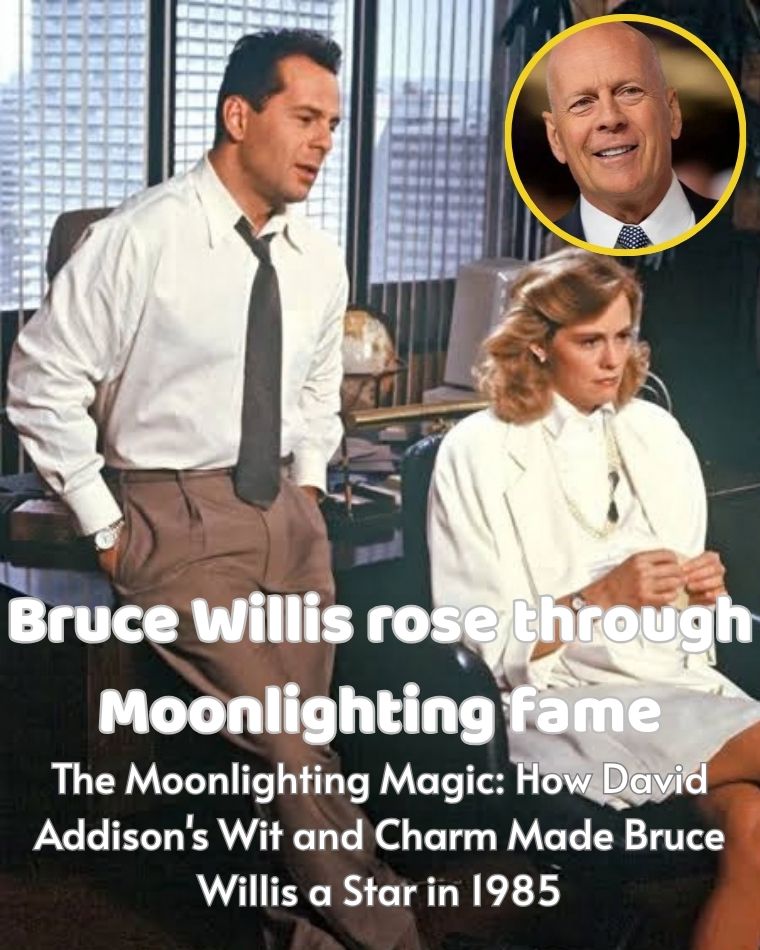
Cre: Wikimedia Commons
The creative chemistry between Bruce Willis and Cybill Shepherd emerged as the central engine driving the success of the entire series.
From their very first interaction on screen, the dynamic produced a rare kind of electric tension that kept audiences glued to their television sets every week.
Their banter unfolded at an extraordinary tempo reminiscent of classic 1930s screwball comedies.
Lines of dialogue overlapped continuously, demanding exceptional concentration, rhythm, and breathless comic timing from both performers.
While Shepherd delivered poise and cutting skepticism, Willis countered with uninhibited whimsy, vocal impressions, and physical comedy.
The palpable romantic tension between their characters became a defining topic of conversation throughout popular culture during the middle of the decade.
Fans tuned in each week eager to discover whether the contentious partners would finally acknowledge their mutual attraction or continue their endless verbal duels.
Behind this dynamic was a demanding writing style that set the show apart from conventional network television of its time.
A standard one-hour dramatic television episode typically utilized a screenplay that spanned approximately sixty pages of text.
Because of the breakneck delivery practiced by Willis and Shepherd, scripts for the series frequently stretched across eighty, ninety, or even one hundred pages.
Willis navigated this verbal obstacle course with breathtaking fluidity, proving that his charisma was matched by disciplined craft.
His capacity to deliver intricate, fast-moving speeches without losing a shred of charm became his undeniable signature.
Critics praised the pair for revitalizing the romantic comedy format within the framework of a weekly investigative series.
The playful hostility between Maddie and David became one of the most celebrated partnerships in television history.
For Willis, every single episode functioned as a national showcase for his unique ability to command the screen through wit alone.
Throughout its run, Moonlighting distinguished itself by breaking almost every established rule of standard television storytelling.
The series regularly engaged in daring meta-narrative experiments that shattered the traditional fourth wall separating performers from viewers.
Characters frequently addressed the camera directly, offering candid comments on the quality of the script or the pacing of the current episode.
Willis proved uniquely suited to this experimental approach, winking at the audience with boundless confidence and self-awareness.
In several episodes, the production embraced stylistic homages that parodied classic cinema, film noir, and even historical literature.
One celebrated production famously reimagined the classic Shakespearean narrative The Taming of the Shrew through the show’s idiosyncratic modern lens.
The show boldly blended live-action dance sequences, fantasy vignettes, and claymation interludes directly into prime-time mystery narratives.
Cold opens sometimes featured the actors standing on soundstages discussing production delays directly with the home audience.
This groundbreaking self-referential style anticipated the post-modern sensibilities that would eventually define television decades later.
At the center of this structural daring, Willis grounded the whimsical universe with genuine emotional weight and infectious exuberance.
His performance ensured that even during the most eccentric stylistic tangents, viewers remained deeply invested in David Addison’s underlying humanity.
The show’s critical acclaim steadily mounted as audiences and media analysts embraced its original narrative risks.
Industry recognition swiftly followed as awards organizations took notice of the innovative detective comedy.
By 1987, the show stood as one of the most widely discussed and decorated productions on American television.
Willis’s portrayal of David Addison earned widespread critical reverence, establishing him firmly at the very summit of prime-time stardom.
The culmination of this critical praise arrived during the 39th Primetime Emmy Awards ceremony held in 1987.
In a competitive category traditionally dominated by veteran dramatic performers, Bruce Willis achieved a landmark victory.
He won the prestigious Emmy Award for Outstanding Lead Actor in a Drama Series for his performance as David Addison.
The recognition was particularly historic because Moonlighting defied clean categorization, blending comedy, romance, and dramatic detective elements in equal measure.
Winning the premier dramatic acting accolade validated Willis not merely as a charming entertainer, but as a formidable dramatic talent.
During his acceptance, the young performer stood before his industry peers as an indisputable leading man who had redefined prime-time acting conventions.
The Emmy victory cemented his status as a certified television superstar whose popularity crossed all demographics.
Magazine covers, media profiles, and high-profile television appearances rapidly followed his major award win.
Yet even at the height of his prime-time acclaim, Willis harbored professional ambitions that reached far beyond the confines of weekly network programming.
He recognized that the creative momentum he had generated provided an extraordinary launchpad to pursue broader cinematic horizons.
The entertainment industry of the 1980s, however, maintained a rigid and unforgiving divide between television performers and major cinematic icons.
Actors who found success on the small screen were rarely viewed by studio executives as capable of carrying massive theatrical features.
Many television stars of the period had attempted the crossover to motion pictures, only to see their cinematic ventures falter at the box office.
Hollywood power brokers frequently argued that audiences who watched a performer for free at home would not pay cinema ticket prices to see them on the big screen.
Willis was determined to challenge this enduring studio skepticism through his undeniable drive and strategic role selection.
He began searching for a film property that would allow him to prove his versatility beyond the familiar confines of television production.
The search eventually led him toward a major action project developed by Twentieth Century Fox that would permanently change the film industry.
That pivotal project was an intense cinematic thriller titled Die Hard, slated for release in the summer of 1988.
The production centered on an everyday police officer trapped inside a skyscraper occupied by an elite team of heavily armed operatives.
When producer Joel Silver and the studio brass selected Willis for the central role of John McClane, the announcement shocked Hollywood insiders.
Industry trade publications openly questioned the commercial wisdom of casting a comedic television personality as the lead of an expensive action spectacle.
Several prominent action stars of the decade had previously built their careers on sheer physical dominance, stoicism, and invincible cinematic personas.
Actors like Arnold Schwarzenegger and Sylvester Stallone had established an era where action heroes were depicted as muscular, near-invulnerable demigods.
By stark contrast, Willis was celebrated primarily for rapid-fire dialogue, roguish smiles, and lightweight comedy on a weekly detective series.
The idea of trusting a television actor with a thirty-million-dollar action production was viewed by many as an extraordinary financial gamble.
Promotional campaigns for the film initially hesitated to place Willis’s face prominently on theatrical posters, fearing negative audience skepticism.
Yet both the filmmakers and Willis understood something crucial that industry critics and rival studios had overlooked.
The unique strengths that made David Addison a television sensation were precisely the qualities needed to revolutionize modern action storytelling.
When Die Hard arrived in theaters in the summer of 1988, it immediately detonated existing conventions surrounding the cinematic action genre.
Instead of an untouchable superhero who walked through fire without flinching, John McClane was a relatable, exhausted, and bleeding human being.
He suffered visible injuries, ran barefoot over broken glass, and openly expressed fear, frustration, and vulnerability throughout the crisis.
Crucially, McClane’s most powerful weapon was not merely his firearm, but the exact brand of improvised wit Willis had mastered on television.
The police detective talked to himself, mocked his dangerous adversaries over stolen radio channels, and deployed gallows humor to endure impossible odds.
Audiences recognized that John McClane was, in many ways, the natural cinematic evolution of David Addison placed under extreme physical pressure.
The sharp comedic timing honed over dozens of television scripts allowed Willis to make McClane feel utterly grounded and authentically human.
When McClane delivered iconic one-liners amidst intense danger, the moments landed with natural perfection because of his performer’s comedic pedigree.
The film became a staggering global box-office triumph, earning widespread critical acclaim and setting a new gold standard for action cinema.
Almost overnight, the narrative surrounding Willis shifted from risky television cast member to one of the most bankable movie stars on the planet.
The massive commercial breakthrough established a new paradigm in Hollywood, proving that a prime-time comedy background could elevate an action hero.
Subsequent action films throughout the late 1980s and 1990s scrambled to replicate the vulnerable, humorous everyman archetype that Willis had pioneered.
None of that cinematic revolution would have been possible without the grueling training ground provided by his weekly television work on ABC.
Working on the detective series had instilled in him a peerless sense of timing, audience connection, and dynamic spatial awareness.
Addison was the incubator that forged Willis’s entire artistic persona, teaching him how to project effortless vulnerability alongside roguish confidence.
The public loved John McClane precisely because they had already fallen in love with David Addison’s warmth, flawed humanity, and quick-witted survival instincts.
The legacy of Moonlighting remains monumental, both for television history and for the trajectory of Bruce Willis’s enduring global career.
The series demonstrated that prime-time television could be just as ambitious, self-aware, and stylistically bold as independent cinema.
It expanded the boundaries of network writing, proving that viewers were sophisticated enough to embrace rapid-fire banter and structural deconstruction.
For Willis, the five seasons spent playing David Addison represented far more than just his inaugural career breakthrough.
The role was a masterclass that showcased his extraordinary range, from physical farce and screwball repartee to earnest dramatic pathos.
Long before he was celebrated as a cinematic action hero, he proved that true charisma does not require an arsenal of heavy weaponry.
All he needed was a telephone, an open doorway, and a lightning-fast line of witty dialogue to captivate millions of homes worldwide.
Looking back across the decades, his performance opposite Cybill Shepherd remains a sparkling high point of 1980s television production.
It captures an electric moment in creative history when an unexpected actor met the absolute perfect vehicle for his specific, untapped genius.
The effortless confidence that David Addison projected across living rooms in 1985 became the cornerstone of a legendary multi-decade career.
Audiences who revisit the classic episodes today are immediately struck by how fresh, sharp, and timeless his comedic delivery remains.
His work on the show serves as an enduring reminder that every great Hollywood icon must first find the stage where their natural voice can shine.
For Bruce Willis, that fateful stage was a fictional Los Angeles detective agency filled with laughter, chaos, and sparkling dialogue.
Through sheer charisma and unmatched comic timing, he proved that words could hit every bit as hard as cinema’s biggest explosions.
His path from a struggling performer to an Emmy-winning sensation remains one of the most inspiring breakthrough stories in entertainment lore.
The character of David Addison did not merely entertain a generation; it paved the way for an entirely new kind of screen hero.
It was the witty detective who dared to laugh in the face of danger who ultimately gave the world one of its greatest cinematic legends.
The history of modern Hollywood would look completely different had Bruce Willis not picked up the phone at the City of Angels agency in 1985.
Để lại một phản hồi