In 1996, Marshall Mathers released his independent debut studio album, titled Infinite, with the hope of launching his professional rap career.
Instead of opening doors to immediate stardom, the project became an overwhelming commercial failure that sold roughly 1,000 copies upon its release.
That devastating rejection left the Detroit artist broke, depressed, and questioning his future, yet it ultimately became the necessary catalyst that created his legendary alter ego, Slim Shady.
The Crushing Commercial Collapse of Infinite
When Marshall Bruce Mathers III stepped out with Infinite in 1996, he was a hungry twenty-four-year-old artist determined to establish his name across Detroit’s competitive underground scene.
The album was pressed in extremely modest numbers and distributed independently on cassette and vinyl.
Eminem carried stacks of physical tapes in his hands and sold copies directly out of the trunk of his car across local streets and parking lots.
Despite his relentless legwork, the record generated almost no commercial traction and sold approximately 1,000 physical copies overall.
Local radio stations largely ignored the independent tracks, leaving the young rapper without the promotional airplay needed to break outside his immediate neighborhood.
Music fans in the Midwest hip-hop circuit showed very little interest in buying the release, causing retail consignment copies to collect dust on shelves.
Local hip-hop critics and listeners dismissed the record as derivative and uninspired rather than recognizing the young artist’s underlying technical talent.
Many peers claimed his lyrical cadence sounded far too similar to established East Coast rhymers such as Nas and AZ.
The stinging coldness from Detroit listeners sent shockwaves through Mathers, who had invested every ounce of his energy and faith into the independent project.
Instead of earning financial freedom or regional respect, Eminem found himself deeply discouraged, completely broke, and thoroughly ignored by the music community.
The devastating reception forced the young artist to confront painful questions about whether he possessed any legitimate future inside the hip-hop genre.
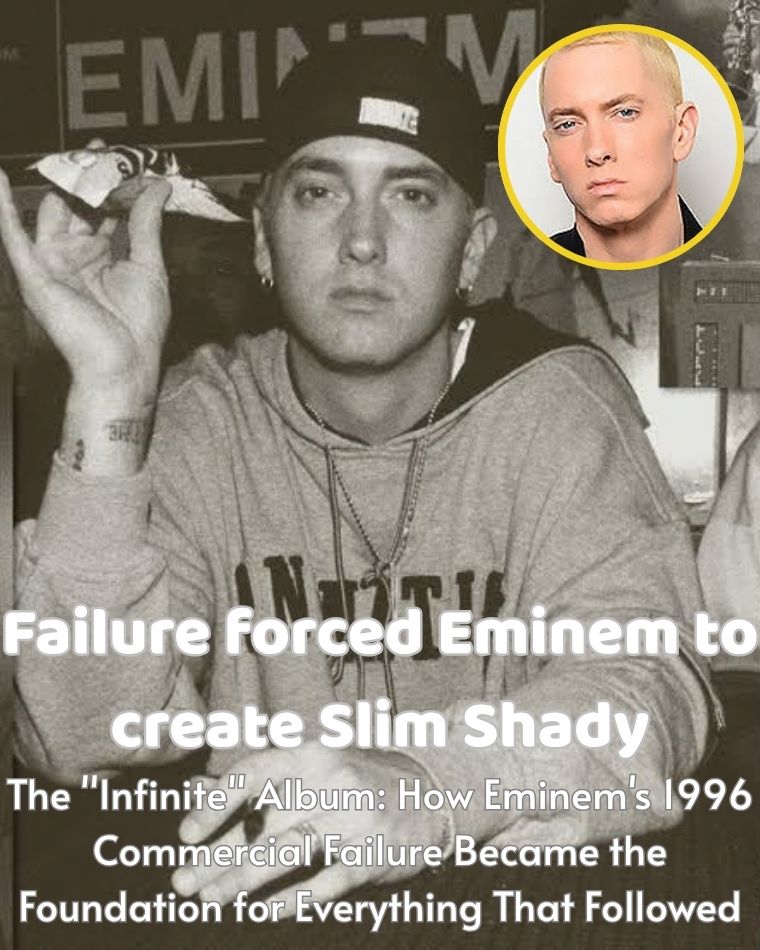
Cre: Wikimedia Commons — Creative Commons Attribution-ShareAlike 4.0 International
Inside the Bassmint: Recording on a Shoestring Budget
The entire sonic foundation of Infinite came together under minimal financial resources and raw operational conditions.
Recording sessions took place inside the Bassmint, a modest underground studio run by the Bass Brothers in Detroit.
Jeff and Mark Bass, working as executive producers, had recognized Marshall Mathers’ raw potential during regional open-mic broadcasts and decided to work with him.
Because everyone involved lacked serious financial backing, the team operated on a strict shoestring budget from the first session to the final mix.
Studio hours had to be arranged around whatever limited time was available, often stretching deep into late evenings and freezing Michigan nights.
Key production work was shared between Eminem and local collaborator Denaun Porter, known to hip-hop listeners as Mr. Porter.
Fellow Detroit native Proof assisted in programming drums and establishing rhythmic patterns for several tracks.
The studio gear was basic, forcing the crew to stretch minimal hardware to capture clear vocal passes and boom-bap percussion.
Because tape stock and studio time were limited, Mathers felt immense pressure to deliver clean, intricate takes on the very first try.
Guest verses were recorded by trusted underground allies from the local Detroit scene, including Eye-Kyu, Three, and Thyme.
Every beat crafted during these basement sessions carried the stripped-back aesthetics of mid-nineties underground rap.
Mathers deliberately focused on multi-syllabic rhyming structures, packing each bar with dense internal wordplay to showcase his verbal mechanics.
The resulting recordings clearly highlighted his sharp breath control, rhythm, and expansive vocabulary.
However, the recording environment and cautious creative choices left the final tracks devoid of emotional friction.
The album sounded like a showcase for lyrical gymnastics rather than a definitive statement from a unique, unmistakable voice.
Personal Poverty and the Burden of Supporting Hailie
The musical failure of Infinite did not happen in a vacuum, as Eminem was navigating severe personal adversity in his everyday life.
During the mid-nineties, Marshall Mathers was trapped in low-wage survival mode throughout suburban Detroit.
He worked grueling shifts at Gilbert’s Lodge, a local restaurant located in St. Clair Shores, Michigan.
At the diner, he washed dirty dishes, prepped food, and cooked meals on minimum wage just to earn basic grocery money.
The repetitive kitchen work drained his physical stamina while offering almost zero long-term financial security.
His personal responsibilities intensified significantly with the birth of his daughter, Hailie Jade Mathers.
Becoming a young father placed immediate, crushing pressure on him to purchase baby supplies, pay utilities, and keep a roof over his family’s head.
Mathers frequently lacked enough money to afford diapers, baby food, or rent, turning daily life into an agonizing financial struggle.
He had dropped out of Lincoln High School after repeating ninth grade three times, which severely limited his job prospects outside manual labor.
Without secondary education credentials or savings, music represented the sole avenue he believed could pull his family out of poverty.
When Infinite failed to produce any meaningful revenue, the disappointment landed with absolute brutality.
Mathers later described that post-release period as one of the darkest, most desperate emotional low points of his entire existence.
He felt the heavy sting of guilt, believing he had let his infant daughter down by chasing an impossible dream.
Facing cold dismissals from local venues alongside empty pockets at home pushed the young father to the brink of total psychological collapse.
Brutal Rejection from Detroit’s Underground Scene
To understand why Infinite stung so deeply, one must examine the unforgiving proving grounds of Detroit’s underground hip-hop culture.
Detroit during the 1990s was home to an intensely competitive, underground rap community centered around venues like the Hip-Hop Shop.
Emcees were expected to show genuine individuality, lyrical power, and unflinching confidence whenever they stepped up to a microphone.
Audiences and rival artists did not hesitate to boo performers off stage if their material felt weak, generic, or unoriginal.
When Eminem presented the songs from Infinite, the response from Detroit listeners was largely lukewarm or overtly dismissive.
Local tastemakers felt that Marshall sounded like a polite copy of successful New York rappers rather than an original voice born of Detroit’s tough streets.
Rival emcees constantly challenged his right to belong in hip-hop, questioning his credibility and background.
The feedback was unforgiving, with peers openly telling him that his music lacked true character, grit, and real-life resonance.
Mathers had spent countless hours studying dictionaries, rhyming syllables, and constructing intricate word puzzles.
Yet listeners consistently treated those complex verses as clinical exercises that lacked raw soul or compelling emotion.
The local rejection made him feel like an unwanted outsider in the only culture where he sought belonging and validation.
Watching local peers dismiss his cassette tapes in his own backyard was a humiliating experience for the ambitious artist.
Rather than quitting, that humiliation generated an explosive reservoir of bottled anger, bitterness, and artistic defiance.
The Brutal Lesson: Why Pure Rhyme Skill Is Never Enough
The failure of Infinite provided Marshall Mathers with the most vital creative education of his entire life.
It delivered an uncompromising masterclass in the realities of artistic communication and audience engagement.
Up until 1996, Eminem believed that technical rhyming dexterity was all an emcee needed to achieve greatness.
He assumed that if his rhymes were sufficiently complex, listeners would automatically respect and elevate his craft.
Infinite proved without question that multi-syllabic acrobatics mean little if the listener does not feel a gripping human presence behind the voice.
The album had carefully sanitized his personal struggles, presenting them in smooth, radio-friendly boom-bap packages.
He had tried to sound polished, conventional, and commercially acceptable, hoping to appease mainstream programmers.
In doing so, Mathers had hidden his genuine pain, his volatile temperament, and the rough reality of his home life.
The resulting material felt emotionally detached, offering impressive phonetic gymnastics while failing to connect with listeners on an emotional level.
The market’s indifference taught him that polite conformity in art produces instant invisibility.
To make an unforgettable impression, an artist needed a defined narrative, a distinctive point of view, and an undeniable edge.
He realized that listeners were not interested in hearing another rapper emulate established styles from other cities.
They wanted unfiltered perspective, unexpected shock value, and emotional transparency delivered with unflinching conviction.
Mathers recognized that he had to abandon his polite approach and expose his deepest frustrations without apology.
Technical precision would remain his primary weapon, but it had to be fueled by unfiltered honesty, confrontation, and theatrical rage.
The Crucible: The Birth of the Slim Shady Persona
Out of the financial ruin, emotional despair, and creative disappointment of Infinite, a new artistic entity emerged: Slim Shady.
The creation of the Slim Shady alter ego was a direct psychological and creative reaction to being ignored and rejected.
Mathers realized that polite Marshall was not getting anyone’s attention in the music industry.
He needed an unhinged persona that could voice his darkest thoughts, express his poverty-fueled rage, and provoke listeners into paying attention.
Slim Shady gave Mathers complete creative permission to abandon safe boundaries, industry decorum, and polite lyrical themes.
Through this new alter ego, the rapper could address poverty, domestic turmoil, substance issues, and psychological instability with pitch-black satire.
The vocal delivery changed dramatically from the smooth, restrained tone heard across Infinite.
Mathers adopted a higher-pitched, nasal, and aggressively confrontational cadence that cut sharply through any drum pattern.
He paired that caustic vocal tone with razor-sharp satire, shocking horrorcore imagery, and biting self-deprecation.
The polite young man who had washed dishes at Gilbert’s Lodge stepped aside for a reckless, manic anti-hero.
This explosive transformation was unveiled on the 1997 Slim Shady EP, recorded once again in Michigan with the Bass Brothers.
Tracks like “Just Don’t Give a Fuck” and “Low Down, Dirty” made it immediately clear that Eminem had severed all ties with his cautious past.
The lyrics were unapologetically provocative, direct, and impossible for any listener or record executive to ignore.
Instead of apologizing for his troubled background or difficult circumstances, Eminem weaponized them into high-octane entertainment.
Slim Shady became the unstoppable battering ram that shattered the barriers that had previously kept Marshall Mathers outside the music industry.
From Underground Tapes to Dr. Dre and Stardom
The creation of the Slim Shady persona transformed Eminem from an overlooked local act into an undeniable force.
Copies of the Slim Shady EP began circulating through underground rap tape exchanges across the country.
In late 1997, Mathers traveled out to Los Angeles to compete in the prestigious Rap Olympics battle tournament.
He placed second in the competition, but his fiery performance captured the attention of Interscope Records staff.
Interscope co-founder Jimmy Iovine listened to the Slim Shady EP cassette tape and passed it along to West Coast producer Dr. Dre.
Upon hearing the tape, Dr. Dre recognized the artist’s unique vocal delivery, extraordinary rhythm, and reckless charisma.
Dr. Dre quickly invited Mathers to Los Angeles to record tracks together in the studio.
The chemistry between the veteran producer and the Detroit lyricist was instantaneous and creatively explosive.
They re-recorded several standout songs from the underground EP and produced brand-new singles like “My Name Is”.
In early 1999, Eminem released The Slim Shady LP under Aftermath Entertainment and Interscope Records.
The major-label debut became a multi-platinum pop culture phenomenon that launched Eminem into international superstardom.
It earned critical praise, commercial dominance, and prestigious Grammy Awards, transforming Mathers into one of the most recognizable icons on the planet.
None of that meteoric success would have materialized without the bitter lessons learned from Infinite.
If Infinite had achieved mild, moderate sales, Mathers might have remained a polite, derivative lyricist stuck in a regional holding pattern.
The total collapse of his debut forced him into the extreme creative measures that ultimately made him a global legend.
Infinite Through the Lens of History: A Collector’s Grail
Decades after its disastrous release, the historical narrative surrounding Infinite has undergone a dramatic transformation.
What was once dismissed as an embarrassing failure is now treated as a holy grail among hip-hop collectors worldwide.
Because only roughly 1,000 original copies were manufactured back in 1996, authentic vinyl records and cassette tapes are exceptionally rare.
Original pressing copies sell for thousands of dollars at specialized auctions, with hip-hop historians studying every groove.
The record remains unavailable across most digital streaming platforms and storefronts, adding to its mysterious aura.
To celebrate the project’s twentieth anniversary in 2016, the Bass Brothers released an official documentary alongside a remixed title track.
When modern listeners hear the remastered title song today, they are stunned by the technical complexity of Eminem’s early flow.
His internal rhyming schemes, alliteration, and syllable matching remain breath-taking examples of pure rap mechanics.
Retrospective critics now view the album as a fascinating audio snapshot of an icon still learning how to use his voice.
It shows Eminem before the platinum certifications, the controversial headlines, the stadium tours, and the fame.
It captures a humble twenty-four-year-old artist working tirelessly against poverty, obscurity, and family hardship.
The record proves that creative failure is not the end of an artist’s path, but rather a vital part of finding an identity.
Infinite stands as an enduring monument to persistence, artistic reinvention, and the relentless drive to rise from rock bottom.
Để lại một phản hồi