Ryan Gosling offers a rare, nuanced breakdown of what it truly takes to step into a cinematic institution without diminishing the titans who built it. By choosing stillness over spectacle and emotional muteness over mimicry, the actor established a defining blueprint for modern legacy sequels alongside Harrison Ford. Here is an in-depth analysis of Gosling’s philosophy, the collaboration behind Officer K, and how giving legends room to breathe elevates expansive cinematic universes.
Entertainment.ie recently brought renewed attention to a revealing interview centered on the production of Denis Villeneuve’s Blade Runner 2049.
The dialogue offers an extraordinary glimpse into the artistic mindset of Ryan Gosling as he navigated one of the most demanding assignments in modern cinema.
Stepping into the neon-drenched dystopia of Los Angeles required far more than physical discipline and stylistic execution.
Gosling found himself tasked with sharing the frame with Harrison Ford, who returned to his iconic role as Rick Deckard after an astounding 35-year absence.
Rather than approaching the project with competitive ambition, Gosling unlocked a masterclass in creative stewardship.
The acclaimed actor recognized that joining a monumental franchise is never about asserting dominance over the past.
Instead, his performance as Officer K proves that honoring legacy demands patience, restraint, and an unwavering commitment to serving the wider narrative canvas.
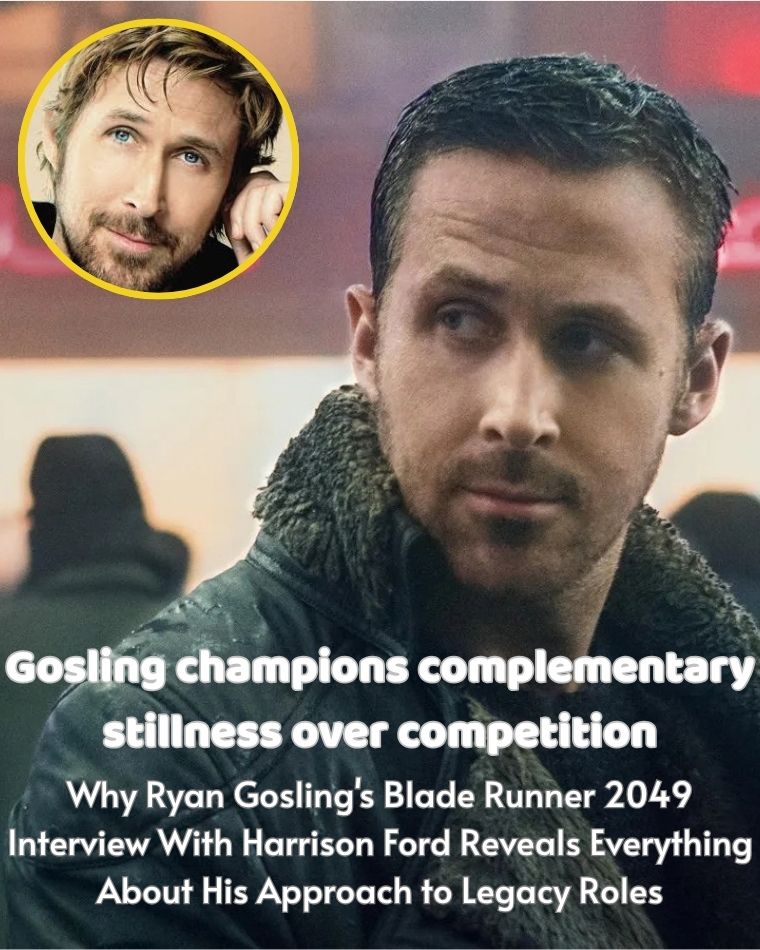
Cre: Wikimedia Commons — CC BY-SA 2.0 / Gage Skidmore
Taking on a project like Blade Runner 2049 carried an immense weight that few Hollywood performers would willingly shoulder.
Ridley Scott’s original 1982 Blade Runner holds near-religious status among science fiction enthusiasts, scholars, and filmmakers worldwide.
For over three decades, the atmospheric noir stood as an untouchable monument of cinematic world-building.
The sheer passage of time transformed Rick Deckard into a mythical figure whose shadow stretched across generations of storytelling.
Entering a continuation after a 35-year gap meant contending with impossible expectations and relentless critical scrutiny.
A lesser actor might have succumbed to intimidation or tried to force an overly theatrical imprint onto the material.
Many franchise revivals stumble precisely because fresh leads attempt to eclipse the veterans who originated the lore.
Gosling, however, viewed the massive historical canvas not as an intimidating barrier, but as a rare artistic privilege.
He saw the project as a golden opportunity to serve the core material rather than compete with its indelible heritage.
To build an authentic bridge between eras, the Canadian star realized he had to construct a character that coexisted organically with Deckard’s history.
That journey began with an intensive study of Harrison Ford’s unique screen presence and timeless craftsmanship.
Gosling paid meticulous attention to Ford’s legendary economy of performance throughout his illustrious career.
He observed how Deckard communicated towering volumes of emotional weight through pure stillness and measured silence.
Ford has long mastered the ability to convey grief, disillusionment, and survival without uttering unnecessary dialogue.
Rather than attempting to match Ford’s singular gravitas, Gosling chose an entirely complementary path.
He envisioned Officer K not as another world-weary cynic, but as a figure defined by emotional muteness.
Where Deckard represented a tired human slowly shedding his soul, K emerged as an obedient replicant yearning for a glimmer of genuine humanity.
This calculated contrast allowed both characters to inhabit opposite ends of the philosophical spectrum.
K’s calibrated quietness stood in sharp opposition to Deckard’s raw, battle-hardened weariness.
By underplaying his hand, Gosling built an enigmatic presence that drew audiences deeper into his internal journey.
The chemistry between the two leads on screen became the narrative engine that powered the critical triumph of Blade Runner 2049.
Gosling explained in the highlighted conversation that his primary objective was to carve out deliberate space around Ford’s presence.
He recognized that the narrative required silence and negative space to allow the legendary detective to truly breathe.
When an established screen icon steps into an existing mythos after decades away, the frame must honor that arrival.
Gosling deliberately crafted K’s interactions so that Deckard never felt rushed, displaced, or sidelined.
At the same time, K never receded into the background as an uninspired secondary observer.
The delicate equilibrium between both performers generated an electric tension that enriched every joint sequence.
This balance prevented the sequel from collapsing into an exercise in hollow nostalgia or modern vanity.
Too many contemporary revivals treat legacy characters as mere plot devices or ornamental handoffs.
Villeneuve and Gosling resisted that superficial trap by treating Deckard’s return with profound dramatic reverence.
The narrative treated Deckard’s past not as a gimmick, but as an essential philosophical anchor.
Gosling understood that great acting inside an established universe is fundamentally about generous listening and spatial awareness.
By creating room for Ford, Gosling heightened the emotional resonance of the entire film.
The audience felt the weight of every shared breath, glance, and unspoken truth between the two men.
This selfless creative instinct explains why Blade Runner 2049 stands as an acclaimed triumph while many similar sequels falter.
The lessons forged during the making of the sci-fi opus extend far beyond a single dystopian adventure.
They illuminate a sophisticated creative methodology that Gosling continues to carry across his career.
Understanding how to navigate expansive intellectual properties has become an essential craft in contemporary Hollywood.
Studios frequently struggle to revive dormant brands because creative teams fail to respect the architecture of earlier works.
When newcomers attempt to shout over original stars, the delicate illusion of the universe inevitably fractures.
Gosling proved that a thoughtful performer can honor sacred cinematic lore without sacrificing individual identity.
His deliberate stillness allowed the visual grandeur and philosophical inquiries of the script to take center stage.
He recognized that K’s role was to shepherd viewers through an evolving world while preserving Deckard’s mythic stature.
This dedication to serving the overall narrative fabric transformed the film into an enduring artistic achievement.
Industry observers frequently point to his performance as a model for how modern leads should approach historic IP.
The Entertainment.ie interview sheds light on the immense artistic discipline required to maintain that quiet composure.
Every glance, pause, and subtle shift in posture was calibrated to uphold the legacy of 1982.
Gosling never treated Rick Deckard as a stepping stone to elevate his personal profile.
He treated the character as a vital historical pillar whose presence deserved maximum narrative impact.
That collaborative generosity fostered an environment where Ford could deliver one of his most compelling late-career turns.
It demonstrated that reverence and bold creative choices can harmoniously align when egos are checked at the door.
For cinema fans and storytellers alike, the production remains a masterwork in creative collaboration.
The philosophy demonstrated in Blade Runner 2049 continues to resonate as Gosling moves toward massive new projects.
The actor carries this identical collaborative approach as he navigates high-profile properties such as Ghost Rider and Star Wars: Starfighter.
Joining sprawling franchises with rabid global followings requires an understanding of creative balance.
Gosling does not enter established pop-culture universes with the intention of tearing down foundations or claiming absolute ownership.
His objective remains steadfastly focused on adding complementary dimensions that make the fictional universe richer.
When an actor respects the canon, audiences immediately sense the authenticity and care injected into the story.
Rather than viewing expansive legacy as an exhausting creative burden, Gosling approaches it as an invitation to build.
He treats long-running narratives as collaborative tapestries woven across generations of artists.
By entering established lore with genuine curiosity and respect, an actor can unlock unexpected narrative depth.
This constructive philosophy protects beloved sagas from the cynical fatigue that often plagues multi-film franchises.
It ensures that modern additions feel like necessary evolutions rather than hollow corporate exploitation.
Gosling’s willingness to embrace restraint allows classic heroes and new protagonists to thrive in harmony.
His methodology shows that true artistic power often lies in what an actor chooses not to do.
Resisting the urge to dominate the screen requires profound self-assurance and technical precision.
Through his deliberate restraint, Gosling established a standard that will influence franchise storytelling for decades to come.
The insights highlighted by Entertainment.ie provide a vital framework for analyzing modern franchise filmmaking.
Blade Runner 2049 succeeded because its creative architects understood that respect is the prerequisite for innovation.
By studying Harrison Ford’s legendary minimalism, Ryan Gosling developed a performance that enhanced both characters.
He proved that silence can speak with greater force than explosive dialogue or manufactured drama.
Officer K remains an unforgettable figure because his quiet yearning never compromised Rick Deckard’s historical standing.
Instead, their fateful meeting in the wastelands of Las Vegas stands as a testament to narrative harmony.
As Hollywood continues to mine cherished cinematic classics for new continuations, Gosling’s blueprint remains essential reading.
Actors stepping into legacy roles must recognize that they are joining a conversation, not delivering a monologue.
When performers prioritize the welfare of the story above personal bravura, cinematic history is enriched.
Ryan Gosling’s collaboration with Harrison Ford reminds audiences why the medium of film continues to captivate the world.
Legacy is never an anchor holding an actor back; it is the wind that fills their creative sails.
Để lại một phản hồi