A real wedding ceremony took place live during Bad Bunny’s Emmy-winning Super Bowl LX Halftime Show, turning one of global television’s biggest spectacles into an unscripted celebration of human intimacy.
Rather than populating his elaborate set with paid extras and rehearsed actors, the Puerto Rican superstar and his production team operated under a singular guiding philosophy: they wanted real people.
This devotion to authentic everyday life captivated 128.2 million viewers, redefined the visual language of sports entertainment, and propelled the performance to an Emmy victory.
Behind the towering stadium speakers and world-class choreography lay a profound artistic statement that placed ordinary community members directly at the center of the world’s most scrutinized stage.
An Unforgettable Ceremony on the World’s Biggest Stage
The stadium lights shifted as 70,823 spectators inside Levi’s Stadium in Santa Clara, California, witnessed something never before seen during an NFL championship halftime performance.
Thomas “Tommy” Wolter and Eleisa “Elli” Aparico stood hand in hand on a recreated neighborhood plaza set in the middle of the football field.
They were not actors executing choreographed stage directions.
They were a real California couple exchanging legal wedding vows live on international television.
The ceremony unfolded seamlessly as Bad Bunny transitioned from his high-energy track “Mónaco” into a broader celebration of Latin music and communal life.
Thomas Wolter, a dedicated registered nurse who earned his bachelor’s degree from California State University, Fullerton, in 2023, had proposed to Aparico in October 2024 at Cannon Beach, Oregon.
When planning their wedding, the couple playfully decided to mail a formal invitation directly to Bad Bunny.
They knew countless fans sent similar mail and simply hoped they might receive an autograph or a polite congratulatory note in return.
Instead, the superstar’s production office contacted them to arrange a surprise Zoom conversation that changed their lives forever.
Bad Bunny invited them to hold their official ceremony directly inside his 13-minute Super Bowl halftime performance.
The global music icon even served as an official legal witness, signing their marriage certificate alongside their officiant.
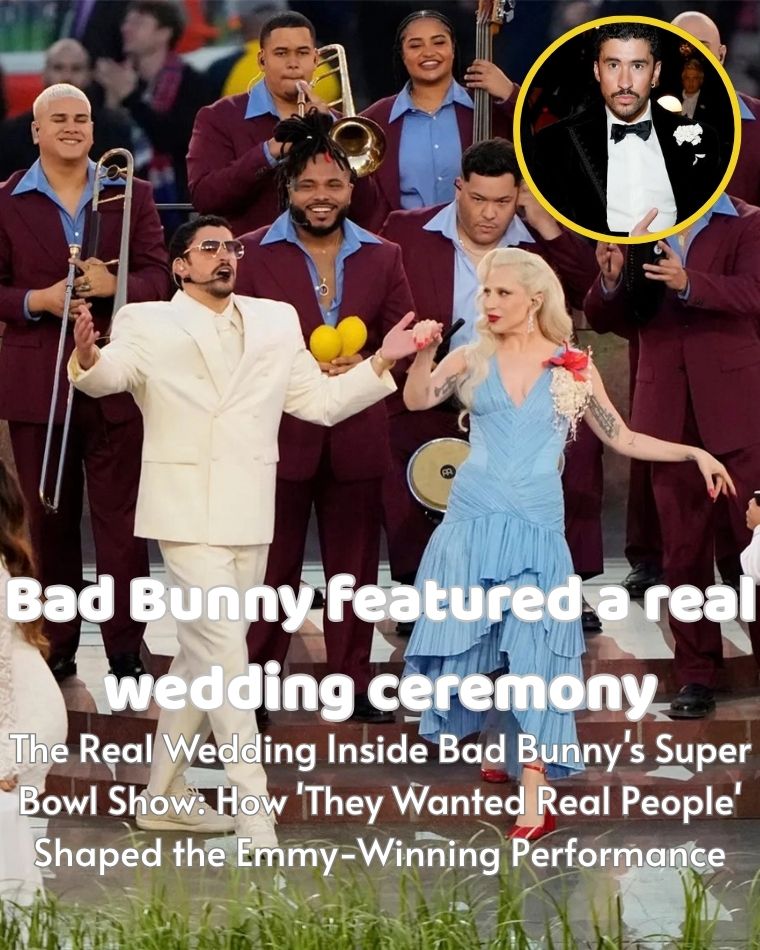
Cre: Wikimedia Commons
Faith, Family, and Secret Nondisclosure Agreements
The legal officiant standing before the couple was Pastor Reyes from Project Church South Sacramento.
Reyes was initially contacted through an entertainment management contact connected to Latin pop star Becky G.
Production representatives asked if he would be open to officiating a wedding for an unnamed couple without disclosing the venue or celebrity connection.
Reyes agreed in good faith to learn more about the opportunity.
Only after he received a strict nondisclosure agreement did the monumental truth reveal itself.
Reyes had to call his wife into the room to double-check the legal paperwork because he could scarcely believe the Super Bowl staging details written in front of him.
When she read the contract and realized her husband would officiate a wedding at the Super Bowl halftime show, she began screaming in utter disbelief.
For Reyes, standing on the grass at Levi’s Stadium represented something vastly larger than an entertainment spectacle.
“As a Mexican, as a Latino, to be part of that — it meant a lot,” Reyes later recalled to KCRA-TV.
“It wasn’t just a show. It was what it represented. It was a moment to represent my faith as a follower of Jesus, and also to represent Latinos. I’m just a local church pastor serving my community in south Sacramento. They wanted real people on that stage”.
The physical wedding environment mirrored this uncompromising commitment to real-life authenticity.
Surrounding the couple was an authentic tiered wedding cake provided by Valencia, a cultural fixture honored during the broadcast.
In the background, a young child lay completely asleep across folded metal chairs, an unmistakable visual hallmark familiar to anyone who has ever attended a bustling Latino family wedding reception.
Pop icon Lady Gaga even appeared to serenade the gathering, blending massive star power with the warm familiarity of a neighborhood celebration.
Following the broadcast, Wolter celebrated the moment on Instagram by referencing the song “BAILE INoLVIDABLE”.
“An unforgettable dance with the love of my life,” the groom wrote, expressing gratitude for the outpouring of global goodwill.
Aparico expressed similar emotions, publicly thanking Bad Bunny for highlighting pure love on a platform viewed by hundreds of millions.
The ‘Real People’ Philosophy Behind the Creative Direction
The decision to feature Wolter and Aparico was not an isolated gimmick or an accidental casting quirk.
It was the emotional anchor of a creative direction that systematically prioritized genuine humanity over commercial polish.
Super Bowl halftime shows have historically relied on hyper-curated precision where every performer is an auditioned industry professional trained to hit exact marks under television lights.
Every movement in traditional shows is typically calculated to simulate spontaneity without risking unscripted reality.
Bad Bunny and his directorial team inverted that long-standing convention.
By insisting that background participants be drawn from real communities rather than Hollywood casting agencies, the production team created palpable emotional resonance.
When television cameras zoomed into the faces of the wedding guests, viewers did not see vacant background actors feigning celebration.
Audiences saw real tears, genuine laughter, and spontaneous nervous smiles that cannot be replicated through stage directions.
This creative framework demanded tremendous courage from television directors and live producers.
Live television operates under extreme timing constraints where single-second errors cost millions of dollars.
Introducing non-professional participants into a live broadcast viewed by 128.2 million people introduces genuine logistical unpredictability.
Yet it was precisely that vulnerability that made the broadcast electrifying.
The performance proved that raw human emotion holds far greater visual magnetism than mechanical stadium perfection.
Deep Roots in Puerto Rican Community and Identity
To comprehend why Bad Bunny championed this real-people ethos on the NFL stage, one must examine his broader artistic identity.
Born Benito Antonio Martínez Ocasio in Vega Baja, Puerto Rico, the artist has consistently resisted assimilating into standardized global pop formats.
Throughout his rapid rise to international superstardom, he has remained fiercely anchored to Puerto Rican culture, slang, and socio-political realities.
His music frequently contrasts glamorous global wealth with the humble, resilient warmth of island life.
In his visual storytelling, the heroes are rarely billionaires or distant celebrities.
Instead, his narratives celebrate neighborhood elders sitting on porch steps, local bodega owners, street mechanics, and families gathering around plastic patio tables.
The Super Bowl LX halftime stage served as an architectural expansion of that cultural worldview.
The set was built to emulate a Puerto Rican town square—a public forum where private life and communal celebration interweave naturally.
In Caribbean culture, weddings and family gatherings are not private, cordoned-off events reserved exclusively for elite social circles.
They are communal milestones where neighbors, passersby, and children all share food, music, and dance floor space.
By welcoming two ordinary citizens to wed at midfield, Bad Bunny was not staging a publicity stunt.
He was extending the front porch of Puerto Rico to the entire planet.
He used the NFL’s platform to declare that working-class love and everyday people are worthy of the world’s most lavish spotlight.
Breaking Away From Traditional Super Bowl Spectacle Strategies
For decades, the standard playbook for halftime show success revolved around technological overwhelm.
Headliners competed over who could deploy the largest laser systems, the most pyrotechnics, the most intricate drone formations, or the most dazzling holographic illusions.
While those technical elements create instant sensory shock, they often risk leaving television audiences feeling detached from the artist.
Bad Bunny proved that emotional intimacy can be vastly more breathtaking than stadium firecrackers.
His performance contained immense energy, world-class dancers, and iconic special guests including Lady Gaga.
Yet the structural soul of the show was rooted in quiet, tender human connection.
A bride slicing a wedding cake, a groom holding back tears, and a sleepy child resting on folding chairs generated more universal conversation than any mechanical stadium rig could produce.
This artistic choice created an unmistakable contrast with prior halftime showcases.
Instead of turning the football field into a futuristic corporate showcase, Bad Bunny turned it into a living room and a town plaza.
Viewers sitting on couches thousands of miles away recognized their own lives, their own families, and their own celebrations reflected back at them.
The performance subverted commercial vanity by reminding viewers why communal gatherings exist in the first place.
Why Emmy Voters Honored This Masterclass in Authenticity
The critical success of Bad Bunny’s performance culminated in an Emmy Award victory for Outstanding Variety Special.
The Television Academy’s recognition signaled a significant evolution in how television industry peers evaluate live entertainment.
Industry voters evaluate hundreds of meticulously produced specials every single year.
Most nominated productions feature immaculate audio mixing, sharp lighting cues, and flawless camera tracks.
What distinguishes an award-winning production from a merely competent one is genuine cultural resonance and directorial vision.
Emmy voters responded directly to the audacious decision to surrender control to live reality.
Executing a legally binding civil marriage amidst a split-second live musical broadcast requires unprecedented technical mastery from camera operators, audio engineers, and floor directors.
The television broadcast had to capture genuine micro-expressions of raw human tenderness without missing a single musical downbeat.
The direction balanced the intimacy of a documentary with the overwhelming power of a live stadium rock concert.
By awarding the show the Emmy for Outstanding Variety Special, industry professionals validated Bad Bunny’s thesis: live television reaches its highest creative peak when it captures unvarnished human truth.
The award recognized that daring to be authentic in a hyper-commercialized broadcast is an act of artistic genius.
Centering Everyday Life as a Lasting Artistic Signature
Examining Bad Bunny’s career reveals that his Super Bowl creative strategy was the logical continuation of a lifelong artistic mission.
Since his breakout debut, Benito has repeatedly weaponized his visibility to celebrate everyday workers, grassroots communities, and marginalized identities.
His celebrated music videos routinely abandon polished luxury mansions in favor of local beaches, family barbecues, public housing complexes, and neighborhood barbershops.
When he staged landmark residency concerts in Puerto Rico, he ensured that local island residents had direct access before international tourists could claim the seats.
He has consistently used major award show acceptance speeches to address systemic issues affecting working families and underfunded communities.
The Super Bowl LX appearance was merely the largest manifestation of this enduring commitment.
Where other artists might have treated the platform as an opportunity for personal myth-making, Bad Bunny used it as an altar for ordinary people.
He demonstrated that a registered nurse from Fullerton and a South Sacramento church pastor possessed equal cultural dignity alongside international pop icons.
By making a real wedding ceremony the centerpiece of his performance, he grounded his stardom in reciprocal community love.
A Cultural Milestone That Reshaped Live Entertainment
The cultural aftershocks of Bad Bunny’s Super Bowl halftime performance continue to ripple across the global music and broadcasting industries.
With more than 54 million views on YouTube alone following the game, the performance became a case study in modern visual storytelling.
It proved conclusively that global audiences are hungry for substance, cultural pride, and unforced human sincerity.
Audiences were fatigued by sterile corporate stagecraft and distant pop elitism.
Bad Bunny delivered an electrifying counter-narrative by inviting the world to attend an authentic neighborhood wedding.
The newlyweds returned to California with an extraordinary story that will endure across generations.
Pastor Reyes returned to his Sacramento congregation having represented his community before the largest television audience on earth.
And Bad Bunny walked away with an Emmy trophy that solidified his legacy as a trailblazing visionary who changed the rules of mainstream television.
The performance reminded producers worldwide that grand spectacles fade from memory quickly, but authentic love remains indelible.
By choosing real people over stage illusion, Bad Bunny created a broadcast masterpiece that will influence halftime performances for decades to come.
Để lại một phản hồi