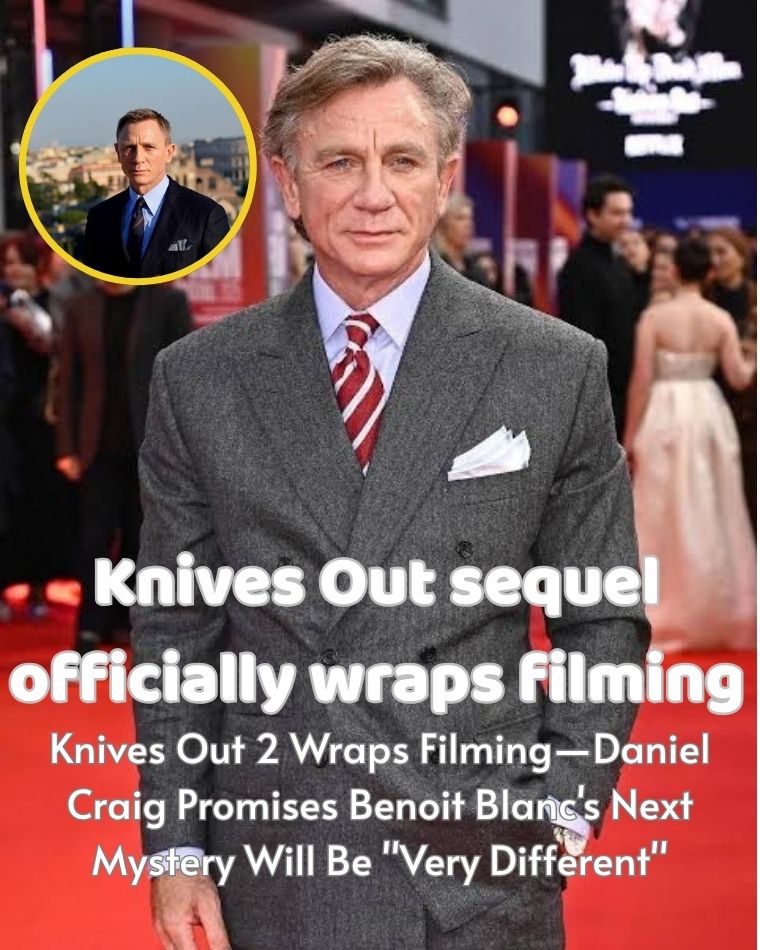
Principal photography on the highly anticipated follow-up to the 2019 box-office smash has officially drawn to a close, marking a major milestone for writer-director Rian Johnson and leading man Daniel Craig. Craig has confirmed that the upcoming sequel will take the gentleman sleuth into entirely uncharted territory while offering audiences an experience distinct from the original. The acclaimed British actor described the new project as something truly unique, promising that Benoit Blanc’s next cinematic chapter will subvert expectations on every level.
Cameras have stopped rolling on the set of the next Benoit Blanc case, signaling the completion of a high-profile production schedule that crossed European borders.
Director Rian Johnson took to social media to officially confirm that his cast and crew had concluded shooting the elaborate murder mystery.
The production journey took the expansive ensemble from the sunny landscapes of Greece all the way to finishing touches in Serbia.
Daniel Craig spoke candidly about the experience of wrapping the film, expressing immense enthusiasm for the completed material.
The actor stated that the creative team had wrapped up filming in Serbia only weeks prior to his public comments.
During conversations about the project, Craig admitted that he found himself thrilled with how the mystery came together under Johnson’s direction.
“Dare I say it’s better?” Craig mused in an interview with Empire while reflecting on the newly completed shoot.
The star quickly tempered his own bold claim by adding that he did not want to tempt fate before audiences had a chance to see it.
What Craig made unmistakably clear, however, was that the second outing does not merely rehash what made the first movie an unexpected pop culture phenomenon.
“It’s different, and that’s the amazing thing,” Craig explained to reporters.
“It’s still a Benoit Blanc mystery, but it’s very different,” the actor emphasized while detailing his excitement for what lies ahead.
For Craig, teaming up once again with Rian Johnson represents one of the most rewarding creative partnerships of his career.
“I’m so lucky to have Rian in my life,” Craig stated regarding their ongoing artistic collaboration.
The actor praised Johnson’s storytelling abilities, calling him a brilliant writer who continuously surprises him on the page.
Craig recalled receiving Johnson’s screenplay for the original 2019 film and feeling astonished by the sheer originality of the detective concept.
He remembered thinking the offer was almost too good to be true when he saw the character’s signature southern accent written into the text.
Now, having returned to that drawl and that idiosyncratic investigative mind, Craig feels that the sequel pushes the entire concept in a refreshing direction.
Cre: Wikimedia Commons
Rebuilding the Whodunit Formula Without Repeating It
When the first Knives Out arrived in cinemas in the autumn of 2019, it breathed fresh commercial life into the classic parlor mystery.
The original film earned rave reviews and collected more than three hundred million dollars worldwide against a modest mid-budget production cost.
Audiences responded enthusiastically to its razor-sharp wit, intricate plotting, and sharp satirical take on familial privilege.
Central to that triumph was Johnson’s deliberate decision to play with narrative expectations rather than simply follow established genre rules.
Instead of hiding the supposed killer until the final five minutes, the initial film revealed the apparent crime early on, transforming the narrative into a tense cat-and-mouse exercise.
That narrative daring earned Johnson an Academy Award nomination for Best Original Screenplay.
Such immense critical acclaim poses an undeniable dilemma for any subsequent chapter.
Sequels that try to photocopy an original runaway hit frequently fall into the trap of diminishing returns.
When viewers already understand the structural tricks of a filmmaker, delivering genuine surprises becomes twice as difficult.
Johnson and Craig recognized from the beginning that trying to recreate the exact atmosphere of the Thrombey mansion would be a creative mistake.
The Massachusetts gothic estate served its thematic purpose, and lingering in that setting would only restrict the detective’s horizon.
By completely shifting the backdrop to sun-drenched European locales, the filmmakers signaled early on that the sequel would possess an entirely different aesthetic cadence.
The visual contrast between gloomy New England woodwork and Mediterranean coastlines underlines Craig’s promise of a different experience.
A change in geography forces a corresponding shift in tone, costume, pacing, and comedic texture.
Blanc remains the connective thread, yet the world surrounding him operates under entirely fresh dramatic rules.
Daniel Craig’s Post-Bond Horizon and Benoit Blanc
The wrap of Knives Out 2 comes at a pivotal historical moment in Daniel Craig’s illustrious acting career.
For fifteen years, the English star served as the face of cinema’s most famous spy, James Bond.
Craig’s tenure across five blockbuster entries redefined Ian Fleming’s secret agent with physical intensity and emotional realism.
That historic chapter reached its official theatrical conclusion with the release of No Time to Die.
Stepping away from Her Majesty’s Secret Service presented Craig with an open artistic landscape that few actors at his level experience.
Rather than retiring from high-visibility franchise cinema, Craig immediately found a second creative home in the guise of Benoit Blanc.
The contrast between the two characters could hardly be more pronounced for an actor seeking reinvention.
Where 007 relied heavily on kinetic brutality, physical combat, and brooding stoicism, Blanc relies entirely on deduction, vocabulary, and social observation.
James Bond existed within severe narrative constraints defined by six decades of studio tradition.
Benoit Blanc, on the other hand, is a completely modern invention, allowing Craig room for eccentric improvisation and lighthearted theatricality.
Instead of enduring brutal physical training regimes, Craig was able to channel his energy into vocal phrasing and comedic timing.
The sleuth’s southern drawl provides Craig with an expressive canvas that feels radically detached from British secret service austerity.
Taking up the detective’s role immediately after hanging up the tuxedo demonstrates a calculated post-Bond career strategy.
Craig has chosen to anchor a new franchise on his own acting terms, prioritizing authorial dialogue and character study over pure spectacle.
Rian Johnson’s Philosophy of the Agatha Christie Tradition
Director Rian Johnson has consistently cited legendary crime novelist Agatha Christie as his foundational guiding light for the series.
Johnson often points out that Christie never wrote true serialized sequels in the modern cinematic sense.
Instead, the queen of mystery used recurring detectives like Hercule Poirot or Miss Marple to anchor completely freestanding books.
Each novel explored a totally different social milieu, a different set of motives, and a completely fresh storytelling mechanic.
One Christie mystery might be a country house puzzle, while another takes place on a train, a riverboat, or a sunlit archaeological expedition.
Johnson has voiced his desire to treat the Benoit Blanc cinematic universe with that exact structural philosophy.
“It’s just what Agatha Christie did,” Johnson previously explained when discussing future installments.
“It’s coming up with a whole new mystery, a whole new location, all new cast, whole new mechanics of the appeal of a mystery,” the director observed.
By treating each movie as an independent standalone novel, Johnson avoids the baggage of convoluted franchise mythology.
Audiences do not need to remember intricate backstory details from the 2019 film to follow what happens in the sequel.
This clean-slate approach grants Johnson total freedom to experiment with subgenres within the mystery umbrella.
He can swing from social comedy to psychological paranoia without violating continuity rules.
The director has emphasized that whodunits are fundamentally about human social behavior under sudden extreme stress.
By throwing Blanc into a new circle of personalities, Johnson creates an entirely fresh laboratory for social satire.
Preserving Benoit Blanc While Reinventing the Suspects
One of the greatest artistic balancing acts in franchise filmmaking is keeping a central protagonist recognizable while surrounding them with novel energy.
If Benoit Blanc changes too much, fans will feel alienated from the quirky investigator they initially embraced.
If nothing around him changes, the narrative runs the risk of feeling predictable and exhausted.
Craig solved part of this challenge by dedicating significant preparation time to ensuring Blanc’s voice and posture remained authentic.
The actor worked carefully to recapture the rhythm of the cadence without turning the character into an exaggerated caricature.
Blanc must remain a serious detective of formidable intellect beneath his flamboyant southern hospitality.
Meanwhile, the supporting cast represents an entirely fresh roster of talent designed to challenge the sleuth in new ways.
The production assembled an impressive group of performers, including Dave Bautista, Edward Norton, Janelle Monáe, Kathryn Hahn, Leslie Odom Jr., Kate Hudson, Madelyn Cline, and Jessica Henwick.
Dave Bautista expressed deep admiration for the sequel’s script during filming, highlighting the richness of the characters.
“I think the characters are just so much more colourful,” Bautista noted when reflecting on the ensemble dynamics.
Leslie Odom Jr. similarly praised the ambition of the production, remarking that the team wanted to up the ante for the audience.
Every new actor brings an idiosyncratic screen persona that forces Blanc to adjust his investigative demeanor.
Interrogating wealthy aristocrats in Massachusetts requires one tactic; interrogating an eclectic circle of modern acquaintances demands another.
Blanc’s charm lies in his ability to read human vanity, and a new group of suspects gives him entirely new vanities to dissect.
The Creative Freedom of Long-Term Collaboration
The decision by Daniel Craig to commit to Benoit Blanc across multiple features speaks volumes about his professional priorities.
Having spent over a decade tied to massive studio machinery, Craig understands the rare luxury of working with an auteur who writes and directs his own material.
Rian Johnson controls the narrative universe from concept to execution, granting Craig a direct line to the writer’s vision.
There are no committees rewriting scenes overnight or conflicting studio mandates dictating character arcs.
Craig has frequently praised Johnson’s clarity of thought and the infectious spirit he creates on set.
Filming in Greece provided an idyllic environment that mirrored the classic ensemble camaraderie of golden-age mystery shoots.
Cast members have spoken warmly about the sense of community forged during the overseas production.
That collective joy translates directly onto the screen, infusing the puzzle with genuine human chemistry.
For Craig, the franchise offers pure acting pleasure without the grinding toll of blockbuster action sequences.
He gets to deliver intricate monologues, dissect clues, and engage in verbal sparring with some of the industry’s finest character actors.
As the project enters its extensive post-production phase, anticipation across the film community will continue to build.
With production officially wrapped in Serbia and Greece, Benoit Blanc is poised to prove that lightning can strike twice in the mystery realm.
Craig’s promise of something “very different” sets a high bar, but it also reflects the supreme confidence of an artist eager to surprise his fans once again.
Để lại một phản hồi