Kansas City Chiefs quarterback Patrick Mahomes has rewritten the modern playbook on major orthopedic rehabilitation following a severe left knee injury. Longtime NFL insider Jay Glazer brought forward behind-the-scenes details showcasing how Mahomes attacked his recovery, regaining significant mobility days after surgery and cementing his rapid return to elite form.
When Patrick Mahomes went down grabbing his left knee during a late-season clash against the Los Angeles Chargers, a collective hush fell over the NFL landscape.
For nearly a decade, the Kansas City Chiefs had enjoyed an uninterrupted era of unprecedented dominance, powered almost entirely by their generational franchise signal-caller.
Subsequent medical evaluations confirmed the worst fears of the coaching staff and supporters: Mahomes had suffered significant ligament trauma, sustaining an anterior cruciate ligament tear alongside damage to his lateral collateral ligament.
In typical professional football circles, an ACL and LCL repair requires an arduous, nine-to-twelve-month physical therapy regimen to restore full lateral cutting and pocket mobility.
Yet, from the moment the diagnosis was rendered, the two-time MVP and multi-time Super Bowl champion took an approach that defied conventional sports medicine wisdom.
Veteran NFL insider Jay Glazer recently pulled back the curtain on Mahomes’ recovery, revealing firsthand observations of a rehabilitation program he described simply as “unreal”.
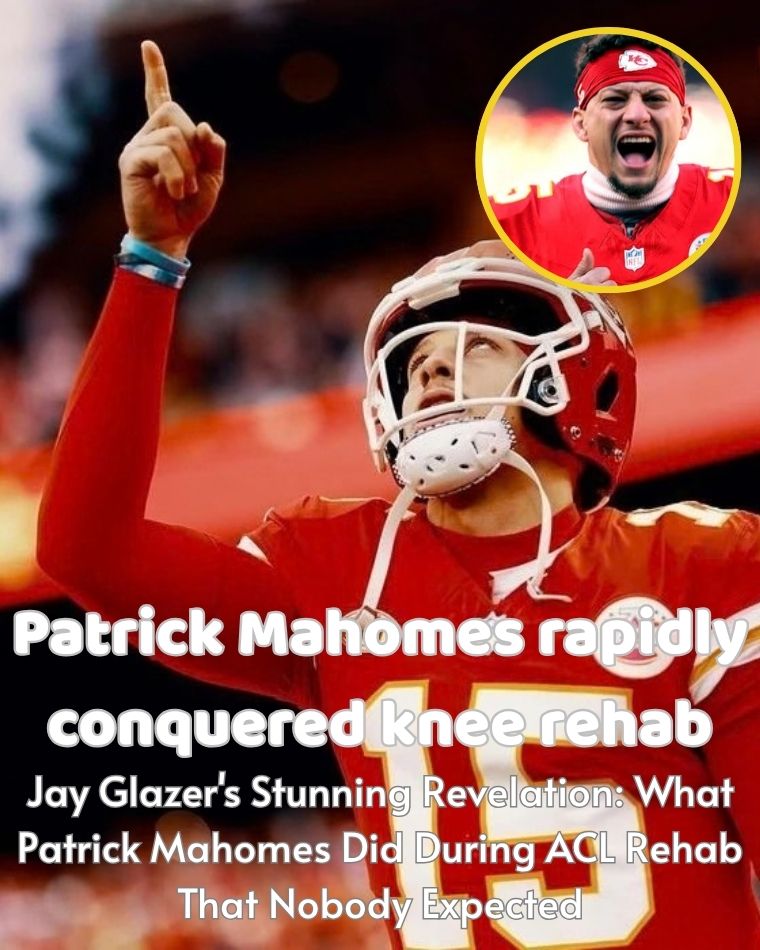
Cre: Wikimedia Commons
Glazer, speaking on his regular media appearances and network features, emphasized that Mahomes’ mindset immediately separated him from ordinary professional athletes facing reconstructed knee joints.
“His pain threshold is different, his work ethic is different,” Glazer shared when assessing why the quarterback was able to accelerate his recovery calendar so dramatically.
The foundational turning point of Mahomes’ rehabilitation came down to the immediate operational timeline established by the Chiefs’ medical staff and surgical consultants.
Rather than delaying the procedure to wait for inflammatory fluid and joint effusion to recede naturally over several weeks, Mahomes underwent surgical repair almost immediately on Monday, December 15.
By operating before extensive localized swelling could lock up the joint, the surgical team protected vital quad muscle activation and preserved baseline neural connectivity.
That decisive surgical scheduling eliminated the common four-week dormant period during which an athlete often suffers severe quadriceps atrophy and soft-tissue stiffness.
According to Glazer, the aggressive push into active motion began almost instantaneously inside the Chiefs’ private facility.
Within barely three to four days following the invasive reconstruction, Mahomes was already sitting on an examination table inside the Kansas City training complex, systematically working through passive and active flexion exercises.
By that Thursday or Friday, the quarterback had already achieved 90 degrees of knee flexion, a milestone that frequently takes ordinary surgical patients anywhere from three to six weeks of painful manipulation.
“He got the surgery before it swelled up,” Glazer highlighted, noting the astonishing pace of the player’s early cellular recovery.
“He was already in the Chiefs’ training room doing rehab, and he had already got his knee bending at 90 degrees at that point,” Glazer continued.
The NFL insider underscored that while modern surgical techniques have advanced rapidly across North American sports, biological healing remains tied directly to an individual’s psychological tolerance and cellular response.
“He’s just different, he heals differently,” Glazer noted when explaining how Mahomes outpaced every statistical tracking model used by sports medicine practitioners.
Head coach Andy Reid was neither surprised by the quarterback’s relentless work ethic nor his defiance of traditional recuperation schedules.
Addressing the media following the initial injury announcement, Reid maintained that Mahomes’ competitive instinct would dictate the pace of his comeback.
“He’ll attack it, just like he does everything else,” Reid told reporters with characteristic calm.
“There have been some pretty good quarterbacks who have had the same injury, and they’ve done pretty well after they came back,” the veteran coach remarked.
Reid pointed out that Kansas City’s comprehensive athletic training infrastructure gave Mahomes the finest physical therapy resources anywhere in professional football.
“He’ll get after it, and he’s got good people here to rehab him; he’ll be right on top of all of that,” Reid affirmed.
Inside the training facility, physical therapists, biomechanists, and strength coaches designed a customized multi-phase program tailored to Mahomes’ unique mechanical requirements.
While pocket passers often rely on linear arm strength and stable balance platforms, Mahomes is renowned across football for his unorthodox throwing platforms, off-platform torques, and chaotic scrambles.
Rebuilding his knee meant preparing the reconstructed ligaments to withstand severe twisting forces, dynamic change-of-direction cuts, and sudden deceleration against oncoming defensive pass rushers.
Daily sessions began in the early morning hours, starting with blood flow restriction therapy to promote muscular hypertrophy without placing excessive mechanical strain on the healing graft.
Mahomes then progressed into hydrotherapy tanks, utilizing underwater treadmills that allowed him to simulate normal dropback mechanics at a fraction of his total body weight.
Throughout each phase, the training staff tracked flexion angles, extension deficits, and bilateral strength symmetry using advanced digital force plates.
Where standard recovery protocols recommend conservative rest intervals between heavy sessions, Mahomes consistently advocated for maximized productive training volume.
Trainers observed a disciplined approach where mental film study was paired simultaneously with seated isometric contractions and upper-body conditioning drills.
Mahomes refused to step away from his role as the locker room general, remaining engaged in offensive scheme adjustments and positional meetings despite being on crutches.
The psychological toll of a catastrophic ligament tear often derails even the most gifted professional athletes, creating fear of reinjury and subconscious hesitation in the pocket.
Yet teammates witnessed a mindset that rejected self-pity from the second the quarterback received the post-game MRI results.
Veteran tight end Travis Kelce and offensive leaders noted that Mahomes set the daily emotional standard inside the rehabilitation wing.
Instead of isolating himself at an off-site private clinic, Mahomes conducted his entire recovery in full view of his teammates at the team headquarters.
Seeing the franchise quarterback grinding through sweat-drenched mobility sets early each morning sent a powerful message across the roster during a difficult stretch of the campaign.
This public display of perseverance reinforced Kansas City’s organizational culture regarding injury management and shared team accountability.
Historically, Mahomes has possessed an extraordinary threshold for physical discomfort, regularly playing through severe ailments that would sideline ordinary starters.
During the 2024 season, he famously battled through an acute high ankle sprain, returning to competition on a condensed short-week schedule to lead the Chiefs on Christmas Day.
Earlier in his career, he shocked the medical community by returning from a dislocated patella in mere weeks, skipping several months of projected recovery time through aggressive rehabilitation.
Glazer noted that this proven track record of rapid cellular regeneration informed his conviction that Mahomes would smash every projected milestone on the 2026 NFL calendar.
While external projections initially questioned whether the quarterback could participate in training camp or be active for opening day in September, Glazer remained unwavering in his optimism.
“At first they were like, ‘Oh, you know, start of the season.’ I would probably hedge on him being back sooner than that—by far—because he just attacks things,” Glazer explained.
As the off-season progressed into spring, the physical markers monitored by the Chiefs’ medical staff confirmed Glazer’s reporting.
Mahomes transitioned effortlessly from straight-line track sprints to full-speed rotational ladder drills and lateral resistance runs.
His functional movement screening demonstrated complete restoration of terminal knee extension alongside zero observable quad asymmetry.
When Kansas City opened voluntary organized team activities and mandatory minicamp, Mahomes was already taking snaps, executing rollout passes, and planting firmly off his left foot without wearing a heavy structural brace.
By the time the Chiefs opened training camp at Missouri Western State University in St. Joseph, the quarterback was moving with complete fluid freedom.
Onlookers and beat reporters noted that his signature scramble-drill improvisation had returned completely intact, with no sign of hesitation or physical compromise.
When Week 1 of the 2026 NFL season kicked off, Mahomes took the field as the undisputed starter, completing a total rehabilitation process that sports commentators had viewed as virtually impossible months prior.
In Kansas City’s early-season slate, the quarterback demonstrated the exact elite playmaking ability that has come to define his legendary tenure under Andy Reid.
From decisive pocket delivery against divisional rivals like the Denver Broncos and Las Vegas Raiders to clutch fourth-quarter drives, Mahomes showed no lingering ill effects from his reconstructed knee.
His passing efficiency, yards per attempt, and off-schedule pocket escapability mirrored his MVP-caliber seasons, silencing any doubts about whether a reconstructed joint would sap his dynamic agility.
The success of Mahomes’ recovery carries massive strategic implications for the Kansas City Chiefs and their sustained championship window.
With significant cap commitments tied to their star quarterback, a compromised or tentative Mahomes would have fundamentally altered the franchise’s offensive philosophy.
Instead, his instantaneous return to full athletic capability reaffirmed Kansas City’s status as perennial contenders in an increasingly competitive AFC landscape.
Beyond the boundaries of Arrowhead Stadium, Mahomes’ case study has sparked vibrant discussions throughout the sports medicine and orthopedic community.
Surgeons and rehabilitation directors are closely examining the benefits of immediate pre-swelling surgical intervention paired with ultra-early post-operative passive mobilization.
For decades, orthopedic dogma dictated prolonged immobilization following major ligament repairs to safeguard the healing surgical graft.
Mahomes’ breakthrough proves that under rigorous clinical supervision, controlled early movement can prevent the muscular atrophy and stiffness that traditionally drag out athlete recovery periods.
Above all else, the narrative confirms what teammates, coaches, and seasoned insiders like Jay Glazer have maintained throughout Mahomes’ storied career.
Physical talent alone does not create dynasties; it is the combination of generational arm skill and an indomitable competitive will that transforms great players into timeless icons.
By facing down one of football’s most feared structural injuries and demolishing every projected recovery timeline, Patrick Mahomes has added another legendary chapter to his athletic legacy.
As the NFL season rolls forward, the Chiefs quarterback stands as living proof that an elite champion’s drive can rewrite the very rules of physical recovery.
Để lại một phản hồi