Kansas City Chiefs star tight end Travis Kelce is setting up a financial transformation that stretches far beyond his career earnings on the gridiron. According to a report by The Times of India, an investment backed by the NFL veteran has achieved an impressive $1.55 billion valuation. This massive corporate milestone highlights a sophisticated approach to portfolio diversification and long-term financial stability.
Travis Kelce has long been celebrated as one of the most dominant tight ends in professional football history.
His legendary career with the Kansas City Chiefs features multiple Super Bowl championships, historic receiving records, and consistent All-Pro selections.
Off the field, his high-profile public appearances and pop-culture presence frequently dominate global media headlines.
Yet away from the bright stadium spotlights and entertainment cameras, Kelce has quietly engineered an aggressive business portfolio.
That business journey reached a significant breakthrough when his recent commercial investment crossed the $1.55 billion valuation threshold.
According to reporting from The Times of India, this valuation represents a watershed moment in Kelce’s off-field wealth creation.
While sports commentators continually dissect his physical stamina and route-running, business analysts are now turning their attention to his commercial foresight.
The sheer scale of a $1.55 billion corporate valuation signals extraordinary market momentum and underlying commercial strength.
It firmly establishes Kelce not just as a prominent pitchman, but as an increasingly capable equity investor.
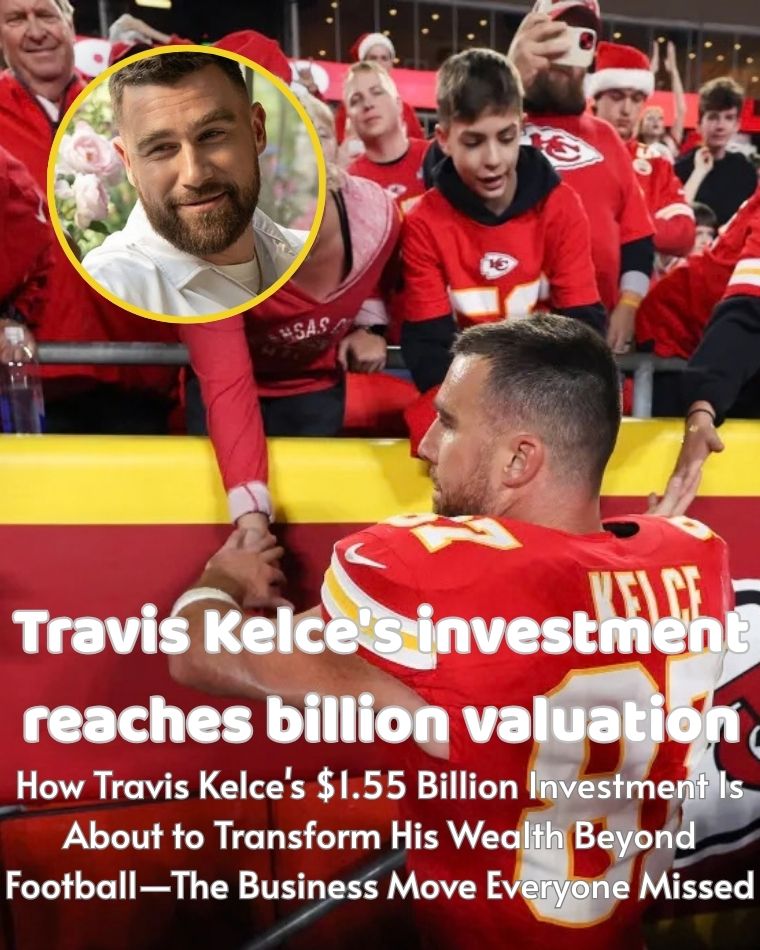
Cre: Wikimedia Commons — Creative Commons Attribution-Share Alike
Many professional athletes rely exclusively on traditional wage contracts and passive brand endorsement deals to build their personal wealth.
Kelce, by contrast, has deliberately directed capital toward commercial enterprises capable of exponential growth.
The substantial $1.55 billion valuation of this venture underscores a decisive transition toward long-term equity ownership.
In modern finance, equity investments allow athletes to build enduring wealth that compounds independently of physical labor.
Athletic paychecks inevitably cease when a player hangs up their cleats, but equity stakes continue producing returns indefinitely.
Kelce appears acutely aware of this fundamental economic reality.
His venture strategy emphasizes assets that retain lasting enterprise value rather than short-lived product endorsement cycles.
The Times of India emphasized that this major commercial move largely flew under the radar compared to his sports triumphs and personal headlines.
The financial press frequently focuses on flashy sponsorship campaigns, often overlooking strategic private equity positions.
Yet private market holdings often generate the most substantial financial returns over extended timelines.
Achieving a billion-dollar valuation puts any business venture into an elite corporate bracket.
When connected to an active sports star, it exemplifies how contemporary athletes are reshaping the parameters of personal financial management.
For Kelce, the timing of this corporate ascent is equally striking.
The valuation surge arrives right alongside his ongoing historic athletic performances during the 2026 NFL campaign.
On the football field, Kelce continues to shatter franchise and league receiving benchmarks.
Week after week, he executes complex tactical schemes while battling elite defensive alignments.
Yet the expansion of his $1.55 billion investment venture did not rely on whether he caught a touchdown pass on any given Sunday.
The investment enterprise succeeded based on business fundamentals, strategic execution, and market expansion.
This structural separation between athletic performance and capital appreciation is the hallmark of modern financial design.
If a player suffers an unexpected physical injury, their game checks might be protected by insurance, but their future contract value declines.
Enterprise equity, however, is immune to hamstring strains or turf-toe ailments.
Kelce’s financial advisors have evidently structured his business footprint so that his net worth expands regardless of game outcomes.
His ability to run routes at an elite level while simultaneously holding stakes in a billion-dollar asset illustrates a dual-track career model.
Examining the financial framework clarifies what this development actually means for Kelce’s overall balance sheet.
The $1.55 billion figure represents the enterprise valuation of the corporate investment entity itself.
It does not indicate that Kelce personally possesses $1.55 billion in liquid cash or personal net worth.
The public report does not disclose the precise percentage of Kelce’s equity ownership in the firm.
Nevertheless, seasoned business observers understand that holding even an early minority stake in an organization valued at $1.55 billion creates substantial personal wealth.
Early institutional and strategic investors frequently see their equity appreciate rapidly during major corporate funding and valuation rounds.
A modest fractional stake in a company of this scale equates to tens of millions of dollars in net equity value.
Moreover, high valuations open lucrative future paths for major liquidity events, corporate acquisitions, or public market listings.
These financial vehicles create transformative windfalls that dwarf typical annual athletic salaries.
Even within the upper echelon of NFL compensation, player salaries remain constrained by team salary caps and collective bargaining agreements.
The top-earning NFL tight ends earn between $15 million and $20 million annually before taxes, agent fees, and living expenses.
While that income provides generational luxury, it carries a strict mathematical ceiling over a typical decade-long career.
Commercial private equity, on the other hand, possesses no regulatory salary cap.
By entering a vehicle now valued at $1.55 billion, Kelce accessed capital appreciation that traditional NFL contracts cannot replicate.
This approach reflects the broader financial evolution of 21st-century professional sports icons.
For decades, retiring athletes faced well-documented financial crises shortly after their final games.
Historical statistics famously showed that a startling percentage of former professional players faced financial hardship within five years of retirement.
Many had concentrated their capital in depreciating luxury assets or ill-advised business schemes led by inexperienced associates.
Modern athletes, however, have studied those cautionary tales and adopted disciplined wealth preservation frameworks.
Kelce belongs to a cohort of forward-thinking athletes who view their sports earnings as initial seed capital rather than permanent income.
By leveraging their fame and disposable income early, they acquire access to exclusive, institutional-grade commercial deals.
This tactical transition places Kelce in the company of premier athlete-investors like LeBron James, Kevin Durant, and Magic Johnson.
LeBron James famously secured a minority equity stake in Liverpool Football Club and took an early ownership position in Blaze Pizza.
Those strategic equity commitments transformed James from a well-paid basketball superstar into a verified billionaire.
Similarly, NBA superstar Kevin Durant established Thirty Five Ventures to invest in early-stage fintech, media, and consumer brands.
Durant recognized years ago that investing capital into rapidly expanding technological platforms offered far greater upside than traditional sneaker commercials.
In the NFL, legendary quarterback Patrick Mahomes—Kelce’s long-time teammate—has assembled minority ownership stakes across multiple professional sports franchises.
Kelce’s involvement in an entity that has achieved a $1.55 billion valuation reflects a similar investment philosophy.
He is not merely collecting an upfront promotional fee to pose with a consumer product.
He is positioning himself as an equity participant whose net worth compounds alongside the company’s valuation.
This structural shift aligns athlete incentives directly with corporate founders and venture capitalists.
When an athlete owns a piece of the underlying business, their active advocacy drives tangible enterprise value that circles directly back to their portfolio.
The Times of India report clarifies that this milestone is the fruit of deliberate business planning across multiple years.
Kelce has steadily built out a dedicated advisory team capable of vetting sophisticated commercial prospects.
Professional athletes receive countless investment pitches every month, ranging from speculative real estate to unproven startup applications.
Navigating these proposals requires disciplined due diligence and ruthless risk assessment.
Backing a commercial venture that subsequently reaches a $1.55 billion valuation indicates that Kelce’s advisory inner circle possesses authentic business discernment.
They identified an asset with genuine product-market fit, scalable unit economics, and resilient leadership.
Long-term wealth strategy requires confronting the brief nature of an athletic career.
The average NFL career lasts barely over three years due to extreme physical attrition and fierce roster competition.
Even an all-time great tight end like Kelce, whose durability and athletic longevity are exceptional, faces the reality of the biological clock.
A professional athlete in his mid-30s inevitably approaches the concluding chapters of his on-field career.
Transitioning gracefully into post-football life requires having substantial operational interests and wealth engines ready beforehand.
Waiting until retirement day to begin constructing a post-sports commercial career is frequently a recipe for disappointment.
By executing this major investment play well before hanging up his helmet, Kelce ensures that his financial trajectory will accelerate rather than decline when he retires.
His post-playing days will not be defined by nostalgia or reliance on speaking fees.
Instead, he will step directly into an expansive business empire featuring seasoned commercial holdings.
This foresight provides total psychological and professional autonomy.
An athlete with immense equity wealth can choose their future endeavors purely based on passion rather than monetary necessity.
Whether Kelce chooses to pursue media broadcasting, team ownership, philanthropic foundations, or private investing, his capital base is fortified.
This stability enables creative freedom and high-leverage commercial negotiations in every future venture.
The broader business community is watching this development with intense interest.
Modern venture capital firms and private equity groups increasingly view tier-one athletes as invaluable strategic partners.
An athlete provides organic cultural reach, brand credibility, and marketing distribution that money cannot easily purchase.
When combined with institutional capital and operational leadership, this athlete-driven distribution can propel companies into hyper-growth.
The $1.55 billion valuation achieved by Kelce’s investment demonstrates the immense power of this collaborative model.
It proves that an elite athlete’s commercial influence can help transform an emerging business into an established market titan.
This landmark milestone also signals a changing of the guard in the culture of professional football locker rooms.
Younger NFL draft picks enter the league today with a much higher degree of financial literacy than previous generations.
They watch veterans like Kelce build diversified portfolios and immediately seek to emulate those strategies.
Discussions around contract negotiations are increasingly shifting toward equity participation, licensing agreements, and intellectual property ownership.
Players want to own the platforms they build and share in the enterprise value they create for corporate partners.
Kelce’s high-profile business win offers a practical blueprint for this emerging generation of athletes.
It demonstrates that an athlete does not have to compromise their on-field greatness to achieve unprecedented off-field business success.
Kelce did not allow his commercial interests to become a distraction; he utilized his prime athletic window to maximize his commercial leverage.
Throughout the Chiefs’ championship campaigns, he maintained obsessive focus on game execution while his business team managed his investment portfolio.
The outcome is an enviable financial position that sets a benchmark across professional sports.
As the sports economy continues its rapid convergence with global finance and entertainment, Kelce’s portfolio stands as a case study in modern wealth building.
His transition from a third-round draft selection out of the University of Cincinnati to an equity stakeholder in a $1.55 billion enterprise is remarkable.
It underscores the limitless financial horizons available to athletes who balance athletic excellence with sound capital allocation.
Moving forward, the business trajectory of this $1.55 billion venture will be monitored just as closely as Kelce’s football box scores.
Future capital rounds, expansion initiatives, and potential public offerings will continue to shape his financial legacy.
One fact remains certain: Travis Kelce has permanently expanded the definition of what an NFL superstar can achieve in the world of high finance.
His football legacy is already permanently secured in Canton, Ohio, but his wealth story is only just getting started.
Để lại một phản hồi