The major-label debut of Eminem arrived at the end of the millennium as a seismic cultural shockwave. By introducing a provocative alter ego and groundbreaking sound, the record redefined rap music, challenged the boundaries of free speech, and catapulted an underground artist into permanent global stardom.
On February 23, 1999, an underground battle rapper from Detroit officially released his major-label debut album, titled “The Slim Shady LP.”
The release instantly shattered the conventional boundaries of mainstream hip-hop.
Prior to this landmark day, Eminem had struggled to capture wide national attention outside of competitive local battle circuits.
With the arrival of this studio record, the Detroit artist transformed into an overnight sensation across the world.
The record functioned as an explosive cultural milestone that reshaped late-nineties pop culture.
Listeners were exposed to a unique voice that refused to conform to traditional radio expectations.
The project quickly established Eminem as one of the most polarizing and compelling musicians of his generation.
Within weeks of its street date, the album dominated critical discussions across newspapers, television, and radio stations.
The music industry quickly realized that a permanent shift in pop music was unfolding.
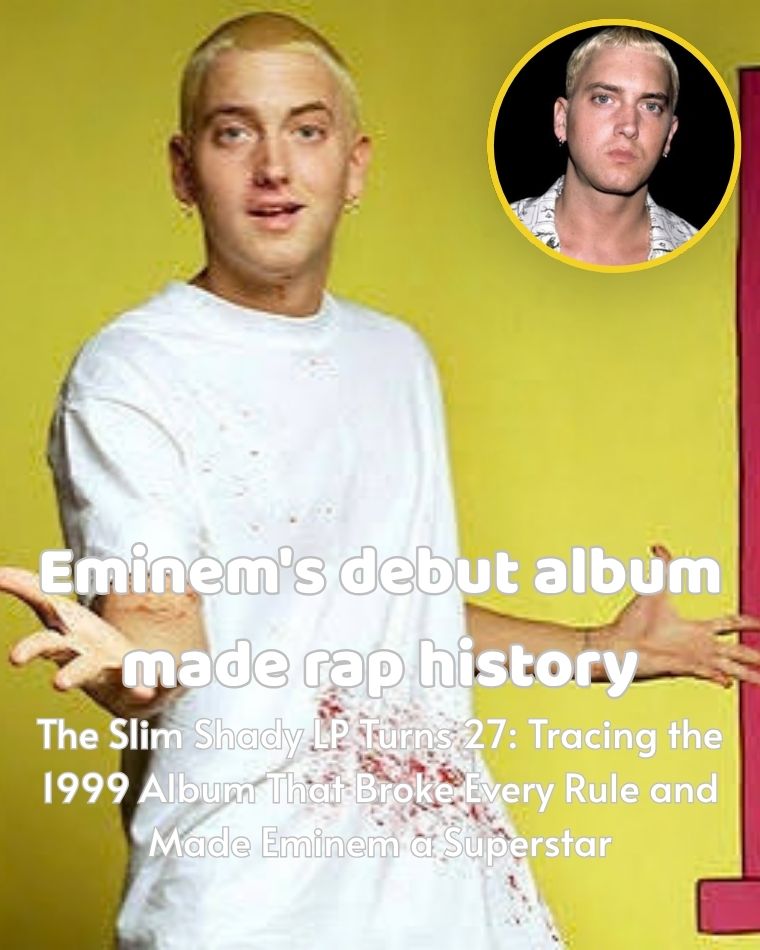
Cre: Interscope Records / Aftermath Entertainment
A central architect behind the sonic identity of the record was legendary West Coast producer Dr. Dre.
Dr. Dre had recently founded Aftermath Entertainment and was searching for an undeniable creative spark.
When Dr. Dre first heard Eminem’s demo tape, he recognized an elite technical lyricist with raw potential.
Their creative partnership inside the recording studio produced an undeniable, potent musical chemistry.
Dr. Dre took on the primary production duties, crafting minimalist, infectious beats that complemented rapid rhyming schemes.
The veteran producer provided mentorship that grounded Eminem’s chaotic energy into cohesive musical compositions.
Under Dr. Dre’s guidance, the production blended heavy boom-bap rhythm sections with haunting synth lines and melodic hooks.
This collaboration granted the Detroit emcee immediate artistic credibility among hip-hop purists and mainstream listeners alike.
Dr. Dre believed that undeniable talent would ultimately triumph over corporate skepticism and industry resistance.
His conviction proved entirely accurate as soon as the first studio recordings were finalized and prepared for distribution.
The Birth of the Slim Shady Alter Ego
Central to the concept of the record was the introduction of the fictional alter ego named Slim Shady.
Eminem created the Slim Shady persona to act as a darker, comedic, and violently satirical mouthpiece.
Through this distinct character, the rapper found full creative freedom to explore taboo subjects without self-censorship.
The persona allowed him to address personal trauma, economic poverty, and social dysfunction using hyperbolic satire.
By adopting this mask, Eminem could vent genuine frustrations while filtering them through cartoonish absurdism.
The alter ego operated with sharp comic timing, delivering outrageous claims with a straight face.
Critics and audiences found themselves debating where Marshall Mathers ended and Slim Shady began.
This calculated tension gave the record an unpredictable edge that kept listeners hanging on every word.
The creation of the character served as an artistic lightning rod that absorbed intense scrutiny.
Ultimately, the alter ego enabled high-level storytelling that distinguished Eminem from every peer in the genre.
The record’s flagship track, “My Name Is,” functioned as the ultimate introductory statement to global audiences.
Built around a prominent instrumental sample, the track immediately captured the imagination of music lovers everywhere.
The song presented humorous autobiographical snippets alongside intentionally shocking one-liners.
Radio stations across the United States added the single to heavy rotation almost immediately.
The accompanying music video for “My Name Is” became a staple on MTV’s popular program, Total Request Live.
Visual sketches in the video parodied political figures, talk show hosts, and iconic pop culture moments.
The constant television exposure ensured that Eminem’s bleached blonde hair and trademark aesthetic became instantly recognizable.
For millions of teenagers, the music video served as an open door into competitive hip-hop lyricism.
The record showed that humor and intricate multi-syllabic rhyming could conquer mainstream video channels.
“My Name Is” solidified its place as the definitive breakthrough single of the late nineteen-nineties.
Beyond the lead single, tracks like “Guilty Conscience” showcased unmatched lyrical interplay between teacher and student.
The song featured Eminem and Dr. Dre acting as the evil and good moral voices on people’s shoulders.
The conceptual narrative structure illustrated an imaginative leap forward for mainstream rap storytelling.
Meanwhile, controversial narrative songs like “97′ Bonnie & Clyde” pushed psychological suspense to cinematic levels.
The dark storyline demonstrated a chilling commitment to character development and dramatic tension.
Each composition throughout the tracklist highlighted unprecedented technical skill embedded within deliberately provocative writing.
Complex internal rhyme schemes were delivered with effortless flow and precise rhythmic cadences.
Even the project’s harshest critics could not deny the exceptional vocal mechanics on display.
Eminem demonstrated that shock value, when paired with genuine craft, creates unforgettable art.
The album demonstrated that lyrical complexity still had a major place at the very top of the charts.
The commercial reception of “The Slim Shady LP” rapidly exceeded standard industry forecasts.
The album achieved triple platinum certification from the Recording Industry Association of America.
Millions of physical compact discs were sold across retail stores worldwide within its first year on shelves.
This immense commercial performance proved that controversial music could generate historic retail revenue.
Mainstream record executives watched in astonishment as suburban and urban demographics embraced the same record.
The staggering sales figures permanently shifted corporate marketing strategies across major record labels.
Eminem proved that countercultural art could outshine sanitized pop acts on the Billboard charts.
The album’s financial triumph paved the way for unconventional artists to secure major label backing.
It proved that listeners were hungry for visceral authenticity rather than focus-grouped commercial products.
Triple platinum status was merely the opening chapter of Eminem’s commercial dominance.
Critical Acclaim and the Historic Grammy Win
Critical accolades quickly followed the tremendous commercial velocity of the project.
At the 42nd Annual Grammy Awards, “The Slim Shady LP” earned Eminem the Grammy Award for Best Rap Album.
Winning Best Rap Album represented a historic moment of institutional validation from the music academy.
The single “My Name Is” simultaneously captured the Grammy Award for Best Rap Solo Performance.
Industry veterans recognized that beneath the controversial shock value lay world-class musicianship.
The recognition cemented Eminem’s status as a legitimate technical titan of the hip-hop genre.
The awards ceremony confirmed that the underground Detroit lyricist had conquered the pinnacle of the music industry.
Peers and competitors acknowledged that his rapid-fire delivery and vivid songwriting had altered the landscape forever.
The prestigious accolades elevated the recording from a novelty phenomenon to an acclaimed modern classic.
His Grammy victories established that artistic merit could shine through the fiercest public controversies.
With widespread exposure came intense national debates regarding censorship and artistic expression.
The album’s unapologetic examination of taboo themes ignited outrage among political leaders and family advocacy organizations.
Watchdog groups held public hearings arguing that the explicit content was inappropriate for younger listeners.
Critics questioned the moral responsibilities of recording artists and major corporate entertainment distributors.
Calls for retail bans and strict legislative restrictions on physical album sales surfaced across several states.
Eminem defended his work by asserting that his lyrics represented dark satire rather than literal calls to action.
He consistently maintained that musical storytelling should be granted the same creative license as Hollywood films.
The cultural clash sparked thoughtful discussions among scholars about First Amendment protections in modern entertainment.
Journalists debated whether censoring aggressive art merely concealed underlying societal anxieties and economic hardships.
The album became a prime case study in the eternal struggle between artistic freedom and societal expectations.
The controversy only served to amplify the public’s fascination with the young Detroit artist.
Attempts to silence the provocative lyrics drove listeners toward buying the project in record numbers.
Young audiences viewed the pushback from authority figures as confirmation of the music’s uncompromising honesty.
The resistance illustrated the timeless phenomenon of moral panics elevating youth-driven artistic movements.
Instead of derailing his trajectory, the widespread condemnation solidified Eminem’s status as an anti-establishment icon.
The cultural firestorm demonstrated that genuine artistic disruption always generates institutional panic.
The record remained permanently etched in the cultural lexicon as a symbol of rebellion.
Sociologists continue to analyze the release as a pivotal moment in the evolution of modern American media.
The national dialogue proved that hip-hop had become the most consequential cultural force in the nation.
Eminem stood firmly at the center of that dialogue, refusing to soften his uncompromising artistic perspective.
“The Slim Shady LP” established the foundational blueprint for the entirety of Eminem’s subsequent career.
The masterclass in marketing, technical precision, and fearless honesty set the stage for upcoming diamond-certified masterpieces.
Every subsequent studio album drew upon the stylistic foundation forged throughout those original recording sessions.
The LP proved that raw technical ability combined with unvarnished storytelling could overcome any industry obstacle.
Eminem established that artists could confront uncomfortable realities without sacrificing lyrical ingenuity.
Generations of subsequent rap performers cite the groundbreaking project as their direct primary inspiration.
The record expanded the acceptable thematic boundaries of popular music, permitting artists to be imperfect and human.
Decades after its original street date, the album’s impact remains deeply embedded in the DNA of contemporary music.
The landmark release demonstrated that genuine artistic conviction can dismantle corporate conformity and alter music history forever.
February 23, 1999, stands as the unforgettable day when Slim Shady introduced his chaotic genius to the world.
Để lại một phản hồi