Director Ridley Scott’s 1991 road drama Thelma & Louise introduced the world to a magnetic new screen talent in a motel room encounter that changed cinema history.
Opposite Academy Award winner Geena Davis, an unknown Brad Pitt delivered an effortlessly charming performance that launched his career into global superstardom.
Their dynamic remains one of modern Hollywood’s most talked-about breakout moments, built on raw screen presence and an unforgettable on-screen balance of seduction and betrayal.
The Serendipitous Casting of J.D.
Every legendary cinematic breakthrough begins with an elusive search for the right face and energy.
In the early planning stages of Thelma & Louise, director Ridley Scott needed an actor to embody J.D., a handsome hitchhiker who crosses paths with two runaway women.
The character required an uncommon blend of innocent boyish charm, disarming warmth, and underlying danger.
Hollywood was filled with ambitious young men eager to read for Ridley Scott, but few possessed the natural magnetism required to make a brief appearance unforgettable.
Brad Pitt arrived at the casting process as an obscure talent seeking his first major opportunity on the big screen.
Before this project, Pitt had worked steadily in minor television roles, commercial spots, and uncredited background appearances.
He lacked mainstream recognition, industry influence, and the protection of an established film resume.
Yet the moment Pitt auditioned, Ridley Scott recognized an instinctual charisma that cameras immediately amplify.
Pitt’s relaxed posture and easy cadence set him apart from other candidates who approached the part with excessive theatricality.
The filmmaker understood that the actor portraying J.D. needed to disarm the audience instantly without speaking lengthy paragraphs of exposition.
Scott decided to trust the relative newcomer with the pivotal supporting role.
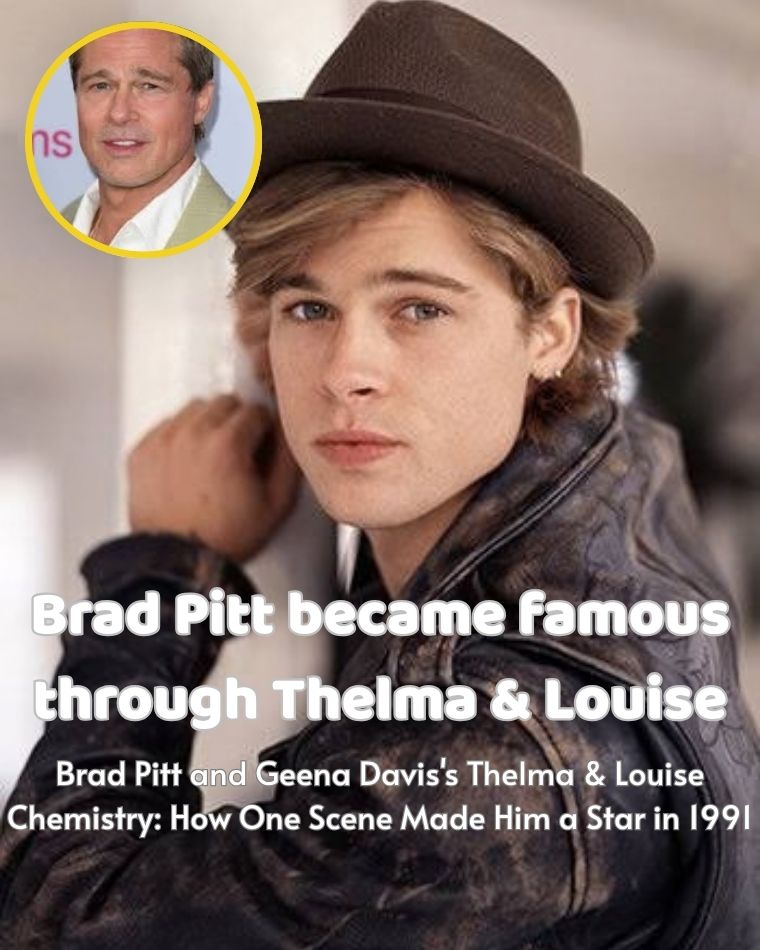
Cre: Wikimedia Commons — Creative Commons Attribution-Share Alike 4.0 International
An Unlikely Pairing Across Experience Levels
When filming commenced, the power balance on set appeared dramatically skewed in favor of the established cast.
Geena Davis was already an accomplished industry figure and a respected Academy Award winner for her acclaimed work in The Accidental Tourist.
Davis possessed proven technical range, impeccable comedic timing, and deep dramatic vulnerability.
She understood how to navigate major studio productions, calibrate emotional depth, and manage camera angles alongside veteran filmmakers.
Pitt, by contrast, was stepping onto a massive production with everything to prove and zero institutional backing.
Working opposite an Oscar winner could easily have overwhelmed an inexperienced performer.
A less confident actor might have shrunk beneath the gravity of Davis’s established authority or tried too hard to dominate the frame.
Instead, Pitt treated the collaboration with an easygoing warmth that matched his character’s freewheeling outlook.
Davis responded with remarkable generosity, creating a creative partnership where both actors fed off each other’s natural energy.
Rather than competing for attention, the two performers established an effortless dialogue anchored by subtle expressions and mutual respect.
Davis held her own completely against Pitt’s rising star power, ensuring the emotional stakes of the scene belonged firmly to her character, Thelma.
The collaboration proved that Pitt had the rare ability to share a frame with seasoned industry royalty without disappearing into the background.
The Anatomy of the Motel Room Sequence
The pivotal moment of Pitt’s performance unfolds within the tight confines of a modest motel room.
This extended sequence was conceived to test Thelma’s boundaries and awaken her suppressed desire for freedom and adventure.
J.D. arrives at the room dripping with charm, carrying his signature cowboy hat and a hair dryer used playfully as a mock pistol.
The scene did not rely on dense literary dialogue or heavy dramatic monologues.
Instead, the magic of the sequence relied almost entirely on body language, timing, and magnetic physical confidence.
Pitt brought an easy rhythm to J.D.’s movements, casually spinning props and offering a teasing, crooked smile that instantly dissolved tension.
Every gesture felt unforced, as though the actor were lounging in his own living room rather than executing calculated choreography under hot studio lights.
Davis played Thelma’s awkwardness and excitement with sublime comedic delicacy.
Her reactions provided the perfect canvas for Pitt’s relaxed bravado, making the sudden romantic spark feel completely spontaneous and earned.
The sequence gave audiences a masterclass in playful on-screen romance, built upon gentle pacing and teasing exchanges.
Viewers watched two characters connect through lighthearted laughter before the atmosphere shifted into genuine intimacy.
The sequence proved that cinematic chemistry cannot be manufactured through dialogue alone; it requires an organic spark between two actors who listen to one another.
Walking the Tightrope Between Charm and Betrayal
The fundamental narrative requirement of J.D. was tricky: he had to win Thelma’s heart while remaining inherently untrustworthy.
If Pitt played the character with obvious sleaziness, Thelma would look foolish for letting her guard down.
If he played him as an entirely noble romantic hero, his subsequent betrayal would feel completely unearned and inconsistent.
Pitt had to strike an instinctual balance between seductive charm and reckless opportunism.
He made J.D. feel like a wandering drifter who harbored genuine fondness for Thelma, even while living by his own dishonest street code.
The actor infused the character with enough warmth to make Thelma’s infatuation entirely believable to anyone watching from the dark of a cinema.
Audiences understood why she surrendered her caution to this charismatic traveler with the gentle drawl and smiling eyes.
At the same time, Pitt maintained a subtle, mischievous edge that hinted at J.D.’s unpredictable wanderlust.
He was a charming thief who moved through the world taking whatever crossed his path, leaving fond memories and broken promises behind.
When the inevitable betrayal occurs and Thelma discovers her money is gone, the tragedy carries real emotional weight precisely because Pitt made J.D. so captivating.
The audience feels the sting of his theft, but they cannot entirely despise him because of the joy he briefly gave her.
Striking that psychological balance was a testament to Pitt’s intuitive understanding of character nuance at that early stage of his career.
Ridley Scott’s Eye for Unvarnished Presence
A director’s belief in an actor often makes the difference between an unremarkable scene and a historic cultural moment.
Ridley Scott was celebrated for his meticulous visual compositions and his uncompromising cinematic vision across landmark films like Alien and Blade Runner.
In Thelma & Louise, Scott turned his lens toward human relationships and the sweeping landscapes of the American Southwest.
When directing Pitt, Scott opted not to overburden the young actor with rigid mechanical instructions.
The director recognized that Pitt’s primary asset was his effortless, relaxed aura and unmanufactured physical magnetism.
Scott framed the motel room sequence to showcase Pitt’s physical confidence, letting the camera linger on his expressions and casual posture.
The filmmaker understood the power of understatement in commercial storytelling.
By allowing Pitt and Davis to establish their own playful cadence, Scott captured lightning in a bottle.
The director gave Pitt the freedom to bring an authentic, unpretentious swagger that felt distinctly modern for the dawn of the 1990s.
Scott’s keen instinct proved correct: the camera loved Brad Pitt, and every second he spent on screen felt charged with potential.
The May 1991 Theatrical Sensation
When Thelma & Louise premiered in theaters across North America in May 1991, it sparked an immediate cultural phenomenon.
The film ignited furious debates regarding its bold themes of female friendship, independence, and justice on the open road.
Critics lined up to shower praise upon the powerful leading performances of Geena Davis and Susan Sarandon.
Yet amidst the passionate critical discussion surrounding the central duo, another conversation began taking hold across the industry.
Virtually every review, entertainment column, and viewer discussion circled back to the striking young actor in the cowboy hat.
Brad Pitt’s brief appearance in the motel room dominated conversations about the movie’s most memorable scenes.
Audiences walked out of theaters asking who the magnetic actor was and where he had come from.
His screen time represented only a small fraction of the film’s total running length, yet his presence hung over the narrative like a revelation.
In an era before viral internet clips and social media fanfare, word of mouth alone transformed Pitt into an overnight sensation.
Moviegoers were captivated by his physical confidence, light comic timing, and the effortless masculine charisma he projected on the silver screen.
Almost overnight, the unknown television extra had become the most sought-after new discovery in Hollywood.
Studio heads and casting directors suddenly realized they were looking at a bona fide movie star waiting in the wings.
Redefining Hollywood Masculinity for the 1990s
Pitt’s emergence in Thelma & Louise arrived at a transitional juncture in modern cinema history.
The 1980s had been dominated by heavily muscled action heroes who solved narrative problems with sheer force and aggressive bravado.
Pitt brought an entirely different energy to the screen, characterized by easygoing southern charm and disarming playfulness.
His physical confidence was undeniable, but it was balanced by a self-deprecating humor that made him approachable rather than intimidating.
He did not rely on aggressive posturing to establish dominance over the camera.
Instead, Pitt leaned on teasing charm, gentle laughter, and an expressive, observant stillness.
This combination of rugged looks and lighthearted charm struck an immediate chord with male and female audiences alike.
He represented a new archetype for leading men heading into the vibrant independent and studio renaissance of the 1990s.
His performance demonstrated that an actor could project irresistible sexuality while remaining grounded, funny, and naturally human.
The motel room sequence served as a visual mission statement for the kind of star Pitt would become over the subsequent decades.
Launching a Legendary Screen Career
The fallout from Thelma & Louise altered the trajectory of Brad Pitt’s professional life forever.
Before the film hit theaters in May 1991, Pitt was hustling for any role that would keep him working in Los Angeles.
After the film opened, Hollywood’s most prestigious directors and production houses came knocking at his door.
The industry understood that Pitt’s impact in the film was no fluke; it was the arrival of a generational screen presence.
Within a short few years, Pitt would capitalize on this breakthrough momentum with a succession of era-defining projects.
He ventured into complex character studies, sweeping historical dramas, and challenging auteur-driven thrillers.
Yet through all his subsequent critical acclaim, industry awards, and box-office records, Pitt’s foundational appeal remained tied to the qualities he displayed alongside Geena Davis.
His ability to communicate depth with minimal dialogue, his unforced screen presence, and his instinctive timing were all evident in that single motel sequence.
The film demonstrated that true charisma cannot be faked or manufactured by an advertising campaign.
It is an innate quality that commands attention whenever an actor steps into the frame, regardless of how small the role might be on paper.
Pitt seized his moment with absolute precision, turning a supporting character into an enduring cultural touchstone.
The Chemistry Snapshot That Still Resonates
Decades after its original premiere, Thelma & Louise continues to stand as a landmark achievement in modern American cinema.
Scholars, film enthusiasts, and new generations of moviegoers continue to revisit the story of two women who refused to compromise their dignity.
And whenever the conversation turns to the film’s artistic highlights, the brief romance between Thelma and J.D. remains central to the discussion.
Their dynamic is universally remembered as one of cinema’s most iconic brief pairings.
It serves as a textbook example of how two talented actors can elevate a short scene into an enduring cultural moment.
Geena Davis’s seasoned generosity provided the perfect foundation for Pitt to shine, while Pitt’s magnetic energy brought out a vibrant joy in Davis’s performance.
Together, they created a moment of pure cinematic magic that feels as fresh and electric today as it did in the spring of 1991.
That brief motel sequence remains the ultimate snapshot of an artist on the verge of greatness, stepping out from the shadows into the blinding light of movie history.
Để lại một phản hồi