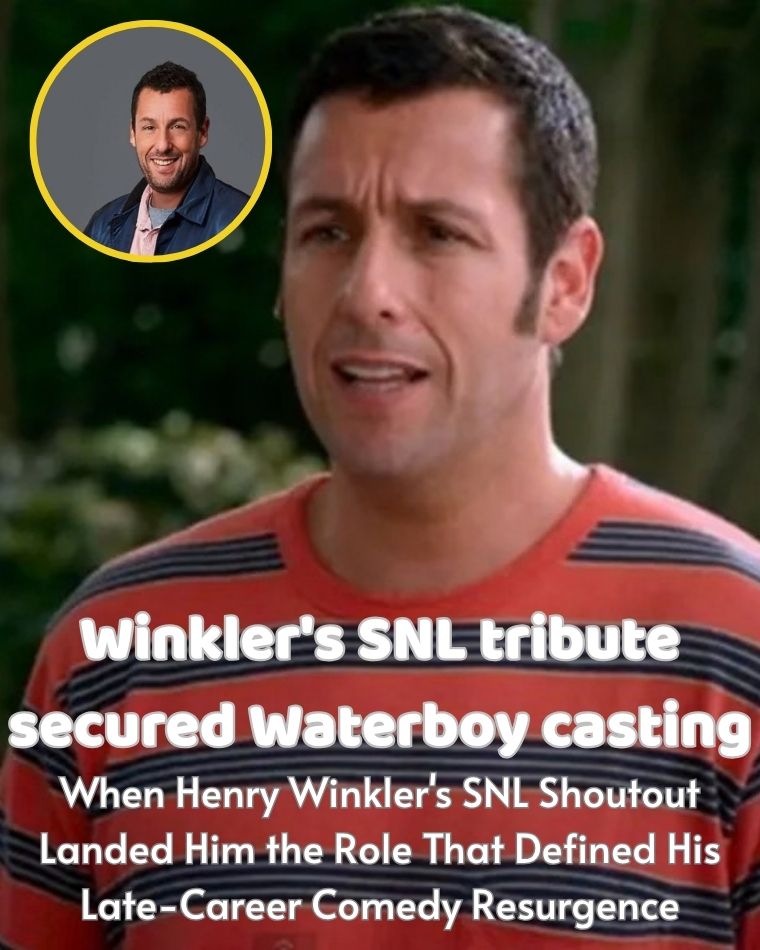
A spontaneous on-air moment during Saturday Night Live catalyzed an enduring Hollywood creative partnership between Adam Sandler and Henry Winkler.That television connection ultimately paved the way for Winkler’s casting as Coach Klein in the blockbuster 1998 comedy The Waterboy.The unexpected collaboration demonstrated how mutual admiration between two distinct generations of comedic talent could yield enduring cinematic magic.
The Unlikely Genesis of an Unforgettable Partnership
Show business relationships frequently blossom from formal auditions, high-stakes boardroom meetings, and agency networking.
Yet some of the most memorable casting triumphs in cinematic history emerge from spontaneous gestures of mutual respect.
The creative union between Adam Sandler and veteran actor Henry Winkler originated precisely from such an organic spark.
During an iconic segment on NBC’s Saturday Night Live, Sandler performed his celebrated musical sketch, The Chanukah Song.
The humorous track playfully cataloged prominent cultural figures and Jewish entertainment icons to bring laughter to viewers worldwide.
Sandler intentionally incorporated a lyrical reference directly honoring Winkler during the broadcast.
The live television lyric caught Winkler’s attention and prompted an immediate emotional reaction from the established star.
Rather than treating the high-profile shoutout as ordinary parody, Winkler viewed it as an endearing expression of comic affection.
He made the conscious decision to reach out directly to Sandler to convey his personal gratitude.
Winkler picked up the telephone and contacted Sandler simply to say thank you for the clever tribute.
That brief telephone conversation bridged the gap between an established comedy giant and a rising star redefining modern humor.
It laid the cornerstone for mutual trust, camaraderie, and future professional synergy.
Cre: Wikimedia Commons — Super Festivals (CC BY 2.0)
Bypassing the Traditional Casting Gauntlet
In the fast-moving machinery of late-1990s studio filmmaking, securing a pivotal role in a major comedy normally required multiple rounds of auditions.
Established performers and rising comedic actors typically read scenes, negotiated screen tests, and awaited executive approvals.
When Sandler began developing his sports comedy The Waterboy for its eventual 1998 theatrical run, the traditional protocol dissolved.
Sandler kept Winkler at the forefront of his creative vision during the development of the ensemble.
The role of Coach Klein called for an actor who could deliver eccentric vulnerability alongside wild comedic rhythm.
Remembering their warm exchange following the Saturday Night Live broadcast, Sandler made a decisive creative choice.
Winkler received the offer to portray Coach Klein without ever setting foot in an audition room.
As Winkler later recalled in interviews reflecting on the casting process, he was picked out of nowhere for the part.
He humorously remarked that he never had to audition because Sandler recognized his creative value from the outset.
The absence of an audition highlighted Sandler’s unwavering faith in Winkler’s innate comedic timing.
Sandler understood instinctively that Winkler possessed the exact blend of warmth, nervousness, and sincerity necessary for the production.
Winkler accepted the invitation with enthusiasm, entering Sandler’s uniquely absurd comedic landscape.
Cre: Wikimedia Commons — Franz Richter / FRZ (CC BY-SA 3.0)
Crafting Coach Klein: Vulnerability Meets Physical Comedy
The Waterboy centers on Bobby Boucher Jr., a naive and socially awkward water distributor who discovers a remarkable talent for college football tackling.
To make that preposterous premise work on screen, the production required a coach figure who was equally fragmented and fragile.
Coach Klein was conceived not as an authoritarian strategist, but as an insecure, stammering mentor paralyzed by past professional trauma.
Winkler leaned completely into this fragile psyche, refusing to play the character merely for cheap gags.
He endowed Klein with a palpable sense of anxiety that made the character deeply endearing to moviegoers.
His performance balanced frantic physical comedy with profound emotional sincerity.
Every stammer, panicked look, and hesitant cheer contributed to the emotional foundation of the football squad’s narrative arc.
Klein’s personal redemption was tied directly to Bobby Boucher’s athletic emergence.
When Coach Klein finally summons the courage to face his fears and guide his underdogs, the triumph feels genuine.
Winkler’s disciplined comedic instincts ensured that the film’s wild sports satire remained tethered to human empathy.
He served as the steady emotional spine around which Sandler’s flamboyant physical performance could orbit safely.
Audiences recognized that Coach Klein genuinely cared for Boucher, turning what could have been a cartoonish caricature into an iconic mentor.
Midnight Dedication and Camaraderie on Set
The bond forged between Winkler and Sandler quickly manifested beyond scripted scenes during the film’s production.
Winkler proved to be a steadfast partner willing to go to extraordinary lengths to ensure the film’s completion.
During filming, an unforeseen emergency arose when a scheduled actor failed to arrive on set in Los Angeles.
Sandler reached out to Winkler in the middle of the night seeking an urgent personal favor.
At approximately 11:30 PM, Sandler called Winkler to ask if he could drive immediately to the shooting location to shoot crucial replacement footage.
Without hesitation, Winkler agreed to assist his friend and collaborator.
He shaved, got into his car, drove across the city, and reported directly to the set.
Winkler sat patiently in the makeup chair until 3:30 AM to prepare for the impromptu shoot.
Recounting the humorous story years later, Winkler joked that his reward for the midnight emergency was simply a single cookie.
He playfully quipped that he was not even permitted to keep his wardrobe after the taxing night shoot.
Yet the anecdote underscored Winkler’s relentless work ethic and deep personal affection for Sandler.
Their creative camaraderie went far beyond ordinary contractual obligations, reinforcing the authentic spirit of the entire production.
Box Office Domination and Cultural Immortality
Released into North American theaters in November 1998, The Waterboy defied cynical industry expectations and achieved massive commercial success.
The comedy went on to gross more than $185 million at the worldwide box office.
It captured the cultural zeitgeist, solidifying Sandler’s position as Hollywood’s undisputed box office powerhouse of the late nineties.
Audiences returned to theaters repeatedly, captivated by the movie’s quotable one-liners, uninhibited absurdity, and heartfelt sports themes.
For Winkler, Coach Klein became one of the defining roles of his storied career.
The portrayal introduced his brilliant comedic versatility to an entirely new demographic of cinema enthusiasts.
Younger moviegoers who had not witnessed his prior television achievements instantly embraced him as Coach Klein.
The film’s staying power has remained remarkable across subsequent decades.
Winkler has frequently noted that college football athletes still approach him to share how their teams watch The Waterboy before games.
Coaches across the United States routinely screen the comedy on team buses to motivate and entertain their players before kickoff.
The film transcended its status as standard entertainment to become an authentic piece of American athletic folklore.
Coach Klein remains a beloved cinematic mentor whose memorable mantras continue to circulate throughout sporting culture.
The Genius of Sandler’s Ensemble Philosophy
The triumphant inclusion of Henry Winkler exemplifies Adam Sandler’s sophisticated philosophy regarding ensemble casting.
Throughout his creative output, Sandler understood that absurdist scenarios flourish best when balanced by seasoned performers grounded in real emotion.
Rather than stocking his movies exclusively with contemporary stand-up comedians, Sandler deliberately sought out iconic veterans.
He built an environment where eccentric behavior had clear emotional stakes.
Winkler’s performance as Coach Klein provided an ideal emotional counterweight to the sheer ridiculousness of the Mud Dogs’ football journey.
Klein gave the audience a character to care for, root for, and empathize with amid rampant physical comedy.
The collaboration proved that comedy thrives when disparate styles interlock harmoniously.
Winkler honored Sandler’s inventive writing, while Sandler provided Winkler with a canvas for joyful absurdity.
Their partnership stands as a compelling lesson in the power of professional goodwill and mutual appreciation.
A simple shoutout during a late-night television broadcast blossomed into a cinematic collaboration that generated box office glory and laughs across decades.
It remains a tribute to the serendipitous magic that defines the entertainment industry at its very best.
Để lại một phản hồi