Long before leading global box office hits, Anna Kendrick delivered a transformative performance as Natalie Keener in Jason Reitman’s 2009 drama Up in the Air.
Sharing the screen opposite Hollywood heavyweight George Clooney, the young actress captured widespread critical acclaim and secured her first Academy Award nomination for Best Supporting Actress.
This breakthrough marked a pivotal turning point, permanently altering her career trajectory from respected stage performer to an in-demand, Oscar-nominated film star.
The Defining Breakthrough of 2009
The year 2009 represented a watershed moment in the career of Anna Kendrick.
Prior to that autumn, moviegoers primarily recognized her from supporting roles or her early beginnings on the Broadway stage.
Everything shifted when director Jason Reitman released his acclaimed drama Up in the Air.
In the film, Kendrick took on the role of Natalie Keener, an ambitious, straight-laced young corporate efficiency expert.
The character entered the corporate narrative armed with cold metrics and a plan to revolutionize corporate downsizings via video conferencing.
Critics immediately noted how the young actress held her ground opposite one of cinema’s most magnetic leading men, George Clooney.
Clooney starred as Ryan Bingham, a seasoned corporate downsizer who spends his life traveling across American airports.
The dynamic between the experienced road warrior and the ambitious newcomer served as the intellectual and emotional backbone of the picture.
When the awards season arrived, the film garnered immense praise from critics and industry guilds alike.
The culmination of this praise came when Kendrick earned an Academy Award nomination for Best Supporting Actress.
That single nomination reshaped her reputation across the entire entertainment landscape.
It signaled to producers, filmmakers, and audiences that Kendrick was an exceptional dramatic force with remarkable range.
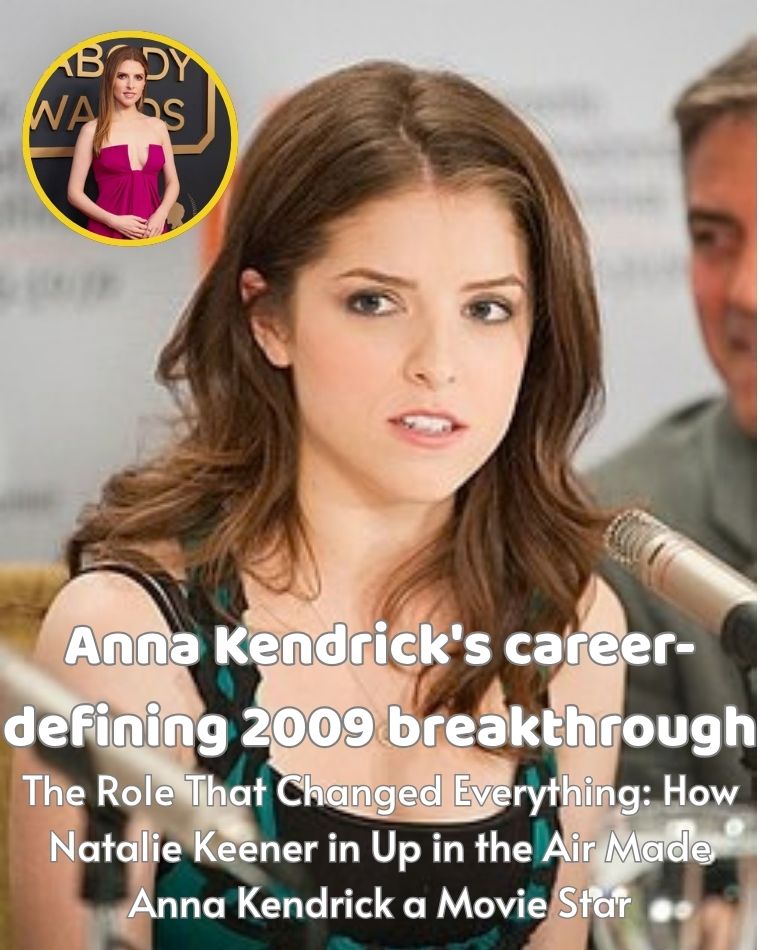
Cre: Wikimedia Commons
The Complexity of Natalie Keener: Balancing Ambition and Vulnerability
The character of Natalie Keener demanded a delicate, high-wire acting balance that few performers in their early twenties could navigate.
On the surface, Natalie presented herself as an unflinching, hyper-efficient corporate strategist.
She was armed with pristine credentials, relentless ambition, and an unwavering faith in algorithmic efficiency.
Natalie genuinely believed that firing employees through a computer screen was both modern and humane.
Yet, as the story progressed, the narrative stripped away her calculated professional veneer.
Director Jason Reitman constructed a journey that forced Natalie to confront the harsh, human cost of her theoretical corporate proposals.
Kendrick captured this duality with extraordinary nuance and restraint.
In scenes where Natalie had to carry out terminations, her eyes conveyed intense internal panic, doubt, and moral discomfort.
Her sharp cadence began to falter whenever raw human heartbreak entered the room.
The emotional climax of the character arrived not in a boardroom, but in moments of profound personal defeat.
When Natalie suffered a sudden romantic heartbreak via text message, her composed exterior shattered entirely.
Kendrick played that emotional breakdown with disarming authenticity.
The performance never reduced Natalie to an annoying corporate caricature or a fragile victim.
Instead, Kendrick crafted a deeply human portrait of a young person trying desperately to appear mature in an unforgiving world.
This balance between intellectual confidence and emotional vulnerability became the hallmark of the entire portrayal.
Going Toe-to-Toe with George Clooney
Performing opposite George Clooney is widely recognized as a formidable challenge for any actor.
Clooney possessed an effortless, old-Hollywood charm that could easily dominate two-person dialogues.
In Up in the Air, Clooney’s character Ryan Bingham was polished, cynical, and deeply entrenched in his transient philosophy of life.
Yet Kendrick matched Clooney’s presence in nearly every shared scene.
Their dialogue exchanges crackled with brisk comedic timing and escalating dramatic friction.
Natalie challenged Ryan’s detached philosophy, questioning his avoidance of domestic intimacy and human commitments.
Conversely, Ryan exposed Natalie’s youthful naivety regarding the complexities of long-term careers and marriage.
Rather than shrinking behind Clooney’s seasoned star power, Kendrick elevated the narrative stakes of their scenes together.
She used her quick verbal delivery and expressive micro-reactions to establish a compelling student-mentor friction.
Their chemistry avoided predictable romantic tropes entirely.
Instead, they formed an unconventional, generational partnership rooted in professional mutual education.
Reviewers singled out these two-handers as the sharpest dramatic sequences in the film.
Kendrick proved that she possessed the discipline required to stand alongside major A-list talent without yielding focus.
Her performance validated Jason Reitman’s casting decision and demonstrated her natural dramatic gravitas.
Expanding Range Beyond Early Theater Roots
Before making her mark in Hollywood features, Anna Kendrick had already cultivated a formidable background in musical theater.
She made her Broadway debut as a child actress in the musical High Society, earning an early Tony Award nomination.
Stage acting taught Kendrick impeccable vocal control, emotional projection, and comedic instincts.
However, transitioning from theatrical projection to the subtle nuances of dramatic cinema can prove difficult for many stage performers.
The camera captures the faintest twitch of an eye, the slightest change in breath, and silent hesitation.
In Up in the Air, Kendrick proved that she could translate her theatrical precision into cinematic subtlety.
She discarded broad theatrical gestures in favor of understated, grounded realism.
Natalie Keener spoke rapidly, but every word carried authentic emotional subtext.
Her line delivery retained musicality, yet it felt entirely spontaneous and natural within a corporate boardroom.
This dramatic discipline demonstrated that Kendrick was far more than a musical prodigy.
It showcased that her foundational training on stage gave her an uncommon technical command that could serve any genre.
Filmmakers observed that she could shift seamlessly between humor and heartbreak within a single breath.
This versatility became the very foundation upon which she built her subsequent cinematic career.
Industry Accolades and Newly Opened Doors
The critical reception to Kendrick’s work in Up in the Air led to immediate industry accolades throughout the 2009–2010 awards calendar.
She collected nominations from the Golden Globes, the BAFTA Awards, and the Screen Actors Guild Awards.
The pinnacle arrived with her nomination for Best Supporting Actress at the 82nd Academy Awards.
Sharing the category with esteemed performers—including her co-star Vera Farmiga—placed Kendrick in rare Hollywood territory.
At just twenty-four years old, she became one of the youngest performers nominated in that category in modern memory.
The Oscar campaign elevated Kendrick’s profile from an indie-film favorite to a household name in film industry circles.
Suddenly, major studios viewed her as an actress capable of carrying significant cinematic properties.
The prestige of the Oscar nomination opened creative doors across multiple Hollywood genres.
Directors sought her out for complex independent dramas, high-concept comedies, and large-scale studio productions.
Producers recognized that Kendrick possessed an unusual combination of accessible, relatable charm and serious dramatic integrity.
The buzz surrounding Up in the Air proved that her talent was enduring, sustainable, and versatile.
Industry executives no longer wondered whether she could lead major films; they actively developed projects around her talents.
The Lasting Legacy of Natalie Keener in Kendrick’s Trajectory
Looking back at Anna Kendrick’s extensive body of work, Up in the Air remains the foundational cornerstone of her modern stardom.
The role of Natalie Keener set the benchmark for the types of layered, sharp-witted heroines she would portray in later years.
It provided the dramatic credibility that allowed her later commercial successes to resonate so deeply.
When she later stepped into mainstream musical comedies and independent features, critics never doubted her core dramatic capability.
The Oscar-nominated role served as proof that behind every witty quip lived an actress capable of immense depth.
Natalie Keener remains one of the most memorable film characters of the late 2000s, encapsulating the economic anxiety and corporate alienation of that era.
Through Jason Reitman’s direction and Kendrick’s committed interpretation, the character elevated the entire film’s philosophical questions.
More than a decade later, the performance still stands as a masterclass in supporting acting.
It demonstrated how a young performer could command the screen, challenge an established cinematic legend, and earn Hollywood’s highest honors.
Without the decisive breakthrough of Up in the Air, modern cinema would look markedly different for Anna Kendrick.
Her work in 2009 remains an indelible portrait of youth, vulnerability, and raw cinematic brilliance.
Để lại một phản hồi