Tom Hiddleston transformed what was originally conceived as a standard comic book antagonist into the emotional cornerstone of Marvel Studios’ cinematic storytelling over an astonishing thirteen-year tenure.
Through Shakespearean gravity, profound emotional vulnerability, and an unwavering commitment to character truth, the British actor guided the Asgardian trickster from a jealous younger brother to the ultimate protector of reality.
Here is the comprehensive story of how a single casting decision in 2011 redefined modern blockbuster acting and reshaped the entire trajectory of the Marvel Cinematic Universe.
The Genesis of an Asgardian God: Shakespearean Roots in 2011’s ‘Thor’
When Marvel Studios commenced production on 2011’s Thor, the superhero movie landscape was undergoing a monumental structural shift.
The primary objective of director Kenneth Branagh was not merely to assemble an alien spectacle, but to anchor mythological entities in genuine family tragedy.
At the epicenter of this ambitious creative endeavor was Tom Hiddleston, a classical theater actor whose dramatic training immediately elevated the material.
Audiences first encountered Loki not as an archetype of pure malice, but as an isolated and profoundly wounded prince.
From his initial scenes in Asgard, Hiddleston played the character through a deeply tragic lens of filial neglect and existential crisis.
Loki learned the devastating truth of his heritage: he was not a biological son of Odin, but an abandoned Frost Giant infant adopted as a political pawn.
Instead of playing a cold-hearted schemer, Hiddleston imbued this discovery with raw, agonizing heartbreak.
Every glance, silence, and vocal quiver in Thor suggested a young man desperate for validation from a father who always favored his elder sibling.
The nuanced tension between Chris Hemsworth’s boisterous Thor and Hiddleston’s brooding Loki gave the film an indelible emotional heartbeat.
Critical reaction to Hiddleston was instantaneous and overwhelmingly positive, with reviewers recognizing that the film’s villain was far more compelling than standard comic book foils.
The character’s initial outing culminated in a poignant fall into the void of space, an apparent demise that was destined not to last.
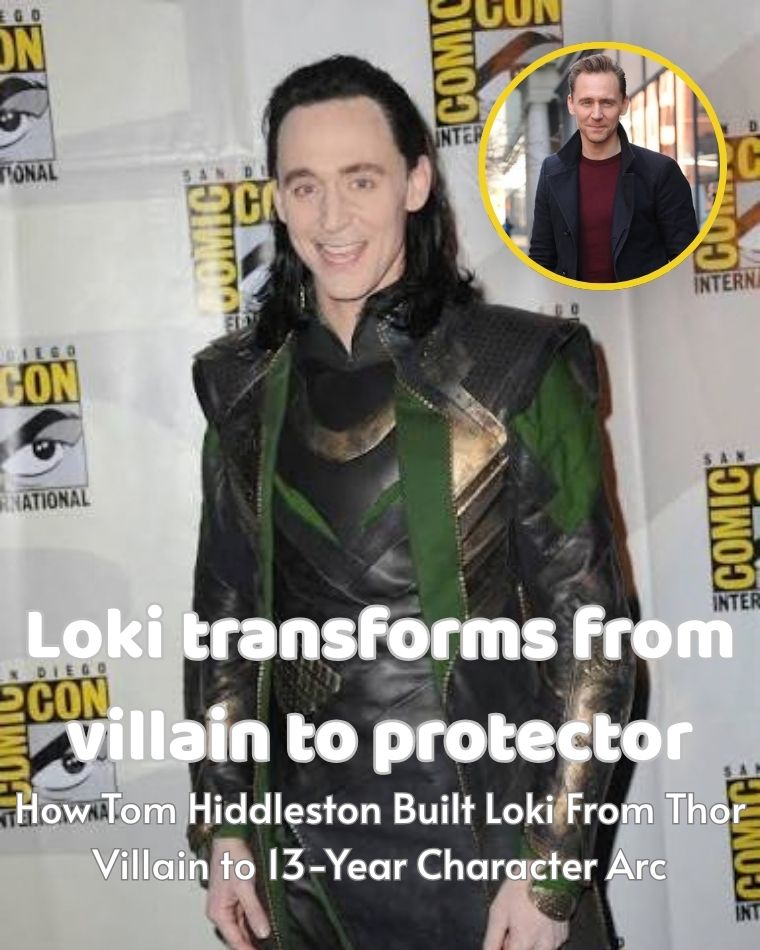
Cre: Wikimedia Commons
Conquering Earth: Establishing the Mastermind in 2012’s ‘The Avengers’
The extraordinary audience reception to Hiddleston’s performance in Thor prompted an immediate strategic pivot for Marvel Studios.
Rather than introducing an obscure cosmic threat, Marvel selected Loki to serve as the unified catalyst for director Joss Whedon’s monumental 2012 ensemble, The Avengers.
This decision represented a monumental creative challenge, requiring a single antagonist to credibly challenge Earth’s mightiest heroes.
Hiddleston met this narrative demand by amplifying Loki’s theatrical arrogance and volatile narcissism.
Armed with the Chitauri scepter and driven by a thirst for dominance, Loki invaded Earth under the twisted banner of “glorious purpose.”
Yet beneath the menacing grin and grandiose monologues, Hiddleston deliberately preserved the character’s profound loneliness and psychological trauma.
He portrayed Loki as an abused puppet of cosmic powers, terrified yet desperate to exert control over mortal lives.
His electric verbal duels with Robert Downey Jr.’s Tony Stark and Samuel L. Jackson’s Nick Fury demonstrated world-class screen presence.
Loki became the standard against which all subsequent Marvel Cinematic Universe villains would be evaluated.
The immense global box-office success of The Avengers established Hiddleston as a household name and cemented Loki as a fixture of pop culture.
Audiences did not merely despise Loki; they were deeply fascinated by his tragic contradictions and theatrical flair.
Kevin Feige’s Prophecy and the Unplanned Expansion of Loki’s Journey
Very few villains in franchise history manage to survive their initial story arcs, let alone command a decade of recurring appearances.
In the original conceptualization of the Marvel Cinematic Universe, Loki was never guaranteed to endure beyond his early adversarial roles.
However, Marvel Studios President Kevin Feige recognized early in the process that Hiddleston possessed something singular and magnetic.
Feige shared an early conversation with Hiddleston, assuring the young actor that Loki’s narrative presence would continue well past Thor.
That creative foresight proved entirely prophetic as the franchise evolved across Phase Two and Phase Three.
As Hiddleston later reflected, this early vote of confidence empowered him to build long-term psychological layers into each performance.
He never treated Loki as a temporary assignment, but rather as an evolving literary figure akin to Hamlet, Edmund, or Iago.
Every line reading was tuned to honor both the comedic absurdity of comic books and the profound gravity of classical tragedy.
By trusting Hiddleston’s dramatic instincts, Feige and Marvel allowed the character to organically adapt to each new creative team.
The ongoing creative dialogue between actor and studio executive formed the bedrock of a multi-year creative partnership.
Grief, Humor, and the Fractured Brotherhood: From Svartalfheim to Sakaar
The middle chapters of Loki’s cinematic arc began to deconstruct his antagonistic persona into something far more nuanced: an antihero.
In 2013’s Thor: The Dark World, personal catastrophe shattered Loki’s illusion of detached malice following the murder of his mother, Frigga.
The quiet, devastating sequence where Loki reveals his true, disheveled state inside the Asgardian dungeons remains one of Hiddleston’s finest dramatic moments.
When Thor sought his imprisoned brother’s help, the dynamic between the two actors crackled with grief, dark humor, and fragile trust.
Loki apparently perished protecting Thor on Svartalfheim, only to secretly usurp Odin’s throne on Asgard in a signature twist.
When director Taika Waititi revitalized the property in 2017’s Thor: Ragnarok, Hiddleston demonstrated remarkable comedic dexterity.
Exiled to the chaotic trash planet of Sakaar, Loki was forced to navigate the absurd eccentricities of the Grandmaster.
Rather than resisting the comedic shift, Hiddleston leaned entirely into Loki’s exasperated survival instincts and theatrical vanity.
The comedic timing between Hemsworth and Hiddleston reached peak refinement during iconic moments like the “get help” sequence.
More importantly, Ragnarok allowed Loki to finally choose his family, returning to rescue the citizens of Asgard from Hela’s wrath.
Standing alongside his brother as Asgard burned, Loki appeared to have finally found peace and reciprocal brotherhood.
The Grim Climax: Defiance and Sacrifice in ‘Avengers: Infinity War’
The opening sequence of 2018’s Avengers: Infinity War delivered one of the most shocking and visceral moments in comic book cinema.
Within the first ten minutes of the film, Thanos and the Black Order boarded the Asgardian refugee vessel, slaughtering half its population.
Confronted with the inevitable demise of his brother, Loki made a decisive and fateful moral choice.
He presented himself to the Mad Titan not as a conqueror, but by reclaiming his true, multifaceted identity: “Odinson.”
Hiddleston played Loki’s final stand with a mixture of trembling dread and desperate, heroic defiance.
Loki’s ill-fated assassination attempt with a concealed dagger resulted in his horrific death by strangulation before Thor’s eyes.
For audiences across the globe, the loss was profound and felt entirely permanent.
The villain who had invaded Manhattan six years earlier had surrendered his life in a futile attempt to save the universe.
That heroic sacrifice provided a devastating yet poetically complete culmination to seven years of continuous character development.
Had Loki’s journey concluded permanently on that Asgardian ship, it would have stood as one of the MCU’s most triumphant character arcs.
Yet the shifting nature of the multiverse and the sheer passion of the audience ensured that Loki’s ultimate chapter remained unwritten.
The Disney Plus Canvas: Exploring Free Will and Identity in ‘Loki’
The introduction of the streaming platform Disney Plus offered Marvel Studios an opportunity to explore long-form episodic storytelling.
Rather than resurrecting the original Loki, the creative team focused on the 2012 time-variant who escaped during the time heist in Avengers: Endgame.
Stripped of his magic, his weapons, and his regal status, this version of Loki was abducted by the bureaucratic Time Variance Authority.
The solo series Loki provided Hiddleston with the expansive creative canvas he had always deserved but could never occupy in team-up films.
Across two visually stunning seasons, the show interrogated the foundational philosophical themes of identity, determinism, and agency.
In the legendary premiere episode, Loki was forced to watch a film reel of his entire destined life, including his future death at the hands of Thanos.
Hiddleston portrayed that psychological collapse without dialogue, allowing waves of grief, realization, and humility to wash over his face.
The performance demonstrated that the actor understood Loki better than any screenwriter ever could.
The narrative paired him with Mobius M. Mobius, played with charming warmth by Owen Wilson, creating an unforgettable philosophical partnership.
Furthermore, meeting his female variant Sylvie forced Loki to confront the mirror image of his own toxic isolation and deep need for companionship.
The series ceased being a conventional superhero action serial and transformed into a character study about overcoming personal dysfunction.
The God of Stories: Sacrificing Solitude for the Sake of the Multiverse
The second season of Loki carried Hiddleston’s protagonist toward an unprecedented, breathtaking metamorphosis.
Confronted with the collapse of the Temporal Loom and the annihilation of billions of timelines, Loki spent centuries learning theoretical physics to avert tragedy.
He relived identical timelines across countless iterations, desperate to find an equation that preserved both freedom and existence.
When confronted with the grim truth that one ruler must dictate all branches, Loki fundamentally rejected the throne of tyranny.
Instead of demanding subservience as he had on Earth in 2012, Loki embraced voluntary, eternal isolation.
In the stunning series finale, Loki stepped out onto the crumbling gangway, shredded the mechanical loom with his bare hands, and gathered the dying branches of reality.
Weaving the timelines together using his own emerald magic, he ascended to a timeless throne at the center of existence.
He reconstituted the multiverse into the shape of Yggdrasil, the mythical Norse World Tree.
By doing so, the character who once declared he was burdened with glorious purpose finally found that purpose in absolute, selfless sacrifice.
He condemned himself to sit alone for eternity holding reality together so that his friends and every living soul could enjoy free will.
It was an ending of staggering emotional resonance, rarely matched in the entirety of modern genre entertainment.
What Made Hiddleston’s Craft Singular and Enduring
To understand why Loki remained a cultural phenomenon for thirteen years, one must analyze Hiddleston’s specific technical approach to acting.
In a cinematic genre frequently criticized for relying on computer graphics and formulaic quips, Hiddleston treated every line as high literature.
He constantly brought an intense, almost forensic psychological curiosity to every revision of the script.
Hiddleston never played Loki as an evil figure, but rather as someone operating under profound pain and misdirected intelligence.
Even in moments of wild comedic slapstick, such as being thrown across the floor by the Hulk, he retained an underpinning of wounded dignity.
His physical control as a performer allowed him to transition seamlessly from sweeping royal arrogance to intimate, hushed confessions.
Furthermore, Hiddleston’s profound intellectual generosity enriched every screen partner he worked with over the years.
His chemistry with Chris Hemsworth, Rene Russo, Anthony Hopkins, Owen Wilson, and Sophia Di Martino formed the spine of their respective scenes.
He understood that Loki was most effective when serving as a catalyst for other characters’ emotional revelations.
His deep respect for the fandom and the mythology meant that he never showed cynicism toward the comic book medium.
That genuine authenticity bridged the divide between critical prestige acting and populist entertainment.
Cultural Resonance: How an Antihero Shaped the Architecture of Modern Storytelling
Loki’s thirteen-year progression from 2011 to 2024 fundamentally mirrors the wider evolution of serialized Hollywood storytelling.
When the Marvel Cinematic Universe launched, blockbuster cinema operated largely on simple binary concepts of clear heroes and despicable villains.
Loki shattered that binary framework, teaching a generation of moviegoers to empathize with broken, morally ambiguous characters.
His transformation set the creative precedent for audiences demanding psychological complexity across the entire superhero genre.
Fans did not rally around Loki because he was powerful; they rallied around him because he was flawed, failed frequently, and still struggled toward light.
The character validated the reality of familial grief, the terror of unworthiness, and the difficult labor of personal redemption.
Hiddleston’s dedication demonstrated that franchise cinema can support mature, multi-decade character arcs that rival classical literature.
Loki evolved from a disposable single-film nuisance into the very god holding the Marvel Cinematic Universe together.
That breathtaking trajectory stands as a testament to creative patience, collaborative filmmaking, and the transformative power of a magnificent actor.
Through thirteen remarkable years, Tom Hiddleston ensured that the God of Mischief will be remembered forever as the God of Stories.
Để lại một phản hồi