When tens of thousands of fans flood open-air arenas to witness Latin music icons take the stage, they step into a world crafted with surgical precision.
Behind the mesmerizing pyrotechnics, thunderous reggaeton bass lines, and floating aerial stages is an invisible army of hundreds of production professionals.
This dedicated touring crew transforms bare sports fields into futuristic entertainment temples within mere hours, operating under unrelenting deadlines and complex technical demands.
The Monumental Scale of Stadium Tour Operations
Staging an international stadium concert requires logistical machinery comparable to a military deployment.
Modern Latin music tours led by superstars like Bad Bunny and Karol G have reached unprecedented scales, breaking venue attendance records worldwide.
When an artist steps out in front of 60,000 screaming ticket holders, they rely entirely on an infrastructure assembled by an elite traveling crew and hundreds of local stagehands.
A single stadium setup can easily require dozens of massive transport trucks traversing thousands of highway miles across continents.
Every piece of equipment, from miles of fiber optic cabling to towering aluminum trusses and precision motors, must arrive on schedule.
The logistical rhythm dictates that as soon as one stadium show concludes at midnight, load-out crews immediately begin dismantling the stage.
Local stagehands work alongside core touring specialists to pack fragile electronics, automation rigs, and heavy steel elements into numbered road cases.
By daybreak, transport convoys are rolling toward the next city while advance rigging teams are already inspecting the structural steel of the upcoming venue.
This continuous touring cycle demands relentless stamina, absolute trust, and flawless operational coordination from every department involved.
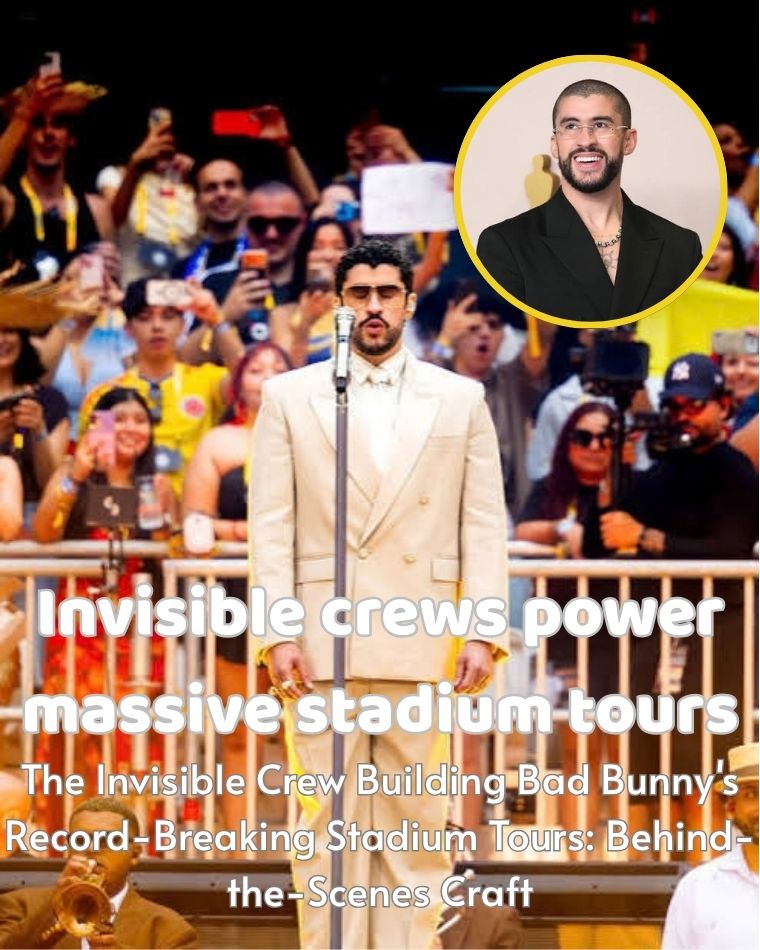
Cre: Wikimedia Commons — Andrew King / CC BY-SA 2.0
The Key Architects: Essential Roles Behind the Scenes
Every stadium spectacle relies on a defined chain of command where specialized craftspeople execute distinct responsibilities under tight timeframes.
At the helm of the traveling city stands the production manager, whose authority guides both operational efficiency and physical safety.
Production managers serve as the ultimate operational coordinators, balancing the artist’s creative ambitions against concrete timelines, structural limits, and transport realities.
Working directly alongside them are stage managers, who command backstage traffic, cue theatrical entrances, and oversee local labor crews.
Lighting designers and directors form another vital pillar of the creative execution, translating musical energy into luminous geometry.
They deploy hundreds of intelligent automated fixtures, powerful stadium-grade strobes, and surgical laser systems to sculpt the stadium environment.
These designers do not just illuminate performers; they establish mood, shift visual architecture, and maintain visibility across massive stadium sightlines.
Meanwhile, front-of-house audio engineers and systems technicians shoulder the immense burden of acoustic clarity.
They are tasked with taming harsh concrete stadiums, eliminating acoustic flutter, and delivering punchy bass that reaches upper mezzanine seats without sacrificing vocal intelligibility.
High above the venue floor, head riggers and climbing specialists calculate mechanical load capacities down to individual pounds of force.
Riggers literally hold the lives of the performers, musicians, and audience members in their hands as they hoist tons of production gear into overhead stadium steel.
Mastering Complex Stadium Acoustics and Audio Engineering
Delivering pristine audio in an outdoor sports stadium presents an entirely different technical challenge compared to indoor arenas.
Open-air stadiums lack natural acoustic dampening, leaving sound engineers to battle reflective concrete walls, open field expanses, and swirling wind currents.
For bass-driven genres like contemporary reggaeton and Latin trap, sub-bass frequencies require massive physical displacement and airtight phase alignment.
If the subwoofers are miscalculated, low frequencies can easily turn into an indistinct, muddy rumble across wide open fields.
Audio teams combat these acoustic hurdles by deploying large-format line array systems paired with flown and ground-stacked subwoofer arrays.
Engineers meticulously configure delay speaker towers positioned across the playing field, calibrated to the microsecond.
These delay systems ensure that sound waves traveling from the main stage arrive in perfect synchronicity with localized speakers near upper decks.
Sound crews also rely heavily on real-time acoustic measurement software and laser distance finders to track atmospheric variables.
Shifts in ambient temperature and evening humidity directly alter sound velocity and high-frequency absorption over long distances.
A change in wind speed can blow critical high-frequency vocal coverage away from thousands of fans in upper grandstands.
System engineers therefore continually adjust parametric equalizers and digital delays throughout the night to keep vocals sharp, direct, and present.
Automation, Flying Rigs, and Visual Engineering
Modern pop and urban concerts have moved far beyond static platforms, demanding three-dimensional kinetics that bring artists directly into the crowd.
Bad Bunny’s record-breaking stadium productions have become famous for their jaw-dropping structural centerpieces, including automated floating rigs and suspended islands.
Engineering a massive moving structure that safely lifts a global superstar over an audience requires specialized scenic automation platforms.
Automation operators manage motorized winch lines, counterweights, and tracking trusses with millimetric precision throughout the performance.
Redundant mechanical safety systems and computerized sensors monitor line tensions continuously, shutting down motorized motions if any irregularity is detected.
Simultaneously, visual designers integrate thousands of square feet of outdoor LED video paneling into the stage architecture.
These high-brightness LED walls must withstand extreme sunlight during early setlists while delivering razor-sharp motion graphics as night falls.
Video directors and media server operators coordinate live camera feeds, visual effects, and pre-rendered graphic narratives in real time.
Synchronizing these massive displays with moving lights and timecoded musical beats creates the immersive visual sensory overload fans expect from global headliners.
From Blueprints to Opening Night: The Planning Timeline
The physical build that audiences witness in a stadium is merely the final chapter of a production process initiated months in advance.
Tour planning begins up to a year before the first truck hits the highway, starting with conversations between artist management and creative directors.
Designers draft conceptual renders, visual storyboards, and miniature CAD models to map out how the show will look and flow.
Once creative concepts are approved, structural and technical engineers transform artistic dreams into physical reality.
They calculate total hanging weights, electrical power distribution demands, and shipping footprint limits.
Manufacturers build custom staging decks, proprietary rigging brackets, and custom flight cases designed for rapid daily deployment.
Months ahead of rehearsals, logistics coordinators begin coordinating permits with municipal authorities, local venue managers, and transport providers.
Every stadium features unique structural peculiarities, ranging from roof weight ratings to restrictive field access tunnels.
Advance production scouts visit every tour stop, surveying crane placements, loading bay clearances, and turf protection systems.
Weeks before the opening date, the entire core crew gathers in massive rehearsal aircraft hangars or private arena facilities.
These full-scale technical rehearsals run through entire concerts repeatedly, allowing operators to program light cues, dial in audio snapshots, and test automation routines.
Only after every fail-safe and scenic transition operates flawlessly does the massive traveling production pack up for its official public debut.
Problem Solving on the Fly: Navigating Real-Time Emergencies
Even with months of preparation, live stadium touring is inherently volatile, requiring lightning-fast troubleshooting when anomalies emerge.
Unexpected weather events represent one of the most formidable adversaries for an outdoor touring crew.
Sudden summer rainstorms, gusty winds, or severe lightning can jeopardize millions of dollars in delicate sensitive electronics.
Weather spotters and safety coordinators constantly track live meteorological radar feeds during the show.
If heavy rain arrives, technicians swiftly deploy weatherproof enclosures, re-route drainage, or reposition delicate moving head lights.
High winds present critical structural hazards for suspended banners, lighting trusses, and towering video walls.
Rigging directors establish hard wind speed thresholds, prepared to lower hanging assemblies if wind speeds approach mechanical engineering limits.
Beyond environmental hurdles, technical malfunctions can surface instantly during a three-hour live setlist.
A critical audio cable can sever, an LED tile can go dark, or a wireless microphone frequency can suffer sudden local interference.
Touring professionals build comprehensive redundancy into every primary performance system to avert show-stopping disruptions.
Audio engineers maintain redundant digital consoles running parallel audio streams, allowing instantaneous failover switching if a desk freezes.
RF technicians scan venue radio frequencies non-stop, ready to re-tune wireless artist packs the instant background static creeps in.
Backstage technicians resolve complex electronic and mechanical failures silently in the shadows without fans ever noticing a glitch.
Raising the Bar: The Technical Revolution in Latin Touring
The monumental success of tours led by Bad Bunny and Karol G represents a watershed moment in the global live entertainment industry.
Historically, the highest-budget, technically complex stadium spectacles were predominantly mounted by legacy Anglo-American rock and pop acts.
Over the past several years, Latin music titans have permanently rewritten the playbook for global live stadium entertainment.
Artists like Bad Bunny have demonstrated that Latin urban music commands the ticket power and cultural weight to sell out multi-night stadium runs.
Karol G’s historic stadium outings shattered attendance benchmarks across the Americas and Europe, establishing dazzling production standards.
These artists invest heavily into cutting-edge production values, utilizing world-renowned designers and bleeding-edge touring technologies.
They integrate elaborate narrative story arcs, immersive audience wearable lighting bands, and innovative stage mechanics.
Their record-breaking commercial feats have proven that language is no barrier to filling the largest stadiums on Earth.
This explosive commercial growth has opened unprecedented doors for specialized bilingual engineers, rigging professionals, and road crews worldwide.
Latin touring has evolved into a powerhouse sector that pushes equipment manufacturers to develop more powerful, durable touring systems.
The Physical and Mental Endurance of Life on the Road
The glitz and glamour seen by concertgoers masks a grueling physical reality endured daily by touring technicians.
Touring crew members regularly log 16- to 18-hour shifts on concrete floors under intense mental and physical pressure.
A typical tour day begins at dawn with the arrival of trucks, followed by intensive rigging, stage assembly, and sound checks.
After running the high-stress live performance through midnight, the crew dives straight into load-out, packing heavy gear into early morning hours.
Sleep is often relegated to moving tour sleeper buses navigating highways between distant metropolitan stops.
Crew members spend months away from families and homes, enduring changing climate zones, dietary shifts, and constant fatigue.
Yet, despite the punishing physical grind, road crews share a fierce cultural camaraderie and passion for live entertainment.
They operate with deep mutual respect, knowing that every teammate’s diligence directly safeguards the safety and success of the group.
The shared rush of pulling off an impossibly complex stadium show night after night fuels a distinct vocational pride.
They are the silent backbone of the modern music economy, providing the sweat equity that fuels cultural phenomena.
Honoring the Craft Behind the Stadium Spectacle
When stadium lights dim and the final cheering fans depart into the night, the stage immediately begins to dissolve back into steel cases.
The monumental visual world that hosted a cultural celebration exists for only a fleeting moment in time.
While marquee headlines naturally celebrate the charismatic artists whose songs captivate stadium crowds, the invisible crew deserves equal reverence.
Without the structural brilliance of riggers, the acoustic mastery of sound engineers, and the vigilance of logistics teams, stadium shows could not exist.
These unsung professionals take monumental creative risks, engineering custom mechanical wonders that move safely above cheering crowds.
They turn cavernous sports venues into warm, resonant, emotionally resonant spaces where music communities bond.
Behind every unforgettable stadium night and record-shattering gross sits a passionate collective of backstage artisans.
Their technical craftsmanship, mental resilience, and invisible excellence make the impossible happen across the world’s grandest stages.
Để lại một phản hồi