Tom Holland is actively studying vaudeville-era performance techniques to prepare for his upcoming Fred Astaire biopic.
This historical theatrical training directly bridges the gap between classic stagecraft and his contemporary athletic work as Peter Parker.
By examining Astaire’s background alongside modern Hollywood action demands, Holland illustrates how early twentieth-century movement principles continue to shape premier superhero cinema.
The transition from modern blockbuster cinema to twentieth-century stage performance represents a significant physical and artistic undertaking.
Holland’s preparation for portraying legendary entertainer Fred Astaire requires a comprehensive examination of vaudeville-era disciplines.
These classic theatrical methods directly connect to foundational movement skills that Holland already demonstrates in his Spider-Man portrayal.
Vaudeville as an art form placed intense physical demands on performers who needed to command immediate audience attention across vast theatrical halls.
Those early stage entertainers had to sustain audience engagement entirely through kinetic storytelling and uncompromising spatial control.
Rhythm and exact physical timing served as the central tools for keeping thousands of live spectators fully engaged without digital amplification.
Crucially, vaudeville tradition required artists to execute remarkably difficult physical feats while making every gesture appear utterly effortless.
Holland brings these exact performance qualities to his acrobatic sequences across multiple cinematic portrayals of Peter Parker.
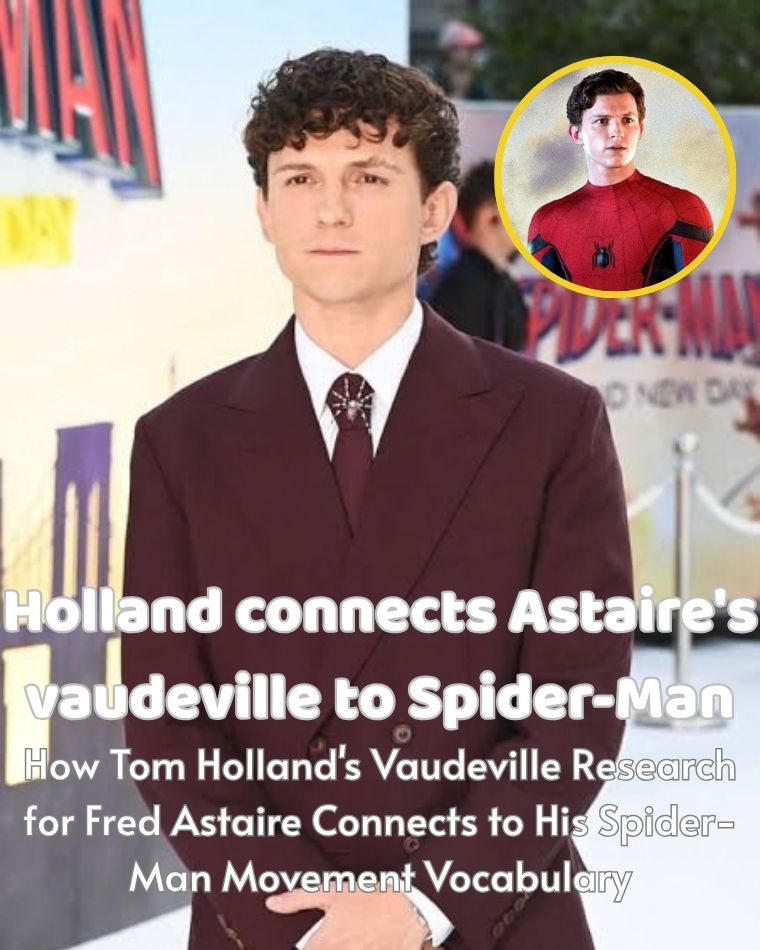
Cre: Wikimedia Commons — CC BY-SA 3.0 (Gage Skidmore)
To fully inhabit the role of Fred Astaire, Holland must explore the precise origins of the legendary dancer’s craft.
Astaire first developed his lifelong movement habits through intensive vaudeville training alongside his sister Adele during the early 1900s.
That rigorous sibling partnership toured extensively, navigating grueling live performance schedules across American stages.
Early twentieth-century stage environments demanded absolute full-body spatial awareness from both siblings in every single routine.
Astaire spent years refining strict rhythmic timing to sync perfectly with live musical accompaniment and spontaneous theater conditions.
The brother-and-sister act honed an extraordinary capability to execute complex choreography while presenting the entire routine as pure spontaneity.
Audiences of the era marveled at how intricate step combinations looked entirely casual rather than relentlessly drilled.
This specific theatrical discipline laid the groundwork for Astaire’s later dominance during Hollywood’s golden age of musicals.
The foundational principles that Astaire perfected in vaudeville are directly relevant to Holland’s modern superhero performances.
When executing Peter Parker’s web-swinging sequences, Holland must apply that same meticulous control over weight, momentum, and balance.
Superhero fight choreography presents a unique challenge because aggressive combat must remain consistent with a character’s underlying personality.
Holland ensures that Peter Parker’s athletic precision reads on camera as awkward, kinetic teenage movement rather than mechanical stunt execution.
A superhero should not merely move like a seasoned stunt double going through predefined combat beats.
Instead, every jump, defensive dodge, and aerial rotation must reflect the spontaneous reactions of a youthful character improvising under intense pressure.
Holland’s physical storytelling relies on making highly technical gymnastics appear instinctive and unscripted.
The deep crossover between vaudeville techniques and superhero filmmaking centers on an artist’s ability to govern audience perception.
Every subtle tilt of the head or shift in posture guides the viewer’s eye across wide frames.
A performer with stage lineage understands how physical gesture conveys narrative information without dialogue.
In vaudeville, an actor had only a single chance in front of a live crowd to communicate emotion purely through motion.
In large-scale comic book adaptations, that exact physical legibility prevents intricate action scenes from degenerating into visual noise.
Fred Astaire revolutionized cinematic dance precisely because he understood how camera angles could either honor or diminish real physical skill.
During his cinematic heyday, Astaire famously insisted that studio cameras capture his entire body in continuous, unbroken takes.
He flatly rejected rapid cuts and deceptive angles that could lead audiences to believe camera tricks disguised technical deficiencies.
Astaire believed that the dancer’s full silhouette must remain clearly visible from head to toe throughout each musical number.
If a sequence required multiple retakes to achieve perfection, Astaire welcomed the exhaustion rather than relying on editorial manipulation.
This insistence established a new standard of visual honesty within Hollywood musical production.
Holland applies a remarkably similar creative philosophy to his demanding Spider-Man sequences.
The English actor consistently advocates for performing as many practical stunts as safely feasible on set.
He utilizes wirework rigs and physical apparatus to achieve practical kinetic momentum rather than leaning exclusively on computer-generated imagery.
This commitment protects physical authenticity so that audiences perceive real human weight shifting through space.
When an actor physically experiences gravity and inertia, genuine biological reactions register across their body language.
Spectators instinctively recognize the difference between genuine physical exertion and synthetic digital manipulation.
Astaire’s stubborn insistence on visual integrity therefore finds a clear twenty-first-century analogue in Holland’s stunt work.
Both performance traditions demand that the artist bear the physical burden of proof on camera.
The modern cinematic landscape often prioritizes post-production wizardry over practical performance capabilities.
Yet Holland demonstrates that human athleticism remains irreplaceable when anchoring fantastical superhero narratives.
The intersection of classic theatrical disciplines and modern cinematic demands requires extraordinary artistic versatility.
Performers who master both realms must harmonize old-school stage stamina with subtle cinematic presence.
Holland began establishing this comprehensive physical skill set at a remarkably young age.
His early stage foundation in the London West End production of Billy Elliot provided him with indispensable technical training.
Playing Billy Elliot forced young Holland to master ballet, tap, acrobatics, and endurance acting simultaneously.
That rigorous stage regimen taught him to sustain peak physical output night after night before demanding live theater audiences.
While Billy Elliot supplied Holland with core technical dance tools, preparing for Astaire requires examining an even deeper performance tradition.
Studying Astaire’s vaudeville background gives Holland direct historical insight into how early twentieth-century artists mastered their craft.
Those pioneering stage actors lacked the safety nets of modern recording technology and digital revision.
They operated under raw acoustic conditions where stage clarity determined immediate career survival.
Performers developed unique micro-movements to project energy across enormous performance halls without showing visible strain.
Understanding this history deepens Holland’s appreciation of how physical discipline produces effortless visual elegance.
Astaire’s legendary lightness on screen emerged from relentless behind-the-scenes conditioning and repetitive drilling.
His ability to glide across hardwood floors hid hours of rigorous physical preparation and muscle fatigue.
This dynamic of concealing arduous labor beneath an exterior of relaxed charm is central to the Spider-Man persona as well.
Peter Parker faces overwhelming emotional weight and physical peril while maintaining an upbeat, witty exterior.
His aerial maneuvers across New York skyscrapers must project youthful joy even as the character endures life-threatening challenges.
Making the difficult appear completely effortless is an imperative that every Spider-Man actor must master.
Holland’s deep dive into Astaire’s career highlights the shared DNA connecting classical variety theater and modern cinematic spectacle.
Both creative traditions exist fundamentally to astonish audiences through breathtaking kinetic displays.
In the vaudeville circuit of the 1900s, diverse acts competed vigorously for audience attention through novel athletic and musical feats.
Today’s summer action blockbusters compete for global attention using state-of-the-art cinematic resources.
Despite the century separating these two entertainment formats, the human center of the performance remains entirely unchanged.
A compelling physical performance still depends on balance, rhythm, focus, and expressive spatial command.
Holland’s deliberate study of vaudeville methods underscores his serious approach to dramatic transformation.
He refuses to treat the Fred Astaire biographical project as a standard Hollywood imitation exercise.
Instead, Holland seeks to understand the exact physical engine that powered Astaire’s peerless movement style.
Learning historical dance vocabulary enables an actor to internalize posture, stance, and balance at an intuitive level.
When an actor embodies those physical mechanics authentically, their performance transcends cosmetic imitation.
Holland’s dual commitment to superhero action and classic dance underscores the broad scope of his physical artistry.
Navigating complex action choreography demands extraordinary cardiovascular stamina and instantaneous muscular adjustments.
Likewise, tap dance requires precise synchronization of foot strikes with musical syncopation.
Both disciplines demand that the performer remain entirely present within their physical body during high-intensity sequences.
A slight lapse in rhythmic concentration can compromise a dance number or cause an on-set stunt mishap.
Holland’s physical discipline allows him to navigate these complementary performance worlds with professional rigor.
His background reminds industry observers that theatrical training remains the gold standard for cinematic action stars.
Many of Hollywood’s most durable physical performers trace their roots back to stage, circus, or classical dance training.
The lessons passed down from vaudeville stages over a century ago continue to offer direct value to modern studio productions.
By studying Astaire’s formative years with Adele, Holland reconstructs the historical progression of American popular performance.
He examines how early twentieth-century stage stars translated theatrical movement into cinematic masterworks.
Astaire learned to soften broad theatrical gestures for the intimacy of the movie camera without sacrificing physical crispness.
Holland executes a reciprocal translation, taking cinematic stunt habits and grounding them in historic stage technique.
This artistic dialogue between eras enriches both the upcoming Astaire biopic and Holland’s broader acting trajectory.
Audiences eager to see Holland step into Astaire’s shoes will witness an interpretation built on thorough physical scholarship.
Rather than relying purely on contemporary acting methods, Holland honors the lineage of artists who established cinematic dance.
The preparation demonstrates that elite athletic storytelling bridges diverse genres across different entertainment epochs.
Whether swinging between metropolitan skyscrapers or gliding across an art deco dance floor, physical precision reigns supreme.
The performer must always direct the audience’s gaze, control the rhythm of the moment, and project effortless ease.
Fred Astaire perfected these principles across grueling vaudeville circuits and triumphant movie musicals.
Tom Holland continues that proud lineage as he prepares to embody one of cinema’s greatest physical legends.
Để lại một phản hồi