Long before Chris Hemsworth wielded the enchanted hammer Mjolnir across multi-billion-dollar Marvel blockbusters, he headlined an obscure independent crime thriller titled Cash.
Released in 2010, the film quietly teamed the future Marvel superstar with Sean Bean just months prior to the veteran actor’s epochal debut as Ned Stark on HBO’s Game of Thrones.
Directed by Stephen Milburn Anderson, this tense cat-and-mouse exercise presents a stark departure from the glossy cinematic landscapes that would soon define both actors’ international reputations.
The narrative foundation of Cash—frequently stylized as Ca$h—revolves around a devastatingly simple moral dilemma rooted in everyday financial desperation.
Australian newcomer Hemsworth portrays Sam Phelan, a stressed young man living alongside his wife, Leslie, played by Victoria Profeta.
The couple resides in modern Chicago, grappling with mounting debt, delinquent household expenses, and the looming threat of economic ruin.
Their dire trajectory alters overnight when a mysterious briefcase packed with thousands of dollars in illicit cash lands on their vehicle from an overpass.
Rather than notifying municipal authorities, the overwhelmed couple succumbs to temptation and decides to claim the dropped fortune as their own.
Believing their persistent economic nightmare has reached a miraculous resolution, Sam and Leslie hastily embark on an impulsive spending spree.
They extinguish critical bills, purchase lavish electronics, and acquire high-end consumer goods, confident that anonymous fate has smiled upon their modest household.
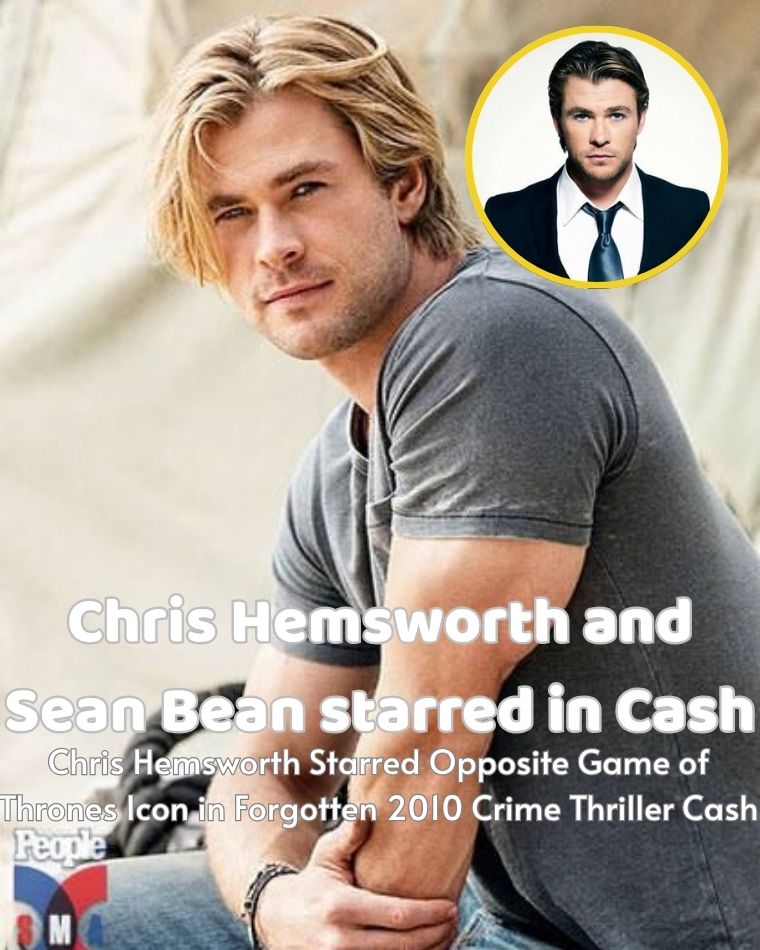
Cre: Wikimedia Commons
The couple’s euphoria dissolves abruptly when a calculated stranger named Pyke Kubic arrives on their doorstep to reclaim every cent.
Portrayed with icy menace by Sean Bean, Kubic reveals himself as the ruthless brother of the jailed criminal who lost the loot during a high-speed police chase.
Kubic operates not merely as a thug, but as an methodical collector who values strict precision over unmeasured brutality.
Upon discovering that the Phelans have already squandered a sizable portion of the sum, Kubic refuses to absorb any deficit whatsoever.
The sinister antagonist invades their home, assumes complete dominion over their daily schedule, and demands the restoration of every missing dollar.
Hemsworth’s character discovers that returning unspent cash cannot balance the ledger when ruthless criminal calculations govern the outstanding balance.
To recover the spent funds, Kubic drags the ordinary young couple deep into an escalating cycle of violent armed hold-ups and petty retail robberies.
Sam finds himself coerced at gunpoint to participate in increasingly desperate heists, crossing ethical boundaries he never imagined confronting.
This dark downward spiral forces Hemsworth to depict panic, moral distress, and raw vulnerability rather than triumphant heroics.
Bean delivers a characteristically menacing performance, blending quiet domestic intimidation with unsettling conversational humor.
The dynamic between Hemsworth and Bean drives the central friction of Cash from initial home invasion to chaotic roadside climax.
Victoria Profeta’s Leslie provides an additional emotional counterweight as she witnesses her domestic sanctuary crumble under extortionate demands.
Director Stephen Milburn Anderson relies heavily on tight interior shots, emphasizing claustrophobia within modest residential rooms and generic suburban vehicles.
At the time of principal photography in 2008 and 2009, neither lead actor commanded the mainstream pop-culture status they occupy today.
Hemsworth was primarily known to international audiences for a brief, emotional prologue appearance as George Kirk in J.J. Abrams’ 2009 Star Trek reboot.
Before that modest Hollywood entry, his professional background centered almost exclusively on Australian television soap operas like Home and Away.
Cash provided the ambitious young performer with his very first leading role in an American feature-length motion picture.
Bean, while already renowned for portraying Boromir in Peter Jackson’s The Lord of the Rings: The Fellowship of the Ring, was still a year away from filming Game of Thrones.
His memorable portrayal of Lord Eddard Stark in 2011 would introduce his distinctive grit to an entirely new global generation of television viewers.
The simultaneous presence of two future genre titans in an unassuming Midwestern crime caper remains one of modern Hollywood’s most curious historical alignments.
Distributed domestically by Roadside Attractions, Cash arrived in select North American theaters on March 26, 2010.
Lionsgate took charge of subsequent home video distribution, releasing DVD and digital packages aimed primarily at direct-to-video consumers.
Despite the intriguing premise and palpable chemistry between Bean and Hemsworth, the movie struggled significantly to gain traction during its modest commercial run.
Independent distributors allocated minimal marketing resources to promote the indie thriller against established studio blockbusters.
Critics offered mixed assessments, acknowledging Bean’s commanding on-screen gravitas while critiquing the script’s predictable pacing and derivative narrative beats.
The modest production budget constrained the scope of the film’s action set pieces, confining most tension to prolonged dialogue exchanges.
Audience response remained lukewarm, leaving Cash to fade rapidly from box-office tracking sheets and public awareness.
Within months of its brief theatrical release, the project vanished into the crowded archives of low-profile contemporary thrillers.
Timing proved extraordinarily ironic for everyone involved in the production of Cash.
Only thirteen months after the film slipped unnoticed out of cinemas, Marvel Studios released Kenneth Branagh’s Thor in May 2011.
Thor achieved astronomical box-office numbers worldwide, launching Hemsworth straight into the upper echelon of global movie stars.
The golden-haired Avenger transformed from an auditioning Australian striver into a tentpole linchpin capable of carrying billion-dollar franchises across two decades.
Simultaneously, HBO’s Game of Thrones premiered in April 2011, establishing Sean Bean’s Ned Stark as the tragic moral heart of prestigious fantasy television.
Audiences revisiting Cash years later often experience a profound sense of temporal whiplash watching these two household names cross paths in an unpretentious B-movie.
Seeing Hemsworth without superhuman physique or mythical weaponry underscores the natural, raw charisma he brought to his earliest American assignments.
His Sam Phelan is neither invincible nor particularly brave; he is an ordinary young husband caught in a terrifying moral downward spiral.
This grounded, vulnerable characterization offers fascinating insights into how Hemsworth approached character work before heavy studio expectations narrowed his screen persona.
Bean, meanwhile, exhibits the effortless menace that made him cinema’s quintessential high-stakes antagonist throughout the 1990s and 2000s.
His portrayal of Pyke Kubic turns the film into an engaging masterclass in psychological pressure and measured intimidation.
The sharp contrast between Kubic’s cold calculation and Sam’s mounting panic salvages several scenes from standard genre predictability.
For movie historians and franchise enthusiasts alike, Cash represents a fascinating cinematic artifact of late-2000s Hollywood casting.
It captures an unvarnished inflection point where future superstars crossed paths before industry algorithms and franchise machinery altered their trajectories forever.
Independent thrillers of this nature once served as essential testing grounds where rising international talent could hone their craft before taking on massive studio IP.
Without the safety net of high-end visual effects or massive publicity campaigns, actors in low-budget indies had to carry every dramatic conflict entirely on their own.
Both Hemsworth and Bean committed fully to the gritty material, refusing to treat the independent thriller as a disposable paycheck.
While Cash never achieved critical acclaim or mainstream box-office victory, it remains an entertaining, compact crime exercise.
Viewers seeking to explore Hemsworth’s pre-Marvel filmography will find a compelling curiosity piece that highlights his early dramatic potential.
The thriller is frequently accessible across rotating on-demand digital platforms and independent streaming catalogues for those curious to dig deeper into modern cinema history.
Rediscovering this forgotten 2010 crime thriller reminds audiences that even the biggest superhero icons began their Hollywood journeys in small, gritty rooms negotiating stolen cash.
Để lại một phản hồi