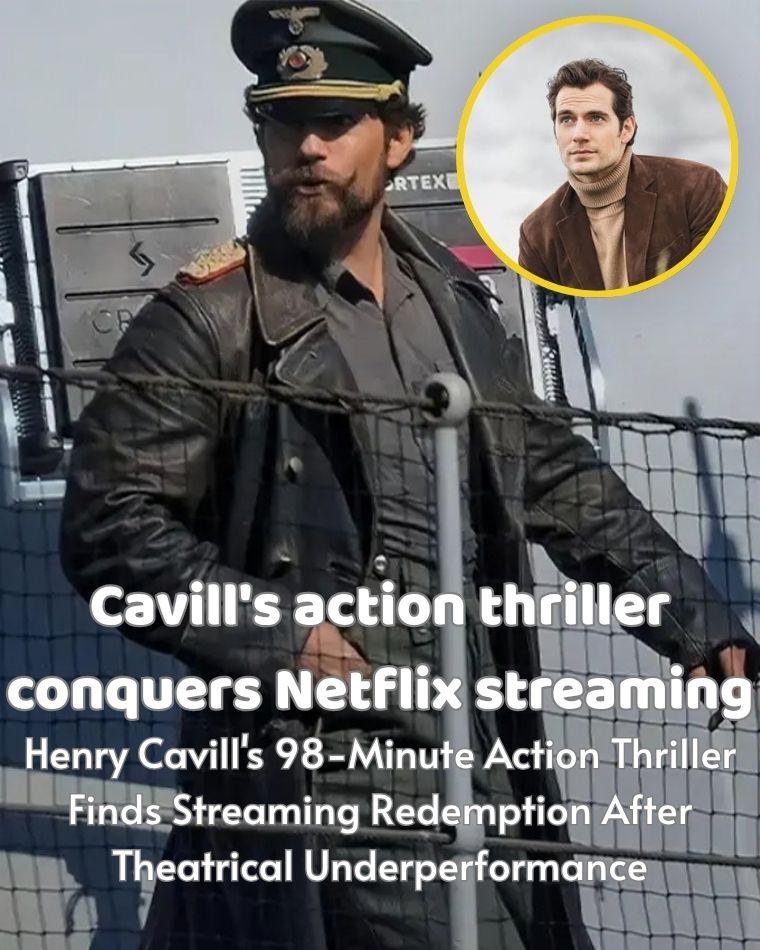
Streaming audiences have officially embraced Henry Cavill’s World War II action feature following its turbulent theatrical run.
The film has transformed its compact runtime and lean pacing into a formidable streaming asset on Netflix.
Viewers seeking punchy military entertainment have propelled the project into platform chart dominance.
Cre: Wikimedia Commons — Gage Skidmore (CC BY-SA 2.0)
Theatrical Underperformance and the Netflix Rebound
Guy Ritchie’s World War II action comedy The Ministry of Ungentlemanly Warfare faced an uphill commercial battle upon its initial cinema debut.
The feature debuted in theaters in April 2024 backed by Lionsgate in the domestic territory.
Despite positive audience word of mouth and strong popcorn scores, the film concluded its domestic run with approximately $20.5 million and under $30 million globally.
Weighed against an estimated production budget of roughly $60 million, theatrical analysts promptly categorized the release as a box office misfire.
International distribution rights had been sold piecemeal, with Prime Video handling key global regions and leaving traditional ticket sales fragmented.
When the title eventually touched down on Netflix in late 2024, the viewing dynamic shifted almost instantly.
The picture quickly climbed the platform’s Top 10 rankings across numerous territories.
Home viewers discovered an entertaining, high-velocity WWII mission that bypassed traditional theatrical friction.
The transition proved once again that commercial underperformance on the big screen does not inherently signal audience rejection at home.
On Netflix, the barrier to entry disappeared completely for casual subscribers browsing for Saturday evening thrills.
The algorithm rewarded the movie’s clear high-concept premise and recognizable ensemble cast.
Within days of its Netflix debut, the production reached the service’s daily top spots.
Viewership data demonstrated that home audiences were actively seeking precisely the kind of energetic combat adventure that cineplexes failed to sell.
Compact Runtime as a Modern Streaming Advantage
Contemporary Hollywood action films have developed an exhausting habit of ballooning well past the two-and-a-half-hour threshold.
Audiences at home increasingly suffer from runtime fatigue when confronted with sprawling multi-hour blockbusters.
In a streaming landscape filled with sluggish pacing, a brisk, tightly packaged action runtime reads as focused efficiency.
Viewers sitting on their couches appreciate an adventure that cuts straight to operational stakes without lingering in narrative filler.
The film’s lean structural pacing allows the central commando raid to unfold with rhythmic momentum.
Rather than burdening the audience with extensive world-building detours, the story immediately establishes its covert objective.
That economical narrative footprint matches modern digital consumption patterns far better than theatrical event programming.
When a subscriber sits down late in the evening, committing to an ultra-long epic often feels like homework.
A streamlined action vehicle promises immediate satisfaction with zero wasted sequences.
Every scene propels the commando unit closer to their maritime sabotage goal.
The brisk pacing ensures that tension remains taut across every skirmish and tactical encounter.
Viewers praise the absence of superfluous subplots that frequently derail mid-tier action releases.
The resulting momentum creates exceptional completion rates on streaming dashboards.
Subscribers watch all the way through rather than abandoning the stream halfway through slow exposition.
Practical Combat Choreography Over Digital Glitz
Henry Cavill anchors the operational narrative with an intense, grounded physicality.
Portraying real-life commando pioneer Gus March-Phillipps, Cavill deliberately sidesteps the glossy, computer-generated spectacle that defined his previous tentpole roles.
Instead of flying through digital skies on blue-screen soundstages, the actor engages in tactile hand-to-hand fighting and period-accurate weaponry handling.
The choreography relies heavily on silent knifework, silenced firearm tactics, and close-quarters suppression.
Cavill spent weeks mastering the functional mechanics of era-appropriate military equipment.
His combat approach emphasizes practical stunt work conducted on practical maritime vessels and open-water locations.
Audiences notice the weight behind each strike and the authentic recoil of antique firearms.
The camera remains steady during physical exchanges, highlighting choreography over disorienting rapid cuts.
Cavill brings a wry, roguish charm to his violent encounters, balancing grim lethality with Guy Ritchie’s trademark swagger.
His screen presence is amplified by co-star Alan Ritchson, who delivers explosive physical feats utilizing bows, blades, and blunt force.
The synergy between the ensemble members feels rooted in genuine stunt rehearsals rather than visual-effects post-processing.
By leaning into practical effects, the movie achieves a tangible grit that digital blockbusters frequently lack.
Stunt performers absorb real impacts across wooden docks, warehouse corridors, and rocking boat decks.
This dedication to physical execution enhances the visceral satisfaction of every raid sequence.
Action connoisseurs on streaming networks routinely single out these kinetic encounters for praise.
World War II Setting and the Dirty Dozen DNA
The historical premise centers on Operation Postmaster, a top-secret British mission executed off the coast of West Africa.
Authorized by Winston Churchill and military mastermind Colin Gubbins, the mission sought to cripple Axis submarine replenishment in neutral Spanish waters.
Ritchie frames the historical event as an irreverent, stylish commando heist reminiscent of classic mid-century men-on-a-mission capers.
The narrative intentionally evokes the spirited camaraderie of The Dirty Dozen and Where Eagles Dare.
By operating outside conventional rules of engagement, the protagonists invent modern black-ops warfare in real time.
The cinematic staging combines luxurious coastal aesthetics with sudden explosions of brutal violence.
Eiza González adds sophisticated espionage intrigue as Marjorie Stewart, working behind enemy lines to divert Nazi naval officers.
Babs Olusanmokun provides crucial tactical support on the ground, creating high-stakes tension prior to the assault.
The dual-track narrative balances tense cocktail-party deception with nocturnal harbor infiltration.
This genre blend honors traditional war cinema while injecting contemporary stylistic verve.
The retro military aesthetic proves immensely appealing to older demographics and historical buffs browsing home libraries.
Simultaneously, the tongue-in-cheek humor and explosive firepower capture younger action enthusiasts.
The setting allows Ritchie to indulge in colorful villainy, giving the commandos despicable adversaries to dismantle without remorse.
That unambiguous moral clarity offers effortless escapism for weekend streaming viewers.
The resulting war caper delivers constant forward motion from planning stages to climactic harbor sabotage.
The Evolution of Henry Cavill’s Streaming Stature
Henry Cavill has increasingly cultivated one of the most reliable and influential footprints in the streaming landscape.
While his major studio theatrical releases like Argylle and Ministry stumbled against lofty box office expectations, his home video appeal remains undisputed.
The British star first cemented his streaming dominance as Geralt of Rivia in Netflix’s global juggernaut The Witcher.
His commanding physical performance in that dark fantasy series proved that millions of households would tune in specifically for his action choreography.
He subsequently charmed audiences across demographic brackets as Sherlock Holmes in the wildly successful Enola Holmes franchise for the same streamer.
Cavill possesses a rare screen magnetism that pairs classical leading-man elegance with rugged, blue-collar action credibility.
When viewers encounter his face on a thumbnail, they anticipate rigorous combat preparation and complete genre commitment.
Subscribers view his participation as a stamp of high-grade stunt entertainment.
His post-superhero trajectory reveals an actor unafraid of mid-scale genre vehicles that value character quirk over corporate universe building.
The theatrical market often demands massive four-quadrant appeal that penalizes idiosyncratic, R-rated character pieces.
Streaming platforms, by contrast, thrive on passionate niche loyalty and immediate accessibility.
Cavill’s devoted global fanbase readily convenes on digital platforms to support his projects outside the studio theater ecosystem.
This dynamic insulates his standing as a bankable action headliner despite traditional theatrical volatility.
His collaborative projects continue to generate exceptional engagement hours and social media discussion.
The Netflix success of The Ministry of Ungentlemanly Warfare validates his enduring commercial drawing power in the living room.
What This Arc Teaches Hollywood About Mid-Budget Action
The journey of Guy Ritchie’s commando romp offers vital diagnostic lessons for contemporary film distribution.
The traditional $50 million to $80 million mid-budget studio action film currently occupies dangerous territory in multiplexes.
Soaring promotional spends and saturated theatrical release calendars make break-even thresholds extraordinarily difficult to achieve.
Audiences have grown selective regarding which titles justify expensive tickets, parking, and theater concession prices.
Spectacle-driven superhero entries or ubiquitous IP franchises absorb the lion’s share of casual cinema admissions.
Original or semi-historical genre exercises routinely struggle to draw opening-weekend crowds.
Yet the immediate consumer appetite for well-crafted mid-budget thrillers has not diminished in the slightest.
Instead, that consumer demand has migrated almost entirely to monthly streaming subscription queues.
Films that stall theatrically find second lives as instant digital blockbusters the moment they bypass ticketing friction.
Studios that treat streaming as an afterthought risk misreading real audience engagement metrics.
A hybrid model that leverages theatrical exposure for prestige before collecting massive streaming volume represents the new operational reality.
The Ministry of Ungentlemanly Warfare demonstrates that solid craftsmanship and brisk pacing hold immense long-tail commercial value.
Audiences still crave charismatic movie stars firing vintage submachine guns on tropical docks.
They simply prefer experiencing that thrill from the comfort of their home entertainment systems.
As streaming giants analyze watch-time metrics, compact, energetic combat thrillers will continue to secure robust acquisition budgets.
The film’s triumphant second life proves that a theatrical box office slip is no longer the final verdict on a movie’s cultural footprint.
Để lại một phản hồi