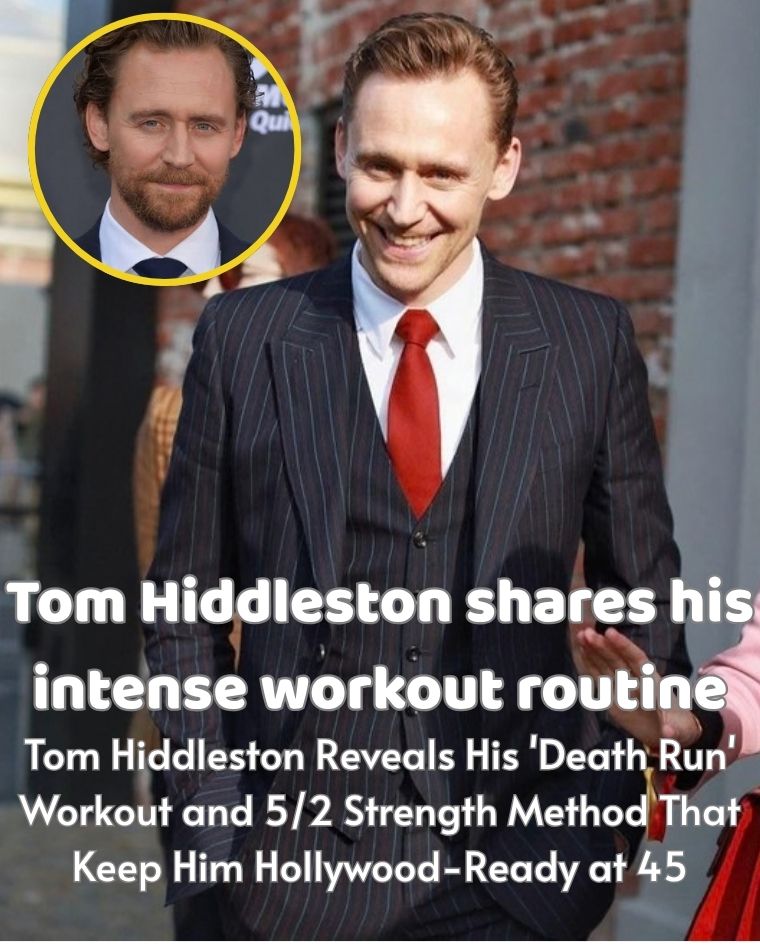
British actor Tom Hiddleston has pulled back the curtain on the punishing physical conditioning routine that keeps him lean, injury-free, and screen-ready at age 45. From running grueling grass shuttles to cycling through high-efficiency functional circuits, the acclaimed performer treats his physique not as an aesthetic trophy, but as an adaptable athletic instrument for Hollywood blockbusters and West End stages.
Tom Hiddleston has long stood out among contemporary leading men for bringing an intellectual intensity and emotional depth to every screen role he inhabits.
Yet behind the regal postures and charismatic dialogue lies an athlete whose cardiovascular capacity rivals that of elite middle-distance competitors.
As he navigates his mid-forties, the British star has formally demystified the precise conditioning regimens that keep him remarkably agile across exhausting shoot schedules.
At the center of his fitness toolkit sits an excruciating workout known plainly as the “death run,” alongside a time-crunched strength system dubbed the 5/2 method.
Rather than chasing transient muscle mass or vanity metrics, Hiddleston approaches daily training through the holistic framework of what he designates “total fitness.”
His overarching ambition is straightforward: developing an engine so robust that neither remote terrain nor intense stunt choreography can push him past his physical threshold.
Cre: Gage Skidmore / Wikimedia Commons
The Anatomy of the Feared Death Run Workout
The “death run” represents Hiddleston’s quintessential barometer for pure cardiovascular conditioning and mental resilience.
The concept of the workout is deceptively simple in design, requiring zero gym equipment and relying solely on open ground.
The athlete marks out an exact distance of 100 meters, ideally on an uneven or resistant surface rather than a smooth rubber track.
Hiddleston performs sets of ten consecutive 100-meter shuttle sprints back and forth without pause.
Each set of ten sprints covers exactly one full kilometer of near-maximum sprinting effort.
The goal during each cluster is unforgiving: complete all ten shuttles in under four minutes.
Once a round concludes, the runner is granted precisely two minutes of controlled rest before launching into the next kilometer.
In total, Hiddleston executes five full rounds, amassing 50 hard 100-meter sprints and a staggering five kilometers of sprint volume.
To compound the difficulty, the actor deliberately foregoes synthetic tracks, choosing instead to run the entire session on thick, uneven grass.
Grass strips away natural foot rebound, drastically increasing friction and forcing the stabilizing muscles of the ankles and calves to work overtime.
The workout demands an uncompromising aerobic base and turns recovery into an active discipline rather than a passive break.
Men’s Health UK editor Christopher Riley joined the actor for the workout and labeled it one of the most punishing physical trials he had ever endured.
For Hiddleston, the ultimate test is learning to control respiratory rate while the heart thumps relentlessly inside the chest.
Mountain Demands: Preparing to Embody Sir Edmund Hillary in Tenzing
The brutal death run did not emerge as a casual workout experiment, but as targeted preparation for his demanding biographical film role in Tenzing.
In the upcoming historical drama, Hiddleston portrays legendary New Zealand mountaineer Sir Edmund Hillary alongside Tenzing Norgay.
Portraying one of the world’s most accomplished high-altitude explorers demanded cardiovascular capacity far exceeding regular cinematic fitness.
Filming at elevation and trekking across unforgiving mountainous terrain requires an aerobic base capable of handling sustained hypoxia and systemic fatigue.
Hiddleston stated that he needed to know with absolute certainty that his lungs and heart were fortified against extreme strain.
He wanted an engine capable of handling steep ascents while maintaining vocal control and mental clarity under punishing alpine elements.
The 5km sprint protocol served as a simulated physiological crucible to forge that exact mountain stamina.
By forcing the body to sprint through severe oxygen debt on grassy fields, Hiddleston conditioned his cardiovascular system to process lactic acid efficiently.
The physical preparation allowed him to spend long filming days in heavy climbing gear without succumbing to chronic exhaustion.
The 5/2 Method: Maximizing Strength and Stamina in 30 Minutes
While the death run handles the aerobic extremes, Hiddleston relies on his signature 5/2 training system to maintain muscular power under tight production schedules.
Finding two uninterrupted hours for traditional bodybuilding splits is nearly impossible when juggling early call sheets and continuous rehearsals.
To solve this dilemma, Hiddleston built the 5/2 methodology to generate maximum muscular stimulus and systemic conditioning inside a compact 30-minute block.
The protocol operates on a recurring seven-minute structural cycle that merges compound resistance movements with active recovery periods.
In every round, Hiddleston performs exactly five minutes of continuous, high-density strength work without taking seated breaks.
This five-minute block incorporates functional movements like kettlebell swings, bodyweight push-ups, pull-ups, squats, and loaded carries.
Exercises are chained together in a flowing circuit designed to challenge multiple muscle chains simultaneously.
Once the five minutes of lifting conclude, the session immediately shifts into two minutes of active cardiovascular recovery.
Rather than sitting down on a bench, Hiddleston maintains low-intensity movement, such as steady nasal breathing walks or slow dynamic mobility flows.
These two minutes facilitate rapid lactate clearance, bringing the heart rate down while preserving neuromuscular warmth.
Repeating this seven-minute cycle across four distinct rounds completes a grueling, high-yield session in just under thirty minutes.
The structure provides the dual benefits of hypertrophy and anaerobic endurance without producing the joint inflammation associated with heavy powerlifting.
For a 45-year-old performer whose schedule spans international time zones, the 5/2 protocol delivers maximum athletic return on invested time.
Two Decades of Transformations: From Asgardian Royalty to the Marvel Battlefield
Hiddleston’s disciplined relationship with fitness has evolved across more than two decades of demanding cinematic work.
When he was first cast as the mischievous trickster god Loki in Marvel’s 2011 blockbuster Thor, his physique required rapid recalibration.
To share the screen convincingly with towering co-stars, Hiddleston famously packed on nine kilograms of lean muscle mass in just six weeks.
The rapid transformation demanded heavy compound weightlifting sessions combined with calorie-dense nutritional protocols.
Training on Marvel soundstages quickly turned into high-stakes athletic competition alongside co-star Chris Hemsworth.
Hiddleston recalled brutal benchmark sessions against Hemsworth that consisted of 100 pull-ups, 100 press-ups, a 1,000-meter row, and 100 squats, all completed strictly for time.
Hemsworth consistently held the advantage on heavy vertical pull-ups, while Hiddleston utilized his leaner frame to gain ground during endurance-focused segments.
Those early superhero training days forged his appreciation for work capacity and functional volume.
Over time, however, the toll of heavy barbell loading led him to shift away from pure aesthetic bulking toward fluid athletic longevity.
The Origins of Total Fitness: War Horse and Sunrise Miles
The foundation of Hiddleston’s passion for endurance running traces back to Steven Spielberg’s 2011 epic drama War Horse.
Filming in the damp, sprawling moors of the English countryside demanded incredible physical grit and prolonged mental focus.
To prepare for demanding pre-dawn filming schedules, Hiddleston instituted a personal daily ritual of running five kilometers before sunrise.
Those early morning miles through dew-soaked fields provided an unexpected mental sanctuary amidst grueling production timelines.
Running acted as an instantaneous neurological reset, clearing cognitive fatigue and ensuring he arrived on set fully awake and receptive to direction.
Over the subsequent years, distance running transformed from an occasional conditioning tactic into a fundamental pillar of his psychological wellbeing.
It taught him how to manage his breath under duress and how to stay grounded through intense psychological scenes.
That long-standing habit eventually matured into the comprehensive philosophy he now describes as “total fitness”.
Total fitness rejects the narrow vanity of mirror-focused workouts in favor of measurable biological resilience, joint integrity, and cardiac output.
Functional Movement Over Aesthetics: Treating the Body as a Working Tool
In an industry often dominated by severe dehydration regimes and cosmetic transformations, Hiddleston’s perspective on fitness remains refreshingly pragmatic.
He views his physical body strictly as an instrument of his theatrical and cinematic trade rather than a billboard for aesthetic vanity.
Action choreography, wirework, Shakespearean soliloquies, and location shoots all demand a physique that moves smoothly without pain or restriction.
Hypertrophy that impedes joint mobility or leaves an actor breathless after climbing a flight of stairs serves no genuine artistic utility.
By prioritizing functional kettlebell mechanics, sprint conditioning, and bodyweight mastery, Hiddleston maintains exceptional range of motion.
His training builds structural resilience in connective tissues, shielding his knees, lower back, and shoulders from common stunt-related injuries.
This functional emphasis explains why he has remained free from debilitating physical setbacks throughout his fourth decade.
He avoids isolation machines in commercial gyms, preferring outdoor green spaces, bodyweight tracks, and versatile free weights.
This real-world approach allows him to transition effortlessly from grueling film sets to the physical rigor of live West End theatre.
The Family Factor: How Fatherhood Reshaped His Workout Motivation
The mental engine driving Tom Hiddleston’s training has undergone a profound shift in recent years.
While his twenties and thirties were fueled by competitive drive and the pressure to meet cinematic aesthetic ideals, his priorities have broadened significantly.
The actor revealed to Men’s Health that staying fit is no longer primarily about looking sharp when the cameras roll.
Instead, the daily energy demanded to keep up with his young children now serves as his primary source of motivation.
Parenting requires sustained vitality, quick reflexes, and the physical endurance to manage active family life without chronic fatigue.
This domestic perspective reinforces his commitment to sustainable athletic longevity over destructive, crash-dieting workout programs.
Training for his children means building cardiovascular health that protects his heart and preserves his vitality for decades ahead.
It removes the ego from training, replacing short-term vanity with a durable commitment to lifelong health and holistic well-being.
The Evolutionary Reality of Diet and Sustainable Nutrition
Complementing his training regimen is a deeply considered understanding of human nutrition and energy balance.
In his discussions on fitness, Hiddleston acknowledged the complex biological friction inherent in modern weight management.
Severe caloric deprivation may yield rapid short-term weight loss on the scale, but sustaining those deficits against heightened biological hunger is exceptionally difficult.
Hiddleston referenced the evolutionary adaptations that wired the human body to resist prolonged energy restriction.
Throughout human history, food scarcity was an existential threat, prompting biological mechanisms that trigger intense cravings whenever calories drop.
In our modern environment, where hyper-palatable, calorie-dense processed snacks are perpetually accessible, biological hunger cues become harder to navigate.
Rather than framing diet as an exercise in sheer moral willpower, Hiddleston recognizes that hunger is an expected biological survival response.
He avoids the psychological traps of crash diets and extreme nutrient restriction that leave performers chronically depleted.
Instead, his nutritional framework prioritizes whole, nutrient-dense foods, balanced macronutrients, and sufficient fuel to power high-intensity sprint sessions.
By working alongside human biology rather than fighting against it, he maintains a lean body composition without suffering hormonal crashes or burnout.
Balancing the West End Stage and Hollywood Cinema
The true proof of Hiddleston’s conditioning routine lies in his sustained artistic versatility across stage and screen.
Between filming high-octane blockbusters, the actor regularly returns to the rigorous demands of classical live theatre, including his acclaimed stage work in Much Ado About Nothing.
Performing on the West End requires two to three hours of sustained vocal projection, dynamic physical movement, and continuous emotional availability eight shows a week.
Stage actors frequently suffer vocal fatigue and muscular tension if their cardiovascular conditioning and postural mechanics are underdeveloped.
Hiddleston credits his balanced conditioning protocols with supplying the stamina necessary to command massive theatrical auditoriums night after night.
The breath control developed through his grass sprint sessions translates directly into effortless diaphragm support during demanding monologues.
Simultaneously, the structural durability built via the 5/2 strength circuits prevents the chronic back and shoulder stiffness common among theatre performers.
His ability to shift effortlessly between theatrical prose and physical action proves that functional fitness serves the mind as much as the muscle.
At 45 years old, Tom Hiddleston has created an inspiring blueprint for aging with vitality, demonstrating that peak physical performance is not reserved for the young.
By abandoning vanity-driven fads in favor of cardiovascular grit, functional movement, and scientific nutrition, he has built an engine designed to endure for decades.
Để lại một phản hồi