John Goodman has opened up about the deep bond and generous support he received from Bruce Willis during the formative stages of their acting journeys in an exclusive conversation with People.
The beloved screen veteran revealed that Willis actively looked out for him during their early days in New York and Los Angeles, establishing a friendship rooted in mutual respect, hard work, and artistic devotion.
Long before they became household names through massive hits like Roseanne and Die Hard, both performers shared modest beginnings and supported one another through the unpredictable challenges of the entertainment industry.
Meeting in New York City: The Chelsea Central Years
The initial encounter between John Goodman and Bruce Willis took place during the late 1970s in Manhattan.
At the time, Goodman was an ambitious young theater performer trying to carve out a foothold in the bustling New York performing arts circuit.
Willis was balancing rigorous acting auditions by working behind the bar at Chelsea Central, an Upper West Side neighborhood venue known for its energetic nightlife.
Goodman recalled that visiting Chelsea Central quickly transformed from an ordinary evening outing into a front-row seat to an impromptu masterclass in performance.
Willis did not simply mix drinks and hand glasses across the counter to patrons.
Instead, the future movie superstar treated every shift at the bar as an engaging theatrical showcase.
Goodman noted that Willis maintained complete control over the room, holding the crowd in the palm of his hand night after night with his wit, comedic timing, and boundless energy.
Patrons loved watching Willis juggle bottles, trade snappy banter, and keep the energy soaring across the entire room.
Goodman would often sit at the counter to nurse a drink, observe the lively atmosphere, and talk shop with Willis between pouring rounds.
📸 [ẢNH: John Goodman tham dự sự kiện thảm đỏ tại Hollywood]
Link: https://upload.wikimedia.org/wikipedia/commons/e/ee/John_Goodman_2014.jpg
Nguồn: Wikimedia Commons — Bản quyền CC BY-SA 2.0 (Ảnh chụp bởi Eva Rinaldi)

A Shared Devotion to the Craft of Acting
Beyond the vibrant nightlife of Manhattan, what truly cemented the friendship between Goodman and Willis was their shared dedication to dramatic storytelling.
Whenever the two actors spent time together, their discussions inevitably gravitated toward theater, screen work, and the subtleties of character development.
Goodman pointed out that regardless of whether they were working or simply goofing around town, their conversations constantly circled back to acting technique.
Willis was never casual or half-hearted about his ambition to become a consummate professional actor.
Goodman recognized early on just how deeply serious Willis was about building a legitimate, long-term artistic career.
Their mutual appreciation for performance gave them an uncommon bond that transcended the superficial networking typical of the entertainment world.
Neither actor hailed from Hollywood royalty or possessed powerful family connections in the film industry.
Goodman came from a working-class background in Missouri, while Willis grew up in New Jersey, giving both men a grounded, blue-collar approach to their creative work.
This mutual understanding fostered an environment where both men felt comfortable sharing their creative frustrations, career uncertainties, and hopes for future opportunities.
The Move West and Generosity in Los Angeles
When Bruce Willis made the strategic decision to relocate to the West Coast to pursue television and film opportunities, John Goodman followed shortly thereafter.
Goodman began seeking work in Los Angeles about a year or two after Willis had already established himself in California.
Arriving in Southern California as an unfamiliar performer can be an intimidating, disorienting, and financially precarious experience for any artist.
Yet having an old friend like Willis already present made the transition markedly smoother for Goodman.
Willis immediately extended a helping hand to ensure Goodman would not feel isolated or overwhelmed in the sprawling studio system.
Reflecting directly on that critical period of adjustment, Goodman stated plainly: “He took care of me… I love him so much”.
Willis opened doors, offered advice, and provided companionship when Goodman was still navigating the steep learning curve of Hollywood auditions.
That unwavering support showed an instinctive generosity that defined Willis among those who knew him well behind closed doors.
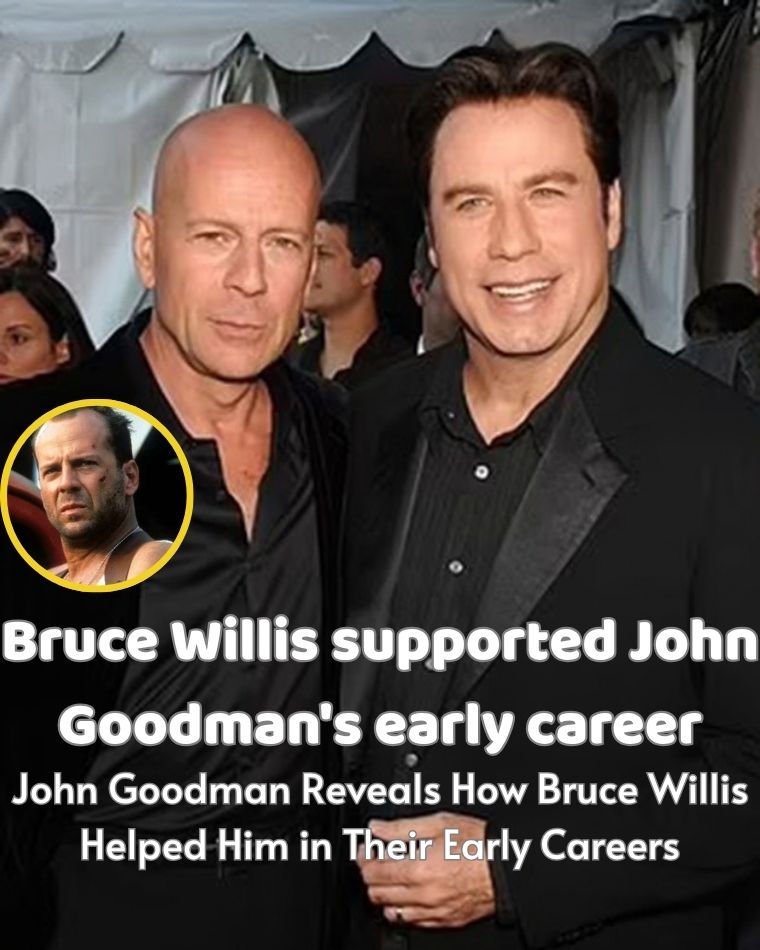
Cre: Wikimedia Commons — CC BY-SA 2.0 (Ảnh chụp bởi Gage Skidmore)
The Breakthrough of Moonlighting and Wild Celebrations
In 1985, Bruce Willis landed the life-changing role that would permanently elevate him from struggling talent to primetime television royalty.
Beating out thousands of hopeful actors during auditions, Willis was cast as the charming private investigator David Addison Jr. opposite Cybill Shepherd in ABC’s smash hit series Moonlighting.
Goodman was right there beside Willis when the momentous casting news finally arrived.
When Willis learned that he had officially landed the part, his ecstatic reaction was unforgettable.
Willis celebrated with explosive, unbridled joy, embracing Goodman with such immense force that Goodman jokingly recalled thinking Willis broke his shoulder.
It was a poignant celebration between two artists who understood firsthand the sheer volume of rejection that preceded any rare Hollywood triumph.
Moonlighting immediately transformed television history with its rapid-fire screwball dialogue, fourth-wall breaks, and palpable on-screen chemistry.
Viewers across the nation fell in love with Willis’s effortless charisma, razor-sharp improvisational skills, and relatable charm.
Despite his sudden catapult into national celebrity status, Willis never lost touch with his theater peers or cast aside the loyal friendships forged in his leanest years.
Rising Trajectories: Roseanne and Die Hard in the 1980s
The late 1980s proved to be a golden era for both performers as their tireless labor yielded extraordinary creative milestones.
Goodman earned critical acclaim on the stage, notably performing in the original Broadway production of the Tony Award-winning musical Big River.
He soon followed with memorable turns in landmark feature films like True Stories and The Big Easy.
In 1988, Goodman secured the iconic role of Dan Conner in the revolutionary sitcom Roseanne.
His portrayal of Dan Conner resonated deeply with millions of viewers, offering one of the most honest, warm, and authentic depictions of blue-collar fatherhood ever seen on television.
That very same year, Willis redefined modern cinematic heroism by taking on the role of NYPD detective John McClane in the 1988 blockbuster Die Hard.
Unlike the invincible, heavily muscled heroes of traditional eighties action cinema, Willis’s McClane was flawed, bloodied, vulnerable, and relatable.
Die Hard was an absolute cultural phenomenon that cemented Willis as an undisputed global box office titan.
A Hollywood Friendship Built on Collaboration and Camaraderie
Throughout their decade-spanning careers, Goodman and Willis demonstrated that genuine camaraderie can survive the fierce pressures of Hollywood.
Both actors maintained reputations as consummate collaborators on set, deeply valuing ensemble work over selfish individualism.
Goodman consistently sought out projects that challenged him artistically, collaborating frequently with visionaries like the Coen brothers while maintaining a commanding presence across film, television, and stage.
Willis continued to champion original storytellers, bringing grit and vulnerability to genres ranging from science fiction and dark comedy to psychological thrillers.
Though their individual paths took them on distinct professional voyages, the bond formed in the late 1970s remained completely unbroken.
Decades after their bartending days in Chelsea, the two veteran actors reunited on the silver screen in the 2017 action-comedy Once Upon a Time in Venice.
Working together on set felt natural and joyful, as if no time had elapsed since their days swapping theater dreams on Manhattan streets.
Goodman celebrated Willis’s natural comedic flair, noting that his former bartending companion had remained just as funny, spontaneous, and generous as he was on day one.
Looking Beyond the Screen Persona
John Goodman’s candid reflections reveal a vital, often overlooked dimension of Bruce Willis’s legacy.
The global public frequently associates Willis strictly with his charismatic movie stardom and relentless action-hero roles.
Yet behind the scenes, Willis established a lasting reputation as a supportive confidant and protector for his fellow artists.
He recognized talent in others and used his personal warmth and early success to make room for his friends.
In an entertainment industry that can often be lonely and cutthroat, having a friend who actively “takes care” of you leaves an indelible mark on an actor’s life.
Goodman’s public gratitude serves as a heartfelt tribute to a friendship that has endured for nearly five decades.
It is a reminder that the greatest triumphs in Hollywood are not simply the awards won or the box office records broken.
Rather, they are the loyal human relationships built along the way that provide genuine shelter, joy, and encouragement when it matters most.
Để lại một phản hồi