In a candid retrospective in September 2026, British actress Emilia Clarke shared her unexpected sense of relief that she never had to film sequels to the sci-fi blockbuster Terminator Genisys.
Stepping into the iconic boots of Sarah Connor for the 2015 summer tentpole was intended to launch a sprawling cinematic trilogy, yet the planned continuations never came to fruition.
Her honest assessment offers a rare and insightful window into the grueling realities of franchise filmmaking and reveals why walking away from massive studio universes can often be an actor’s greatest creative blessing.
Emilia Clarke has built a career marked by bold choices, unforgettable characters, and a refreshingly candid approach to public life.
In an industry where high-profile performers are often expected to maintain a seamless veneer of enthusiasm for studio intellectual properties, Clarke has rarely shied away from honesty.
During an interview in September 2026, the acclaimed actress reflected directly on her high-profile involvement in the historic science fiction franchise Terminator.
When looking back at the aftermath of her headlining role in 2015, Clarke openly admitted that she felt genuine relief when the planned sequels never materialized.
That single admission struck a powerful chord across Hollywood and among dedicated film enthusiasts worldwide.
Actors attached to legendary pop-culture properties typically express polite disappointment whenever ambitious multi-film slates are quietly shelved by production companies.
Clarke, however, offered an unapologetic and grounded evaluation of her personal journey through the blockbuster studio machinery.
She stated clearly that she was relieved she did not have to return for additional Terminator sequels down the road.
Her reaction demystifies the glossy prestige often associated with signing multi-picture contracts for multi-million-dollar Hollywood tentpoles.
It also highlights how demanding and exhausting modern franchise filmmaking can be for emerging artists seeking meaningful creative satisfaction.
By reflecting openly on her experience, Clarke validated the complicated feelings that many performers silently harbor when caught inside massive corporate release calendars.
Her transparency illustrates that avoiding an open-ended cinematic universe can often liberate a performer to pursue deeper artistic fulfillment elsewhere.
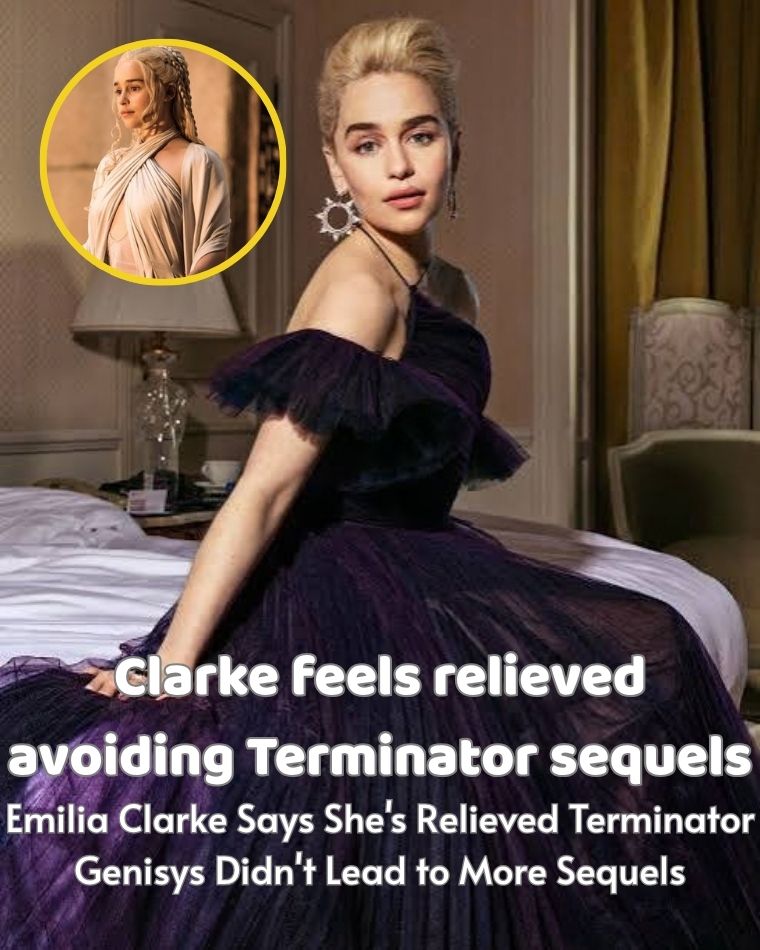
Cre: Wikimedia Commons — Vengerb3rg / CC0 License
Taking Over the Legacy of Sarah Connor in Terminator Genisys
To fully appreciate Clarke’s candid reflections, one must revisit the ambitious landscape of summer 2015.
Clarke signed on to portray the iconic heroine Sarah Connor in Terminator Genisys, directed by Alan Taylor.
The project arrived at an absolute pinnacle of mainstream cultural curiosity surrounding Clarke’s star power.
She was already universally recognized for her transformative work as Daenerys Targaryen on television, commanding audiences across the globe.
Stepping into the Terminator universe represented her definitive leap from prestige cable television into the upper echelons of global cinema.
Sarah Connor was not just any action heroine; she was an established pop-culture icon pioneered with ferocious physical intensity by Linda Hamilton.
Hamilton’s groundbreaking turns in James Cameron’s original 1984 classic and 1991 masterpiece had permanently redefined women in action cinema.
Filling those iconic combat boots carried immense creative weight and inescapable critical scrutiny from an unforgiving global fanbase.
Clarke brought youth, resilience, and emotional complexity to an altered alternate timeline version of the character.
In this reimagined narrative, Sarah Connor was raised from childhood by a reprogrammed T-800 guardian, shifting her foundational journey.
Clarke dedicated months of arduous effort toward demanding stunt work, comprehensive firearms drills, and strict athletic training routines.
She shared extensive screen time alongside bodybuilding legend and original franchise patriarch Arnold Schwarzenegger.
The veteran action icon reprise his hallmark role as the aging cybernetic protector opposite Clarke’s battle-ready heroine.
On screen, Clarke committed herself completely to the high-stakes narrative and pyrotechnic action sequences demanded of her.
Despite her earnest commitment to the role, the pressures of carrying such a revered science-fiction legacy were formidable from the outset.
Navigating the mechanics of temporal paradoxes, heavy visual effects, and relentless exposition presented a singular creative hurdle.
The experience granted Clarke a firsthand understanding of how studio-driven spectacles operate under immense corporate pressure.
The Vanishing Sequel Slate and Unfulfilled Trilogies
When Paramount Pictures and Skydance Media produced Terminator Genisys, they never viewed it as an isolated standalone film.
The production was actively conceived and formally announced as the definitive launching pad for an entirely new cinematic trilogy.
Ambitious studio executives initially penciled in two back-to-back sequels alongside a companion television series to expand the lore.
Release dates for the proposed installments were initially marked on major theatrical distribution calendars before the first movie even opened.
Actors signing onto such massive contemporary projects routinely sign sweeping multi-picture options extending over several years.
These binding agreements essentially claim large windows of an actor’s prime career schedule long before scripts are even finalized.
For an actor whose star was rapidly rising, agreeing to play Sarah Connor carried the real prospect of several sequels dominating her future.
However, the sprawling franchise plans quickly stalled following the release and theatrical run of Genisys in 2015.
The envisioned direct continuations featuring Clarke’s Sarah Connor quietly slipped off studio production boards.
Instead of mounting the planned subsequent chapters, the intellectual property sat in extended development limbo for years.
When the series eventually resurfaced years later, the studio chose to take a completely different creative route with a different timeline.
For Clarke, the quiet discontinuation of that planned trilogy meant an abrupt and unexpected exit from the franchise loop.
Rather than experiencing bitterness or professional heartbreak over unmade follow-ups, Clarke experienced an immense sense of relief.
She realized that the cancellation of those additional chapters spared her from returning to an environment that offered little personal joy.
Her straightforward acknowledgment in September 2026 confirmed that she never harbored lingering regrets about the story ending right there.
Franchise Realities and the Fight for Creative Autonomy
Clarke’s refreshing candor shines a bright light on the complex inner workings of major Hollywood franchise filmmaking.
From the outside, landing a central leading role in a legendary legacy series seems like the ultimate career triumph for an actor.
Audiences envision lucrative paychecks, universal acclaim, global billboard campaigns, and the glamour of world premiere tours.
Yet behind the scenes, franchise filmmaking frequently operates as an intensely commercial, committee-driven industrial machine.
The sheer volume of financial capital invested in tentpoles often leads to heightened studio oversight and relentless narrative compromises.
Directors, writers, and actors can easily find themselves constrained by corporate risk aversion, strict branding mandates, and heavy marketing requirements.
Under such conditions, the pure craft of performance is sometimes overshadowed by the logistical demands of massive special effects and stunt choreography.
Clarke observed these pressures firsthand while navigating the challenging production environment of the 2015 production.
She previously noted that director Alan Taylor, whom she deeply respected from their time together on television, struggled within the studio crucible.
Taylor appeared ground down by the immense institutional machinery and conflicting studio priorities during the difficult shoot.
Watching a respected creative collaborator endure that level of pressure left an indelible impression on the young British actress.
The production was so notoriously strenuous that news of its backstage friction even drifted to neighboring studio soundstages in Louisiana.
When the working environment on a major production turns fraught, the prospect of repeating the experience multiple times becomes daunting.
An ongoing franchise commitment can trap a performer in years of mandatory physical training, lengthy press tours, and prolonged filming schedules.
Clarke’s genuine relief in September 2026 stems directly from recognizing that her creative freedom was saved when those sequels collapsed.
She was spared from having to inhabit a grueling character space repeatedly within an apparatus that failed to nurture its artists.
Her words remind the film industry that an actor’s mental well-being and creative autonomy far outweigh the nominal status of headlining sequels.
The Contrast of Westeros: Eight Seasons of Dedication
Clarke’s reaction to the demise of the Terminator sequels stands in stark, fascinating contrast to her other monumental franchise commitment.
For nearly a full decade, Clarke remained fiercely dedicated to HBO’s groundbreaking fantasy epic Game of Thrones.
Beginning in 2011 and culminating in 2019, she lived and breathed the complex, arduous role of Daenerys Targaryen across eight sweeping seasons.
Filming Game of Thrones was certainly no easy vacation for the young actress.
The production demanded punishing shooting schedules across freezing Irish hills, sweltering Croatian fortresses, and remote Moroccan deserts.
Clarke also survived severe personal health crises, including two life-threatening brain aneurysms, during the early seasons of that rigorous production.
Yet despite the grueling physical demands and emotional toll, Clarke never expressed relief at escaping the world of Westeros prematurely.
She poured her soul into the evolution of Daenerys from an exiled, timid princess into a formidable, world-conquering monarch.
The creative difference between the two experiences reveals everything about what motivates Clarke as an authentic artist.
On Game of Thrones, the grueling labor served a rich, character-driven narrative with profound dramatic resonance and psychological depth.
The long-form storytelling allowed her to explore grief, power, love, vengeance, and moral ambiguity across dozens of meticulously written hours.
Her collaborators functioned as a tight-knit artistic family that supported her artistic risks and sustained her during her deepest personal trials.
In contrast, the commercial studio mechanics of Terminator Genisys felt far more transactional, stressful, and disjointed.
When an actor feels that deep human connection to a story and its community, grueling labor becomes a labor of love rather than a burden.
When that shared joy and narrative clarity are missing, even a celebrated legacy franchise becomes an artistic cage.
Her contrasting reactions clarify that Clarke does not fear hard work, long-term dedication, or demanding physical roles.
Rather, she simply values her creative peace and refuses to spend years serving projects that do not provide genuine artistic nourishment.
Carving a Distinct Career Path Beyond Corporate IP
The collapse of the planned Terminator sequels ultimately proved to be a pivotal turning point in Emilia Clarke’s blossoming career.
Had those sci-fi sequels proceeded as originally scheduled, Clarke would have spent the late 2010s locked into rigorous shooting schedules.
Instead, the sudden vacancy on her calendar allowed her to pivot toward a remarkably eclectic and daring slate of acting projects.
She immediately leaned into intimate, emotionally resonant romantic drama by starring in the 2016 film adaptation Me Before You.
Her heartfelt and charming performance as Louisa Clark showcased a joyful, comedic warmth that surprised audiences accustomed to her stern warrior roles.
The film struck a powerful chord with moviegoers around the globe and established her as a versatile, bankable leading lady outside of heavy sci-fi action.
Clarke continued to challenge herself by exploring diverse genres, including psychological thrillers, independent dramas, and holiday comedies.
In 2019, she delighted audiences by leading the festive romantic comedy Last Christmas, demonstrating her natural charm and musical talent.
Beyond mainstream cinema, Clarke turned her creative energies toward the legitimate stage to sharpen her classical acting craft.
She earned widespread theatrical praise for her commanding performance as Nina in Anton Chekhov’s classic play The Seagull in London’s West End.
Performing live on stage night after night demanded a raw vulnerability and technical precision that big-budget CGI spectacles could never nurture.
She also founded her own production venture, actively acquiring literary properties and championing unique, female-driven narratives.
When Clarke did eventually return to large-scale entertainment, she did so strictly on her own terms and with measured curiosity.
She made a memorable foray into the Star Wars galaxy as Qi’ra in Solo: A Star Wars Story, bringing nuanced mystery to the criminal underworld.
Later, she entered the Marvel Cinematic Universe in the espionage miniseries Secret Invasion, enjoying the freedom of a contained television format.
Each subsequent choice demonstrated an actress deliberately steering her own artistic destiny rather than being steered by multi-year studio mandates.
Her willingness to say no to comfortable, predictable franchise pathways has preserved her passion for the dramatic art form.
As she confirmed in September 2026, freedom from unwanted sequel obligations gave her back the most precious commodity any actor can possess: time.
With that time, she built a rich, diverse, and deeply satisfying body of work that continues to evolve with maturity and grace.
Her honest voice stands as an empowering reminder that stepping away from blockbuster machines is often the boldest move a star can make.
Để lại một phản hồi