Two decades after Casino Royale upended cinematic espionage, the film industry looks back at Daniel Craig’s definitive 15-year tenure across five interconnected blockbusters.
When Daniel Craig first ordered a vodka martini in 2006, he fundamentally dismantled the character’s legacy of gadget-heavy escapism in favor of visceral, emotional realism.
This definitive ranking traces Craig’s complete journey from an untested, raw recruit to the tragic farewell of No Time to Die.
The Cultural Shockwave of 2006 and the Blonde Bond Skepticism
In 2005, the announcement of Daniel Craig as the sixth official James Bond triggered intense skepticism across global fandom and entertainment tabloids.
Critics openly questioned whether a blonde, rugged theater-trained actor could embody the effortless debonair charm established by Sean Connery and Pierce Brosnan.
Online boycott campaigns emerged before a single frame of footage had been captured or screened to the public.
The franchise was recovering from the cartoonish excesses of 2002’s Die Another Day, an entry defined by invisible cars and CGI tsunamis.
Producers Barbara Broccoli and Michael G. Wilson recognized that 007 needed an absolute operational overhaul to survive the post-Bourne era.
The answer was returning straight back to Ian Fleming’s very first novel, stripping the character down to his core anatomy.
Craig brought an austere, muscular intensity that felt closer to an assassin than a runway model.
When Casino Royale premiered in November 2006, all skepticism evaporated within minutes.
Audiences witnessed a bleeding, bruised secret agent who suffered genuine emotional trauma and physical exhaustion.
The film set a brand-new standard for 21st-century action filmmaking, introducing a serialized psychological depth never before attempted across the franchise’s history.
Over the course of 15 years and five films, Craig transformed James Bond into a mortal man bound by grief, duty, and sacrifice.
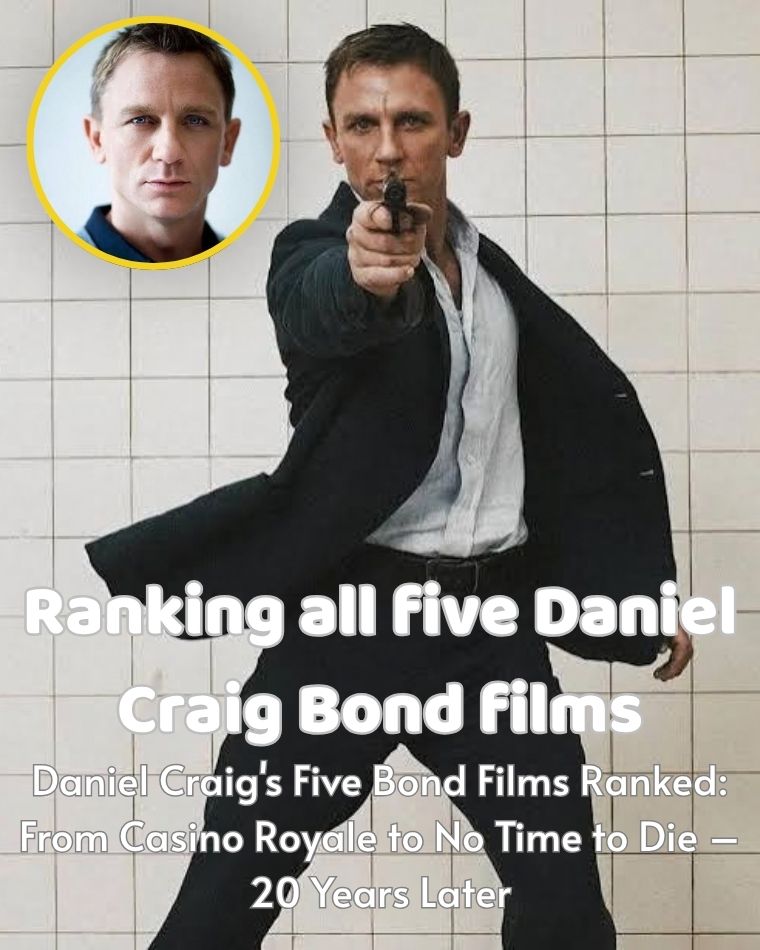
Now, marking the 20th anniversary of Craig’s debut, UK publication Film Focus Online published its comprehensive ranking of all five entries.
Here is how Daniel Craig’s five James Bond adventures rank, from the flawed franchise experiments to the masterpieces of the genre.
Cre: Wikimedia Commons — CC BY 2.0
5. Quantum of Solace (2008): A Frantic Aftershock
Ranked at number five on the retrospective list, Quantum of Solace carried the impossible burden of directly following a genre masterpiece.
Director Marc Forster took the helm of an entry that began mere minutes after Vesper Lynd’s tragic demise.
Running at a brisk 106 minutes, it stands as the shortest feature in Daniel Craig’s entire 007 filmography.
The central narrative concept remains genuinely compelling: exploring a secret agent paralyzed by raw grief and explosive rage.
Bond refuses to compartmentalize Vesper’s betrayal, turning MI6’s international operational apparatus into an instrument of personal retribution.
However, the film was severely compromised by the Hollywood writers’ strike, leaving the production without a polished script.
Craig and Forster were frequently forced to rewrite dialogue and structural action beats while on set.
The resulting film suffers from hyperactive, frenetic editing heavily influenced by contemporary Bourne-style editing trends.
Action sequences—from the opening car pursuit around Lake Garda to the Sienna rooftops—often move too rapidly for visual geography to register.
Villain Dominic Greene, portrayed by French actor Mathieu Amalric, never quite projects the menace required to challenge Craig’s lethal operational agent.
Greene’s scheme to monopolize Bolivia’s subterranean water supply, while politically grounded and realistic, lacked cinematic grandiosity.
Yet Quantum of Solace possesses undeniable artistic merits that film scholars and retrospective analyses have come to appreciate.
The Tosca opera sequence in Bregenz represents one of the most sophisticated set pieces in modern action cinema.
Bond quietly unmasks members of the shadowy Quantum syndicate simply by speaking through an open communications channel.
Olga Kurylenko’s Camille Montes offers a refreshing subversion of the typical Bond heroine archetype.
Camille is motivated strictly by her own parallel quest for personal vengeance rather than romantic attachment to Bond.
Craig’s colder, severely unhinged performance captures an operative clinging desperately to his humanity while descending into psychological darkness.
Ultimately, Quantum of Solace feels less like an independent film and more like a furious, turbulent epilogue to Casino Royale.
4. Spectre (2015): The Weight of Unnecessary Continuity
Arriving at fourth place in the ranking, Spectre demonstrates the perils of retroactively forcing continuity onto standalone cinematic stories.
Following the historic critical and commercial triumph of Skyfall, director Sam Mendes returned to deliver an expansive globetrotting spectacle.
On an audiovisual level, the film starts with undisputed brilliance.
The opening tracking shot through Mexico City’s Day of the Dead celebration remains a masterclass in staging, timing, and choreography.
Craig moves through vibrant crowds in a skull mask before executing an assassination that brings down an entire city block.
The film successfully reacquired the rights to Ian Fleming’s legendary criminal organization SPECTRE and Bond’s arch-nemesis Ernst Stavro Blofeld.
Casting two-time Academy Award winner Christoph Waltz appeared to be an immaculate creative choice on paper.
Furthermore, Léa Seydoux brought intellectual mystery and poise to the role of Dr. Madeleine Swann.
Thomas Newman’s evocative score and Hoyte van Hoytema’s atmospheric cinematography provided immense visual and auditory polish.
However, the screenplay made the fateful decision to retcon all previous Craig villains into Blofeld’s singular master plan.
Blofeld claimed to be “the author of all your pain,” revealing himself as the shadowy puppet master behind Le Chiffre, Dominic Greene, and Raoul Silva.
Worse still, the narrative manufactured an unconvincing foster-brother relationship between Bond and Franz Oberhauser.
This contrived familial rivalry reduced global geopolitical stakes to petty, teenage domestic resentment.
Individual narrative victories and standalone threats that worked seamlessly in earlier chapters suddenly felt diminished by this forced connection.
Despite structural script missteps, Craig’s charismatic ease in the role keeps the film afloat throughout its second act.
The brutal, close-quarters train fight against Dave Bautista’s Mr. Hinx stands among the most punishing physical skirmishes in franchise history.
Spectre succeeded as an affectionate nod to 1960s classicism, but it struggled under the strain of an unearned grand universe design.
3. No Time to Die (2021): Emotional Reckoning and an Audacious Farewell
Placing third in Film Focus Online’s retrospective assessment, No Time to Die had to confront unprecedented real-world and narrative expectations.
After multiple production delays and global pandemic disruptions, the film arrived as Daniel Craig’s absolute swansong as Agent 007.
Director Cary Joji Fukunaga brought visual flair and cinematic ambition, delivering a massive 163-minute epic that refused a predictable exit.
The film provided Bond with something no previous cinematic iteration had ever enjoyed: a genuine existence outside of Queen and Country.
Retiring to Jamaica, Bond has disconnected from MI6, attempting to leave behind a lifetime soaked in gunpowder and bloodshed.
His romantic relationship with Madeleine Swann deepens considerably, eventually revealing that Bond has fathered a young daughter, Mathilde.
Craig delivers arguably his most raw, emotionally committed performance across his 15-year tenure.
He portrays a weathered warrior who suddenly discovers a profound, desperate reason to stay alive.
The action set pieces shine with precision, especially the sun-drenched Matera car chase utilizing the classic gadget-laden Aston Martin DB5.
Ana de Armas steals the film entirely during her brief appearance as CIA operative Paloma in Havana, bringing electrifying charm and lethal speed.
Lashana Lynch’s Nomi injects sharp comedic friction as the newly assigned operative who inherited the 007 designation.
The film is not entirely immune to narrative flaws.
Rami Malek’s Lyutsifer Safin begins with terrifying presence during an ice-lake prologue, but devolves into an underwritten, vaguely motivated cartoon villain.
Safin’s biological nanobot weapon, the “Heracles” virus, functions more like an apocalyptic plot device than a coherent ideological threat.
Yet when the narrative zeroes in on James Bond’s internal sacrifices, No Time to Die hits with devastating emotional resonance.
The climax sees Bond infected with nanobots genetically coded to kill Madeleine and his daughter, rendering physical touch fatal to his loved ones.
Refusing to leave the missile blast zone on Safin’s island base, Bond faces down a rain of British naval cruise missiles.
His final radio transmission to Madeleine—reaffirming his enduring love as the missiles descend—shattered 60 years of franchise convention.
Killing James Bond was an audacious, unprecedented artistic gamble that divided conservative segments of the audience.
Yet within Daniel Craig’s singular, serialized universe, giving 007 a definitive, noble death was the only honest culmination of his journey.
2. Casino Royale (2006): The Blueprint for 21st Century Action Cinema
Holding the runner-up spot after two decades of intense scrutiny, Casino Royale remains the untouchable gold standard for franchise reboots.
Helmed by veteran director Martin Campbell, the film did not merely reintroduce a cultural brand; it radically interrogated its protagonist’s soul.
The opening black-and-white prologue in Prague instantly established the new cinematic rules through harsh, monochrome brutality.
Bond earns his license to kill not through effortless flair, but through a drowning struggle in an office sink and a point-blank gunshot.
From there, the Madagascar parkour sequence pitting Bond against Sébastien Foucan set an adrenaline benchmark that Hollywood spent the next decade imitating.
Unlike Hollywood action heroes who float through physics, Craig’s Bond is an unyielding human battering ram who crashes through drywall and lands heavily on concrete.
The film’s structural brilliance lies in how action balances against cerebral, psychological warfare.
Once the narrative transitions to the poker tables of the Casino Royale in Montenegro, the suspense shifts entirely to human faces, card tells, and tactical betting.
Mads Mikkelsen delivers an iconic performance as Le Chiffre, a desperate banker weeping blood from a damaged tear duct.
Le Chiffre is terrifying precisely because he is vulnerable: he is not trying to take over the planet, but merely trying to win back terrorist capital before his warlord clients murder him.
The infamous wicker chair torture scene dismantled decades of invincible Hollywood spy tropes.
Bond is stripped bare, screaming in agonized defiance, proving his psychological grit when technology and weapons are stripped away.
Above all, the emotional engine of Casino Royale is Eva Green’s transfixing performance as HM Treasury representative Vesper Lynd.
Their intellectual sparring on the train through Europe established the sharpest banter in modern franchise history.
Vesper is the only woman who ever saw completely through Bond’s armored defense mechanisms, noticing the orphan boy underneath the bespoke tailoring.
The shower scene following a stairwell knife fight—where Bond sits in his tuxedo beside a traumatized Vesper to comfort her under cold water—infused the series with unmatched vulnerability.
Her eventual betrayal, followed by her tragic drowning inside a sinking Venetian palazzo, directly created the cold, detached killer audiences had known for 40 years.
The final scene, where Bond shoots Mr. White in the leg and recites the iconic catchphrase over David Arnold’s roaring orchestra, gave viewers chills.
Casino Royale proved that a blockbuster could possess immaculate popcorn thrills alongside the psychological depth of high-end literary drama.
1. Skyfall (2012): The Phenomenon That Mastered Past and Present
Taking the crown at number one on Film Focus Online’s definitive list, Skyfall stands as the artistic zenith of Daniel Craig’s James Bond era.
Released during the 50th anniversary of the film franchise, Skyfall achieved the near-impossible feat of celebrating 007’s past while deconstructing his future.
Director Sam Mendes transformed a classic British pop-culture staple into an operatic, psychological character study.
The film asks an uncomfortable, timely question: Does an aging physical field agent still matter in a modern world governed by cyber warfare and invisible algorithmic threats?
Bond begins the story as a physically broken, psychologically exhausted operative who fails his opening test and drinks heavily in hiding.
When MI6 headquarters in central London suffers a devastating cyber attack, Bond returns to duty despite being biologically and psychologically unfit for field service.
What elevates Skyfall into legendary status is its unmatched visual and technical craftsmanship.
Legendary cinematographer Roger Deakins created what is universally heralded as the most breathtakingly gorgeous spy film ever lensed.
The neon-lit sniper duel set against glowing jellyfish billboards in a Shanghai skyscraper plays out like hypnotic shadow puppetry.
The lantern-lit boat arrival in Macau feels mythic, while the burning manor house on the foggy Scottish moors provides a gothic, atmospheric climax.
Adele’s haunting Oscar-winning theme song and Thomas Newman’s pulsating orchestral score wrap the movie in operatic majesty.
The narrative centers on the intimate maternal dynamic between James Bond and Judi Dench’s formidable intelligence director, M.
Dench had portrayed M across seven films, but Skyfall turned her into the undisputed emotional co-lead of the picture.
Javier Bardem crafts an all-time great franchise adversary in Raoul Silva, a former MI6 operative abandoned to torture in Hong Kong.
Silva is Bond’s dark psychological mirror: an abandoned “son” seeking to destroy the cold, calculating “mother” who traded his life away for state secrets.
Their confrontation inside an abandoned Japanese island fortress hums with genuine menace and psychological boundary-pushing.
Rather than culminating in a high-tech villain base, the third act strips away modern technology entirely.
Bond takes M back to his ancestral home, Skyfall Lodge in the Scottish highlands, accompanied by gamekeeper Kincade and an old shotgun.
The reintroduction of the classic Aston Martin DB5, complete with ejector seat controls, brought retro iconography back without descending into cheap parody.
The film successfully reintroduced Ben Whishaw as an intellectual young Q and Naomie Harris as Eve Moneypenny, grounding them firmly in Craig’s contemporary universe.
When M succumbs to her bullet wounds inside the family chapel, Craig sheds genuine tears, completing an extraordinary emotional arc.
Skyfall proved that a James Bond film could conquer the global box office—surpassing one billion dollars—while earning serious Oscar recognition and elite artistic acclaim.
It remains the most complete, emotionally resonant, and visually stunning entry of Daniel Craig’s entire 15-year career as Agent 007.
The Enduring Legacy: How Daniel Craig Redefined the Icon
Looking back across two decades since Casino Royale debuted, Daniel Craig’s overall cultural impact on cinema remains profound.
Before Craig took the mantle, James Bond was largely perceived as an invincible, unchanging caricature who reset his emotional odometer at the start of every adventure.
Craig proved that a continuous character arc could exist across a five-film, multi-billion-dollar franchise.
He transformed 007 into a bruised, complicated figure who loved deeply, suffered immensely, and carried physical scars forward into subsequent missions.
By anchoring high-octane spectacle to authentic emotional stakes, Craig ensured that Ian Fleming’s Cold War assassin remained vital, dangerous, and culturally indispensable for modern cinema.
Để lại một phản hồi