Michael Jackson’s iconic 1982 masterpiece “Thriller” has secured a historic peak on Billboard’s Top R&B Albums chart, continuing its dominance more than forty years after its initial debut.
The resurgence highlights how classic catalogs remain commercial powerhouses in the modern streaming ecosystem, fueled by anniversary tributes, biopic projects, and global fan rediscovery.
With songs that defined modern popular music, the album continues to reach multi-generational audiences while breaking longevity records across Billboard tallies.
Industry analysts point to the project’s unprecedented genre synthesis—merging funk, disco, pop, and hard rock—as the blueprint that continues to inspire contemporary artists today.
The latest chart ascension underscores how timeless songwriting, revolutionary production, and unmatched visual identity allow historic works to outperform modern chart releases.
From physical vinyl sales to viral social media trends, the landmark record proves that true artistic brilliance does not diminish with time.
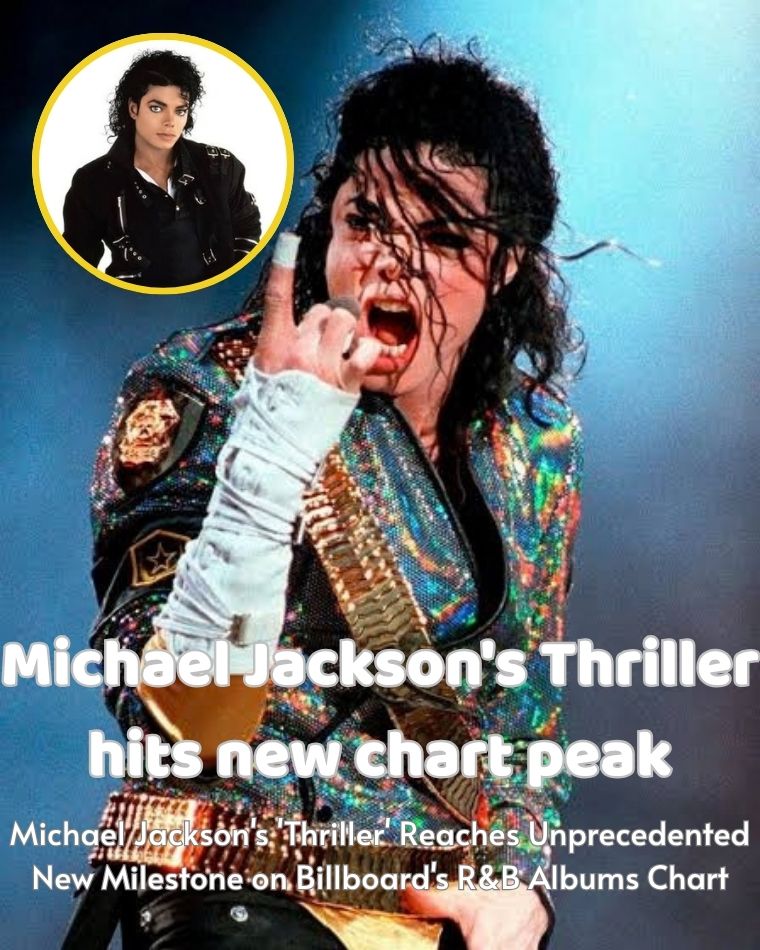
Cre: Wikimedia Commons — Public Domain / Creative Commons Attribution-Share Alike 3.0 Unported
A Historic Milestone on the Billboard R&B Albums Chart
Four decades after its release in November 1982, “Thriller” has reached a new summit on Billboard’s Top R&B Albums chart.
Music publication Rated R&B reported that the album logged a monumental multi-week stay at No. 1 on the chart.
The milestone extends Michael Jackson’s record for the longest-running No. 1 release on Billboard’s Top R&B Albums ranking since the list was officially created in 2013.
Certified 3x Diamond by the Recording Industry Association of America (RIAA), “Thriller” remains the gold standard of commercial and critical triumph.
Billboard tracks album performance by combining traditional album sales, digital track downloads, and audio on-demand streams from major platforms.
The fact that an LP recorded during the analog studio era can dominate consumption metrics in an algorithmic streaming era speaks volumes about its enduring value.
Few albums from the early 1980s maintain sufficient streaming and sales volume to compete with current chart heavyweights.
Yet “Thriller” has repeatedly overtaken recent major releases across digital service providers and physical retail chains.
The album’s latest climb proves that its impact is not merely a memory preserved in music history books.
Instead, the record remains an active, revenue-generating, and culturally vital force in today’s entertainment landscape.
Listeners who bought the original vinyl upon release in 1982 are now joined by Gen Z and Gen Alpha discovery listeners.
Digital streaming providers routinely place tracks from the album into top editorial playlists, introducing classic tracks to first-time listeners every day.
The ongoing chart longevity cements Jackson’s standing as one of the most commercially durable figures in modern entertainment history.
The Cultural Impact of the Record-Breaking Biopic ‘MICHAEL’
The immediate catalyst behind this historic chart resurgence is the worldwide release and monumental success of the cinematic biopic “MICHAEL”.
Directed to capture the King of Pop’s life and artistry, the film made box-office history by surpassing $1 billion in global ticket receipts.
Starring Jaafar Jackson, the entertainer’s nephew, the biographical film brought Michael Jackson’s intensive studio work and stage craft back into global public discourse.
Theatergoers walked out of multiplexes and immediately turned to streaming platforms to explore Jackson’s studio albums.
Biopics historically create measurable commercial bumps for legacy recording catalogs.
Queen experienced a global streaming renaissance following the release of “Bohemian Rhapsody” in 2018.
Similarly, Baz Luhrmann’s “Elvis” drove an influx of younger fans to Elvis Presley’s Sun Records and RCA catalogs in 2022.
However, the magnitude of the streaming resurgence following “MICHAEL” has eclipsed previous industry benchmarks.
The cinematic depiction of the “Thriller” recording sessions reminded viewers of the sheer precision behind every drum snare, synthesizer riff, and vocal take.
Audiences witnessed the painstaking labor invested into arranging tracks like “Billie Jean” and “Beat It”.
This film-driven exposure translated directly into verifiable Luminate tracking data and Billboard chart positioning.
‘Billie Jean’ and the Relentless Power of Individual Tracks
While the entire album has surged, individual singles from the record have achieved their own extraordinary streaming milestones.
Jackson’s immortal 1983 single “Billie Jean” logged extensive double-digit weeks at No. 1 on Billboard’s R&B Streaming Songs chart.
“Billie Jean” stands as Jackson’s longest-running No. 1 single on that particular streaming tally since the chart’s launch.
The song’s iconic bassline—performed by legendary bassist Louis Johnson and conceived by Jackson himself—remains one of the most recognizable riffs in popular culture.
From its signature drum shuffle played by Ndugu Chancler to Jackson’s tension-filled vocal delivery, the track commands uninterrupted attention.
Streaming metrics indicate that listeners regularly play “Billie Jean” alongside modern urban hits by Drake, SZA, and Bruno Mars.
Beyond “Billie Jean,” the rock-infused anthem “Beat It” also experienced a massive influx of plays across global DSPs.
Featuring Eddie Van Halen’s blistering guitar solo, “Beat It” redefined how pop and hard rock could merge without alienating radio listeners.
Meanwhile, the nine-song album provides listeners with an uninterrupted listening experience devoid of filler tracks.
Songs like “Wanna Be Startin’ Somethin’,” “Human Nature,” and “P.Y.T. (Pretty Young Thing)” register millions of monthly streams on Spotify and Apple Music.
“Human Nature,” written by Steve Porcaro of Toto and John Bettis, continues to be sampled by modern hip-hop and R&B producers across multiple generations.
The title track “Thriller,” with its macabre orchestration and Vincent Price narration, enjoys an annual resurgence every autumn while sustaining strong base-level listening year-round.
The cumulative consumption of these nine cohesive tracks drives the full LP upward on national album sales rankings.
The Architectural Blueprint: Quincy Jones, Bruce Swedien, and Westlake Studios
To understand why “Thriller” continues to chart at the summit in 2026, one must examine its meticulous production architecture.
Recorded between April and November 1982 at Westlake Recording Studios in Los Angeles, the album was helmed by producer Quincy Jones.
Jones and Jackson sought to create a record where every single song could serve as a standalone hit single.
Working alongside master recording engineer Bruce Swedien, the team developed cutting-edge sonic techniques that set a new benchmark for audio fidelity.
Swedien utilized his proprietary Acusonic Recording Process, pairing paired stereo microphone setups with synchronized multi-track analog tape recorders.
This technique captured unmatched dynamic punch, acoustic depth, and spatial dimension that modern digital mastering often struggles to replicate.
The bass frequencies were calibrated to hit the chest of the listener without causing distortion on vinyl grooves or cassette players.
The brass arrangements, conducted by Jerry Hey, delivered punchy accents that cut through complex synthesizer textures.
Synthesizers like the Roland Jupiter-8, Minimoog, and Yamaha CS-80 were layered with acoustic horns, percussion, and live guitars.
Rod Temperton, the British songwriter formerly of Heatwave, contributed masterclass compositions including “Baby Be Mine,” “The Lady in My Life,” and “Thriller.”
Temperton’s harmonic sophistication provided an elegant counterpart to Jackson’s rhythmic funk instincts.
Every arrangement choice was scrutinized until the sonic presentation met exacting professional standards.
When the initial mix did not meet expectations, Jones and Jackson took the bold step of remixing the entire album track by track under grueling deadline pressure.
That obsessive attention to detail produced an acoustic masterwork that sounds as crisp on high-end modern headphones as it did on 1980s stereo systems.
The Music Video Revolution and MTV Transformation
The enduring footprint of “Thriller” cannot be divorced from its visual innovations, which permanently altered the music industry’s commercial infrastructure.
Prior to 1983, Black recording artists faced steep barriers to receiving regular rotation on MTV, which was then a fledgling cable network focused primarily on rock acts.
Jackson’s visual treatments for “Billie Jean” and “Beat It” broke that racial barrier, forcing cable networks to embrace Black pop artists.
“Billie Jean,” directed by Steve Barron, showcased Jackson as an enigmatic figure whose touch brought illumination to urban sidewalks.
“Beat It,” directed by Bob Giraldi, utilized real rival street gang members to deliver a powerful message of peaceful de-escalation through choreography.
Then came the definitive landmark: the 14-minute short film for the title track “Thriller,” directed by feature filmmaker John Landis.
Budgeted at roughly $500,000—an extraordinary sum for a promotional music clip at the time—the project was produced as a mini-horror feature.
With elaborate zombie prosthetics designed by Rick Baker and iconic red-leather costuming designed by Deborah Nadoolman Landis, the video captivated global television audiences.
The choreography crafted by Jackson and Michael Peters became an international phenomenon, learned by dancers across every continent.
MTV aired the full short film multiple times per day, generating unprecedented viewership ratings and skyrocketing album sales worldwide.
The release of the home video documentary “The Making of Michael Jackson’s Thriller” pioneered the sell-through commercial home-video market.
These historic cinematic clips have accrued billions of cumulative views on YouTube, where remastered 4K editions introduce Jackson’s choreography to new generations of youth.
The visual iconography of the red leather jacket, the white sequined glove, and the moonwalk remain instantly identifiable worldwide.
Chart Parallels and Contemporary R&B Landscape
The ongoing success of “Thriller” unfolds within a vibrant contemporary R&B landscape where modern superstars share chart space with classic royalty.
According to Rated R&B’s chart reporting, Jackson’s compilation “Number Ones” also occupied the runner-up No. 2 spot alongside “Thriller”.
Modern releases by artists like SZA (“SOS”), Steve Lacy (“Oh yeah?”), and Bruno Mars (“The Romantic”) actively populate the Top 5 alongside Jackson’s catalog.
On the radio front, artists such as Ne-Yo have maintained substantial longevity with hits like “Up Out & Gone” topping the Adult R&B Airplay charts.
Singer Kehlani has similarly driven waves across airplay lists with chart-topping tracks like “Folded”.
Meanwhile, rising sensations including Olivia Dean and Tems continue to score major streaming and airplay hits.
This dynamic chart environment illustrates that the R&B genre is experiencing an expansive renaissance.
Modern listeners seamlessly alternate between contemporary alternative R&B and the foundational classics that shaped the genre’s history.
Streaming algorithms frequently bridge these eras by recommending Jackson’s catalog to fans of modern vocalists like The Weeknd and Chris Brown.
The Weeknd’s production style on records like “Dawn FM” and “After Hours” explicitly honors the sonic architecture established by Jackson and Quincy Jones.
Similarly, Bruno Mars and Anderson .Paak’s Silk Sonic project channeled early 1980s funk and soul arrangements directly inspired by the Westlake sessions.
Because modern pop and R&B continually draw inspiration from the 1980s, “Thriller” sounds completely natural in modern automated playlists.
How Streaming Platforms Changed Catalog Value
In previous decades, physical music retail operated under limited shelf space and finite manufacturing cycles.
Record stores routinely phased out older releases to make room for promotional priority releases and new album cycles.
Older catalog albums were relegated to back-catalog discount bins or specialized vintage shops.
The streaming model dismantled these physical shelf-space constraints entirely.
Every recorded song released across history is now equally accessible to any smartphone owner around the globe.
Under this consumption structure, high-quality music competes purely on emotional resonance, replay value, and cross-generational appeal.
Algorithms on Spotify, Apple Music, and YouTube Music reward tracks that generate high completion rates and repeat listens.
Because every track on “Thriller” features strong melodic hooks and dynamic pacing, listeners rarely skip songs during album play.
This consistent engagement signals to recommendation engines that the album should be surfaced to wider listening audiences.
Furthermore, social media platforms like TikTok and Instagram have transformed how vintage songs go viral.
Brief snippets of dance choreography, vocal covers, and nostalgic retrospectives spark viral challenges that pull millions of streams back to streaming services.
Even catalog tracks that were not primary singles can experience sudden global revivals through user-generated social media clips.
The music industry has consequently re-evaluated the financial valuation of legacy catalogs.
Publishing and master recording rights for iconic artists command hundreds of millions of dollars on international investment markets.
“Thriller” stands as the crown jewel of music publishing catalogs, providing stable, recurrent streaming dividends across four distinct decades.
The Cultural Longevity of Pop’s Crowning Achievement
The cultural footprint of “Thriller” extends far beyond Billboard chart metrics and monetary royalties.
Upon its original run, the album spent 37 non-consecutive weeks at No. 1 on the Billboard 200 between 1983 and 1984.
It earned eight Grammy Awards at the 26th Annual Grammy Awards in 1984, setting an all-time record for a single artist in a single evening.
The LP yielded seven top-ten singles on the Billboard Hot 100, an unprecedented feat that proved every cut had radio viability.
Beyond statistics, the album helped unify fragmented cultural spheres during a critical era of modern American history.
It brought together rock enthusiasts, disco patrons, R&B communities, and global international markets into one cohesive audience.
World tours, stadium concerts, and global television broadcasts established Jackson as the most famous entertainer on the planet.
Decades later, international flash mobs regularly gather in cities from Tokyo to London to recreate the signature “Thriller” zombie dance routine.
Schools, dance academies, and community centers teach the steps of “Billie Jean” to young students who admire Jackson’s technical footwork.
Tribute concerts and symphony orchestra renditions regularly celebrate the complex musical arrangements composed by Jackson and Rod Temperton.
The album has been inducted into the Library of Congress’s National Recording Registry, recognized as culturally, historically, or aesthetically significant.
Grammy Hall of Fame inductions and museum exhibits around the world continue to preserve artifacts from the recording sessions.
Why ‘Thriller’ Refuses to Age
When listening to modern pop releases, one frequently encounters quantized drum grids, aggressive pitch correction, and heavily compressed mixes.
While these tools offer pristine polish, they often sacrifice organic human groove and dynamic range.
In contrast, “Thriller” was recorded with world-class session musicians playing together in top-tier acoustic chambers.
Drummers like Jeff Porcaro and Ndugu Chancler played with a subtle micro-timing that gave the rhythms natural swing and infectious bounce.
Bassist Louis Johnson brought authentic funk grit to the low-end frequencies.
Jackson’s vocal performances captured raw emotional breath, percussive vocal hiccups, and astonishing four-octave harmonic stacks.
He layered his own backing vocals dozens of times to create a rich, choir-like wall of sound.
Because the instrumentation breathed with human vitality, the music never feels dated or trapped within a bygone historical era.
Instead, the production sounds warm, textured, and deeply three-dimensional to contemporary audiophiles.
As contemporary artists seek to move away from sterile digital programming, they frequently study the Westlake studio sessions for creative inspiration.
Engineers and producers cite Bruce Swedien’s microphone placement notes as masterclass instructional material for audio production programs worldwide.
The album’s technical brilliance ensures that each subsequent remaster and spatial audio mix unveils new musical textures for the listener.
An Unbroken Legacy Across the Century
The latest milestone on Billboard’s Top R&B Albums chart is not a momentary anomaly.
It represents the continuing trajectory of an album that fundamentally rewrote the rules of the global music business.
“Thriller” demonstrated that an album could achieve unprecedented commercial volume while maintaining uncompromising musical artistry.
It established the modern multi-media release model, connecting album releases with cinematic visuals, signature merchandise, and global events.
As biographical films, streaming platforms, and social platforms continue to introduce historic art to rising generations, “Thriller” remains perfectly positioned to maintain its cultural dominance.
Great art does not expire; it continually gathers new layers of cultural context and collective adoration.
Michael Jackson’s crowning studio triumph continues to guide, challenge, and inspire the sound of global popular music.
Decades after its debut, the world continues to dance to its rhythms, study its arrangements, and celebrate its record-shattering achievements.
As chart histories are rewritten in the modern digital era, “Thriller” stands unchallenged as the definitive pop album of all time.
Để lại một phản hồi