On what would have marked the late rapper’s 53rd birthday, Eminem shared a deeply heartfelt tribute to his closest brother in music, reminding millions that brotherhood never fades with time. The public message arrived exactly twenty years after Proof’s heartbreaking passing, reaffirming the irreplaceable impact of the man who believed in Marshall Mathers long before the world knew his name.
On October 2, 2026, hip-hop icon Eminem honored his late best friend and fellow D12 co-founder, Proof, on what would have been the Detroit MC’s 53rd birthday.
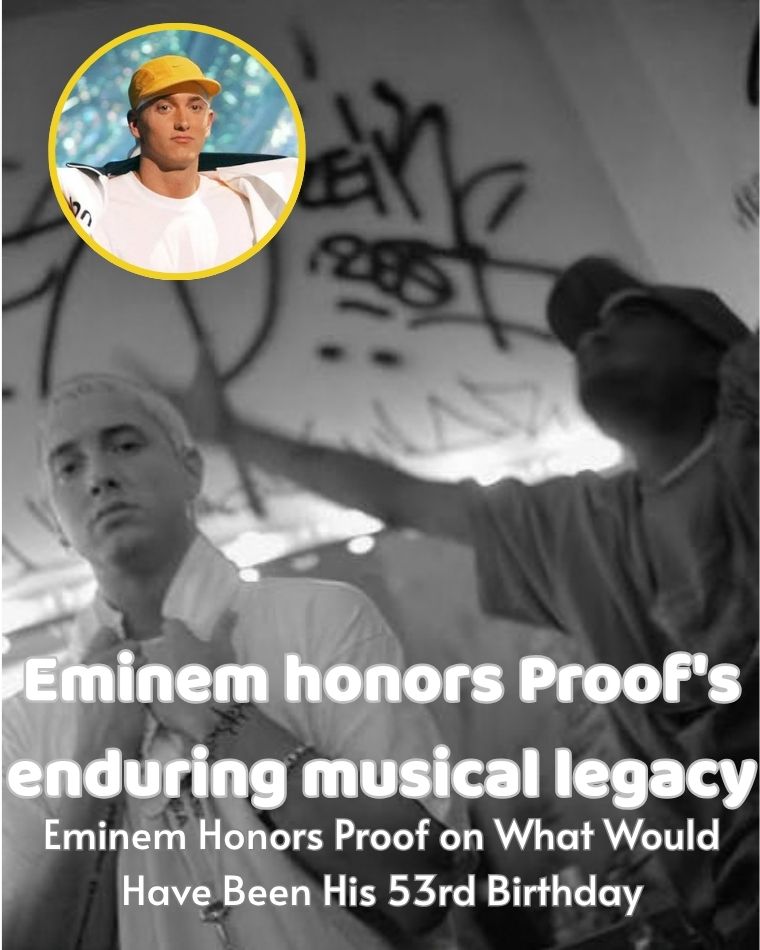
The rap superstar took to his social media platforms to commemorate the special date, posting a nostalgic photograph alongside a personal message of love and remembrance.
Writing directly to his lifelong companion, Eminem shared the touching words: “Remembering and celebrating your life Doody 🕊️ today and always!!! Happy Bday Big Proof.”
The moving birthday note arrived just months after Eminem reflected extensively on the somber 20th anniversary of Proof’s passing in April 2026.
Born DeShaun Dupree Holton on October 2, 1973, Proof was tragically killed in Detroit in 2006 at the young age of 32.
His premature death stunned the worldwide hip-hop community and permanently altered the course of Eminem’s personal life and artistic career.
Yet twenty years later, Eminem’s consistent tradition of publicly honoring Proof demonstrates an enduring bond that neither time nor immense fame has managed to diminish.
Every year on October 2, fans across generations join Eminem in honoring a pioneer whose guidance helped shape modern rap music from the ground up.
Cre: Wikimedia Commons
To understand Eminem’s meteoric rise to global superstardom, one must first recognize the pivotal role Proof played on the streets of Detroit during the 1990s.
Proof was far more than an ordinary collaborator; he was the charismatic heartbeat, respected mentor, and unifying glue of the entire local hip-hop scene.
Growing up on the east side of Detroit, DeShaun Holton quickly established himself as an undeniable lyrical force in regional open mics and competitive freestyle battles.
He was widely respected for his warmth, razor-sharp improvisational skills, and unwavering dedication to uplifting underground talent in his hometown.
When a young Marshall Mathers was struggling to find his voice and acceptance within a skeptical rap scene, Proof opened every door that mattered.
Proof welcomed Eminem into legendary Detroit gathering spots like the Hip-Hop Shop on West 7 Mile Road, hosting battles and demanding that skeptical crowds give his friend a fair hearing.
Proof recognized Marshall’s exceptional lyrical dexterity and relentless rhythm before anyone else had caught on.
In an environment that was often unforgiving to newcomers, Proof used his earned stature and street respect to protect and encourage Eminem’s burgeoning talent.
He stood beside Eminem at battle after battle, reinforcing the young rapper’s self-belief whenever self-doubt threatened to derail his artistic aspirations.
Eminem has repeatedly credited Proof with transforming his early instincts and granting him the quiet confidence required to step onto any stage without hesitation.
Their brotherhood went well beyond artistic collaboration, forged over shared struggles, deep poverty, and an obsessive passion for rhythm and rhyme.
Proof gave Eminem the affectionate nickname “Doody,” a personal moniker that both men continued to use with each other throughout their lives.
When Eminem’s alter ego Slim Shady eventually caught the attention of Dr. Dre and sparked a worldwide phenomenon, Proof remained squarely in his corner.
Rather than standing on the sidelines as his best friend achieved unprecedented global fame, Proof became an active architect and co-pilot of the journey.
In 1996, Proof had already spearheaded the creation of the legendary Detroit rap collective known as D12, short for The Dirty Dozen.
The visionary concept behind the six-member ensemble was simple yet brilliant: each member created a distinct alter ego, yielding twelve eccentric musical personalities.
Proof rhymed as Derty Harry, while Eminem adopted his globally notorious persona, Slim Shady.
The group formed a fierce pact that whoever achieved mainstream commercial success first would return to lift the entire collective to the top.
True to their solemn word, as soon as Eminem became an international sensation, he immediately prioritized bringing D12 alongside him under Shady Records and Interscope.
Proof served as the de facto leader and emotional stabilizer of D12, navigating the creative differences and complex egos of six hungry Detroit emcees.
With Proof steering their dynamic, D12 produced massive commercial hits and critically acclaimed multi-platinum albums, including “Devil’s Night” in 2001 and “D12 World” in 2004.
Their chart-topping tracks dominated global airwaves, proving that the raw energy of Detroit hip-hop could conquer the worldwide music industry.
Throughout high-profile global tours like the legendary Up in Smoke Tour in 2000, Proof served as Eminem’s primary onstage hype man.
Sharing massive stadium stages across the globe, Proof was the energetic engine that kept Eminem grounded, focused, and electrifying in front of tens of thousands of fans each night.
His unmistakable stage presence and infectious joy brought warmth and levity to stadium sets that were otherwise intense and fiercely demanding.
When Hollywood came calling with the autobiographical feature film “8 Mile” in 2002, Proof’s real-world influence was subtly woven into the very fabric of the story.
The character Future, portrayed by Mekhi Phifer, was directly inspired by Proof’s real-life role as the charismatic host and host of Detroit’s underground battles.
Proof also made an unforgettable cameo appearance in the movie’s opening sequence as Lil’ Tic, delivering the rapid-fire freestyle battle that challenges Eminem’s protagonist, B-Rabbit.
Even as Eminem became the best-selling artist of the 2000s, Proof remained his closest confidant, trusted advisor, and ultimate grounding force.
Proof had the rare courage and standing to tell Eminem the unvarnished truth, whether inside the recording studio or in the quiet moments away from the spotlight.
The sudden and tragic loss of Proof on April 11, 2006, shattered the foundation of Eminem’s world and sent shockwaves through Detroit and the broader music industry.
Proof was killed in an early-morning altercation at a club on 8 Mile Road in Detroit, cutting his vibrant life short at just 32 years of age.
The news devastated those who knew Proof as a generous father, gifted artist, community leader, and loyal friend.
Thousands of mourners gathered at Proof’s funeral in Detroit, including Dr. Dre, 50 Cent, and members of D12, reflecting the enormous respect he commanded across the industry.
For Eminem, the grief was profoundly destabilizing and led to one of the darkest, most agonizing chapters of his life.
The loss of his closest confidant, stage partner, and protector triggered a severe downward spiral and an extended hiatus from public life and creative output.
Eminem retreated from the music industry for several years, openly describing later how the emotional void left by Proof seemed impossible to endure.
Without his best friend’s infectious laughter and steady guidance, the studio that once felt like home became an overwhelming place of sorrow.
It took years of painful recovery, inner discipline, and dedication for Eminem to rebuild his health and find his way back to making music.
When Eminem finally returned with his celebrated comeback albums, Proof’s memory was woven deeply into the emotional core of his renewed artistry.
On heartfelt and cathartic tracks like “Difficult” and “You’re Never Over,” Eminem laid bare the sheer weight of losing his brother.
He delivered verses that poured out raw vulnerability, detailing the unbearable emptiness of entering an arena or a recording booth without Proof standing by his side.
In “You’re Never Over,” Eminem channeled his sorrow into an uplifting celebration of Proof’s eternal spirit, vowing that his legacy would live on through every lyric and melody.
Proof’s enduring spirit became a guiding compass for Eminem’s ongoing sobriety, artistic discipline, and renewed gratitude for life.
Every milestone, platinum plaque, and stadium concert in the ensuing decades carried the silent, powerful dedication to the brother who helped him get there.
What makes Eminem’s relationship with Proof so remarkable to modern hip-hop observers is the steadfast consistency of his remembrance across twenty long years.
Celebrities often express sorrow in the immediate aftermath of a tragedy, only for the passage of time to slowly mute public declarations of grief.
In sharp contrast, Eminem has never let a single year pass without honoring Proof on his birthday each October and marking the anniversary of his passing each April.
Whether posting archival polaroids, sharing handwritten reflections, or dedicating performances, Eminem consistently uses his massive platform to keep Proof’s memory vivid and celebrated.
During the 20th anniversary of Proof’s death in April 2026, Eminem articulated this lifelong dedication with profound clarity and emotion.
“Not a day goes by that I don’t think about you in some way, shape or form,” Eminem shared with his worldwide audience.
“You will always be my best friend, no matter how much time passes, and I will never forget you as long as I live,” he declared in that anniversary reflection.
Eminem’s longtime manager, Paul Rosenberg, echoed those sentiments, acknowledging how April remains one of the most difficult and emotional times of the year for their entire circle.
Yet the annual celebration on October 2 carries a decidedly different energy: one of profound joy, honor, and celebration of an extraordinary life well lived.
The 53rd birthday tribute on October 2, 2026, was not about mourning an untimely absence, but about championing a remarkable man’s spirit that continues to walk with those who loved him.
By calling him “Big Proof” and referencing their shared moniker “Doody,” Eminem instantly transported millions of listeners back to the pure, untainted brotherhood of their youth.
Proof’s family, including his children who have grown into talented adults pursuing music and creative arts, frequently receive heartfelt support from Eminem and the extended Shady family.
The preservation of Proof’s artistic catalogue and unheard material remains an ongoing priority for those who shared recording booths with him.
Groups like D12 continue to revisit and celebrate their archive, ensuring that future generations discover Proof’s brilliant rhyming style and infectious vocal charisma.
His solo works, including his 2005 conceptual project “Searching for Jerry Garcia,” stand as enduring testaments to an eclectic, fearless musical mind that defied easy classification.
In an industry characterized by fast trends, disposable allegiances, and fickle friendships, Eminem’s twenty-year devotion to Proof offers a rare lesson in unwavering loyalty.
Their relationship was never predicated on commercial metrics, record sales, or celebrity status; it was forged in poverty, passion, and genuine human kinship.
Proof saw greatness in Marshall Mathers when the rest of the world looked away, and Eminem has spent two decades ensuring history never forgets the architect who stood by him.
Every energetic freestyle, stadium tour, and classic record that Eminem releases carries the subtle signature of Proof’s original encouragement.
The October 2, 2026 tribute serves as a poignant reminder that while lives can be cut tragically short, authentic brotherhood transcends mortality itself.
Through every milestone reached and every stadium conquered, Eminem carries DeShaun “Proof” Holton on his shoulders, ensuring that the heart of Detroit rap beats on forever.
Để lại một phản hồi